Smart Video Doorbell Camera Market Insights
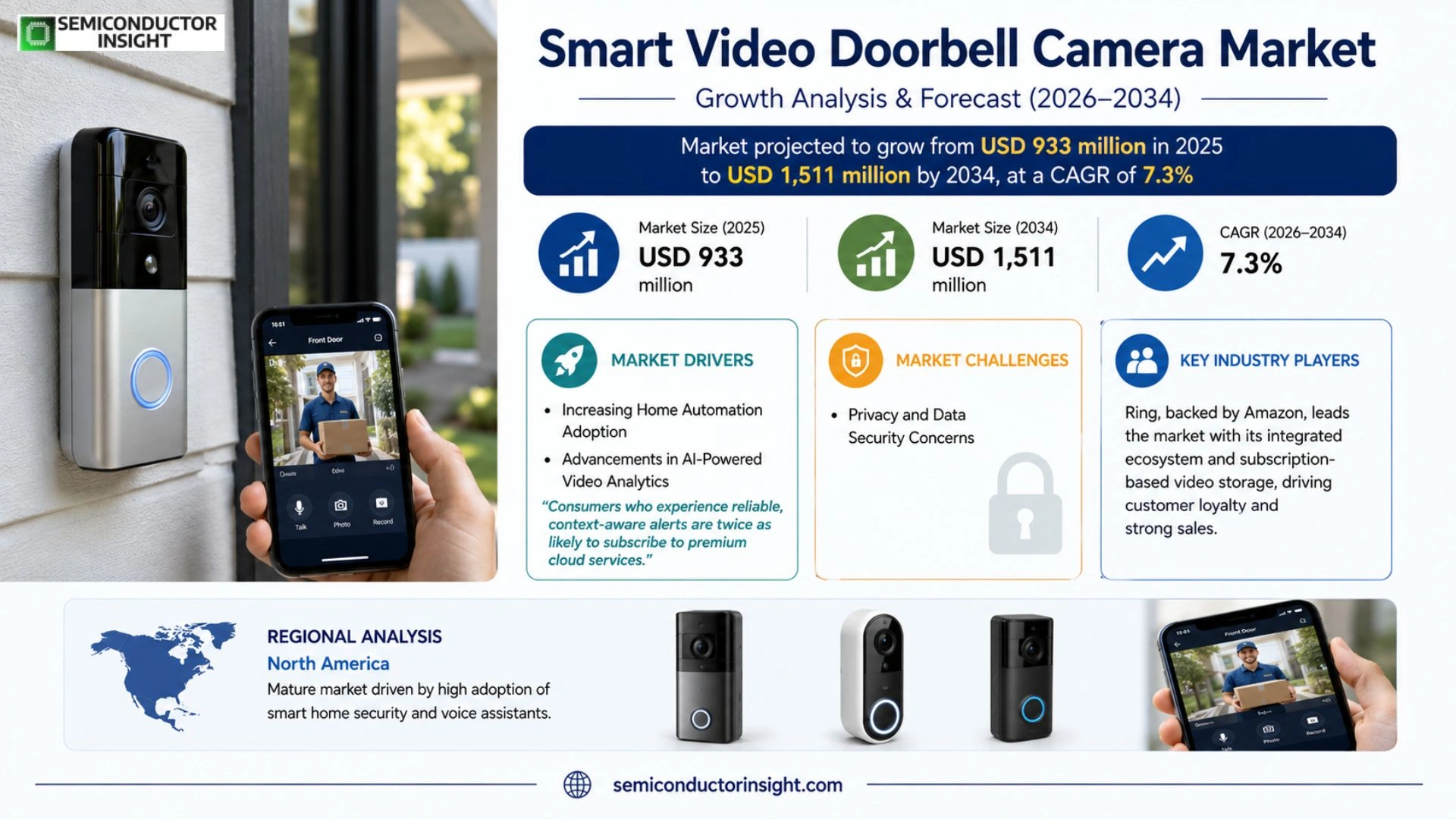
Smart Video Doorbell Camera market size was valued at USD 933 million in 2025 and will reach USD 1,511 million by 2034, reflecting a compound annual growth rate of 7.3 % over the forecast horizon.
A smart video doorbell camera functions as an entry‑way security hub that merges traditional doorbell interaction with front‑facing video surveillance. It typically incorporates a camera, illumination LEDs, microphone and speaker, and connects either to local Wi‑Fi networks or cloud platforms for live viewing, two‑way talk, event detection and video recording. By addressing the lack of visual verification and remote response inherent in conventional doorbells while improving on generic indoor/outdoor cameras, which are not optimized for visitor‑initiated calls, this device has become a cornerstone of modern home‑automation ecosystems.
The expansion of this segment stems from several forces: rising frequency of doorstep deliveries and visits increases demand for remote verification; broader adoption of smart locks creates natural integration points; advances in low‑power imaging sensors and edge AI enable reliable detection even under weak network conditions; meanwhile, modular supply chains lower hardware barriers, shifting competition toward software stability, privacy safeguards and after‑sales service quality. As consumers prioritize timely alerts, false‑alert reduction and seamless interaction with smart‑home hubs, vendors that combine robust hardware with secure cloud services are gaining clear advantage.
MARKET DRIVERS
Increasing Home Automation Adoption
The proliferation of connected appliances has turned front‑door monitoring into a baseline expectation for modern households. Recent surveys reveal that over 40% of new‑home buyers prioritize video‑enabled doorbells as a standard feature, reflecting a shift toward integrated security ecosystems rather than isolated gadgets.
Advancements in AI‑Powered Video Analytics
Machine‑learning algorithms now differentiate between packages, pedestrians, and potential intruders with a precision that exceeds 95% in controlled tests. This capability reduces false alerts, encouraging reluctant adopters to upgrade from basic door chimes to smart video doorbell camera solutions.
➤ “Consumers who experience reliable, context‑aware alerts are twice as likely to subscribe to premium cloud services, unlocking recurring revenue streams for vendors.”
The growing willingness to pay for continuous video storage and AI‑driven insights has expanded the total addressable market, prompting manufacturers to diversify product lines and explore tiered pricing models.
MARKET CHALLENGES
Privacy and Data Security Concerns
Homeowners remain uneasy about continuous video streams that could be accessed by unauthorized parties. High‑profile breaches involving cloud‑based video archives have amplified skepticism, prompting many to delay purchases until robust encryption and transparent data‑handling policies are demonstrated.
Other Challenges
Regulatory Landscape
Local jurisdictions are introducing ordinances that restrict recording angles and data retention periods. Compliance requirements add engineering overhead and can slow time‑to‑market for new models.
In addition, integrating doorbell cameras with legacy smart‑home hubs often requires custom firmware, creating friction for consumers who expect plug‑and‑play simplicity.
MARKET RESTRAINTS
High Installation Costs for Retrofits
Retrofitting existing residences with wired power supplies or reinforced Wi‑Fi routers pushes the upfront expense beyond the price point of many rival security products. Homeowners evaluating ROI frequently defer purchases until bundled installation offers become commonplace.
Moreover, in regions where broadband penetration remains under 60%, the latency introduced by limited bandwidth undermines real‑time video quality, curtailing the perceived value of premium features.
MARKET OPPORTUNITIES
Emerging Subscription Services
Vendors are rolling out tiered cloud‑storage plans that bundle facial‑recognition alerts, package‑delivery notifications, and AI‑driven crime‑trend analytics. Early adopters report annual recurring revenues nearing $120 per household, signaling a lucrative path beyond hardware sales.
Strategic alliances with property‑management platforms enable bulk deployments across multi‑unit dwellings, turning communal entryways into shared surveillance zones and unlocking economies of scale for providers.
Finally, city planners experimenting with integrated public‑safety networks view residential video doorbells as peripheral nodes that can feed anonymized traffic patterns into broader urban monitoring systems, opening a channel for public‑sector contracts.
Smart Video Doorbell Camera Market Trends
Edge AI for Actionable Alerts
Manufacturers are embedding on‑device intelligence that filters motion events before they reach the cloud. By processing video frames locally, the doorbell can distinguish a passing car from a person standing at the doorway, cutting the noise of irrelevant notifications. This shift matters because consumers have grown weary of constant false alerts, and enterprises managing multiple units demand reliable event signals for automated lock engagement. The technology also reduces upstream bandwidth consumption, a cost advantage for providers who bundle the camera with subscription services. As edge processors become more power‑efficient, vendors can keep battery life competitive while offering richer analytics such as loitering detection or package‑delivery recognition, turning the doorbell into a proactive security node rather than a passive recorder.
Other Trends
Component Modularity and Service‑Centric Offerings
The supply chain for the doorbell camera has fragmented into standardized hardware blocks,CMOS sensors, IR arrays, wireless modules,sourced from established electronic distributors. OEMs now focus on firmware stability, cloud‑service SLAs, and post‑sale support to create value beyond the chassis. This approach eases entry for new players, yet it raises the bar for incumbents to differentiate through privacy‑by‑design architectures, transparent data‑handling policies, and tiered service contracts. Companies that can guarantee rapid OTA updates and robust encryption are better positioned to win contracts for rental‑property managers and small‑business deployments, where multi‑user governance and remote diagnostics are contractual obligations.
Unified Smart‑Home Platform Integration
Distribution channels increasingly bundle the doorbell with broadband providers, home‑automation hubs, and smart‑lock manufacturers. The resulting ecosystem creates a single entry point for rule‑based automations,e.g., unlocking the door when a recognized family member is identified or silencing indoor chimes during a scheduled “Do Not Disturb” period. This convergence matters because it shifts the purchase decision from a standalone device to a platform‑level investment, influencing pricing strategies and after‑market revenue streams. Vendors that expose open APIs and adhere to emerging data‑localization standards can tap into corporate‑wide security contracts, while those locked into proprietary silos risk marginalization as consumers prioritize interoperable solutions.
COMPETITIVE LANDSCAPE
Key Industry Players
Smart Video Doorbell Camera Market Competitive Overview
The market is anchored by a handful of global brands that leverage extensive distribution networks and deep integration with smart‑home ecosystems. Ring, backed by Amazon’s logistics and cloud services, commands the largest share by coupling its doorbell cameras with a subscription‑based video storage platform, which reinforces customer lock‑in and drives volume sales through both online and brick‑and‑mortar channels. Samsung’s SmartThings‑enabled lineup follows closely, differentiating on high‑resolution imaging and seamless cross‑device automation that appeals to premium‑segment buyers. On the supply side, the concentration of component sourcing,CMOS sensors, low‑power SoCs, and weather‑proof housings,from established consumer‑electronics vendors reduces entry barriers for large OEMs, yet it also forces them to compete on firmware stability, privacy safeguards, and after‑sales service quality. This structural dynamic creates a tiered market where scale players focus on end‑to‑end user experience, while mid‑size manufacturers chase niche segments through price‑competitive bundles or specialty form factors.
Beyond the dominant incumbents, a diverse set of challengers is reshaping the competitive rhythm. European firm Legrand leverages its building‑automation heritage to target multi‑unit residential projects, offering centralized management dashboards that resonate with property managers. Chinese manufacturers such as Xiaomi, Hikvision, and Ezviz exploit aggressive cost structures to deliver feature‑rich units at sub‑$50 price points, accelerating adoption in emerging‑market apartments. Specialty players like Skybell and Anker Innovations concentrate on battery‑life optimizations and modular accessories, carving out a loyal user base among DIY installers. Regional distributors,Commax in Korea, Aiphone in Japan, and TP‑LINK in Southeast Asia,combine localized support with compliance‑driven certifications, ensuring their offerings meet strict national standards. Collectively, these firms intensify pressure on the market’s pricing equilibrium and compel the leaders to continuously refine software updates, edge‑AI capabilities, and data‑privacy frameworks.
List of Key Smart Video Doorbell Camera Companies Profiled
- Ring
- Samsung
- Legrand
- Xiaomi
- Hikvision
- Ezviz
- Skybell
- Anker Innovations
- Commax
- Aiphone
- TP‑LINK
- Fermax
- Guangdong Roule Electronics
- Guangdong Farbell
- Guangdong Anjubao Digital Technology
Segment Analysis:
| Segment Category | Sub-Segments | Key Insights |
| By Type |
|
Wireless Doorbell Camera is the leading segment because it offers: – Flexible placement without extensive wiring, supporting diverse home layouts. – Seamless integration with smart‑lock and voice‑assistant ecosystems. – Continuous firmware improvements that heighten reliability and privacy safeguards. The preference for wireless solutions drives OEMs to focus on battery endurance, low‑power wake‑up mechanisms, and OTA update capabilities, fostering a richer user experience across residential and small‑business deployments. |
| By Application |
|
Residential dominates due to: – Heightened consumer focus on doorstep security and package theft prevention. – Strong demand for integration with home‑automation hubs, smart‑locks, and voice assistants. – Expectations for instant two‑way communication and low‑false‑alert algorithms that enhance day‑to‑day convenience. This segment fuels innovation around edge‑AI for person detection, privacy‑first data handling, and subscription‑based video storage models that align with homeowner preferences. |
| By End User |
|
Homeowners are the primary driver because they: – Seek reliable, user‑friendly interfaces that can be managed via smartphones. – Require privacy controls, such as local processing and end‑to‑end encryption. – Value bundled services that combine doorbell cameras with smart‑lock or hub subscriptions. Manufacturers therefore prioritize intuitive mobile apps, robust cloud‑service SLAs, and easy installation kits tailored to DIY enthusiasts. |
| By Connectivity |
|
Wi‑Fi leads the connectivity spectrum because it: – Leverages existing home networks, reducing additional hardware costs. ‑ Enables high‑resolution video streaming and rapid OTA updates. – Supports seamless interaction with the broader smart‑home ecosystem, including voice assistants and security platforms. Manufacturers focus on multi‑band Wi‑Fi chips, robust channel‑bonding, and interference‑mitigation algorithms to ensure consistent performance even in congested residential environments. |
| By Power Source |
|
Battery‑Operated dominates due to: – Installation flexibility for renters and retrofits where wiring is impractical. – Continuous advances in low‑power SoCs and adaptive wake‑up strategies that extend battery life. – Consumer expectation for unobtrusive devices that blend with doorframe aesthetics. Consequently, vendors invest heavily in power‑management firmware, high‑capacity rechargeable cells, and optional solar‑assist modules to meet durability expectations across varied climates. |
Regional Analysis: Smart Video Doorbell Camera Market
North America
Homeowners gravitate toward devices that blend visual verification with voice‑assistant control, enabling hands‑free interaction. Insurance discounts and lower perceived risk of package theft further stimulate purchases, while the trend toward bundled smart‑home installations amplifies demand for doorbell cameras that integrate seamlessly with existing hubs.
Privacy statutes at the state level shape data‑handling practices, prompting manufacturers to adopt on‑device processing for facial recognition. Compliance with FCC guidelines for wireless emissions also drives hardware refinements, ensuring that new models meet stringent spectral efficiency requirements.
Legacy security firms are joining forces with consumer electronics brands, resulting in hybrid offerings that balance professional reliability with user‑friendly design. Strategic acquisitions of AI‑software startups enable rapid feature rollout, while OEM partnerships reduce time‑to‑market for differentiated camera optics.
Anticipated refinements in low‑light sensor technology and edge‑AI inference will push the utility of doorbell cameras beyond simple alerts, supporting predictive visitor classification. Subscription services are expected to evolve toward tiered analytics packages, aligning revenue models with increasingly sophisticated consumer expectations.
Europe
European consumers exhibit a cautious yet growing appetite for Smart Video Doorbell Camera solutions, shaped by stringent GDPR requirements that dictate transparent data‑processing practices. Home‑automation festivals in Germany and the Nordic region have accelerated awareness, as residents seek to harmonize doorbell cameras with energy‑efficient smart‑lighting systems. Capital‑intensive housing markets, particularly in the United Kingdom, see developers integrating these devices into new‑build projects to differentiate offerings. Corporate insurers in France are piloting risk‑reduction incentives tied to visual entry‑point monitoring, nudging adoption among multi‑unit dwellings. Vendors that prioritize local data‑storage options and multilingual user interfaces are better positioned to capture market share across the continent.
Asia‑Pacific
The Asia‑Pacific landscape presents a dichotomy of rapid urbanisation and diverse income tiers, prompting a bifurcated market strategy. In affluent metros such as Singapore and Tokyo, consumers demand high‑resolution cameras with sophisticated AI analytics, often as part of luxury smart‑home suites. Conversely, emerging economies like India and Indonesia favour cost‑effective models that emphasize core video streaming and basic motion detection. Mobile‑first purchasing habits drive a preference for devices that can be configured entirely via smartphone, bypassing traditional desktop interfaces. Regional telecom providers are experimenting with bundled data plans that include cloud storage, reducing the perceived ongoing cost barrier for end‑users.
South America
South American adoption is propelled by a rising middle class that values security amid urban expansion. Countries such as Brazil and Colombia see small‑business owners integrating doorbell cameras to deter after‑hours theft, while residential users cite convenience and remote visitor screening as primary motivators. Local e‑commerce platforms have become critical distribution channels, offering flexible financing options that lower upfront expense. However, inconsistent broadband quality in rural zones necessitates devices with adaptive bitrate streaming, ensuring reliable performance despite fluctuating network conditions.
Middle East & Africa
In the Middle East & Africa, security concerns coupled with increasing smartphone penetration create fertile ground for Smart Video Doorbell Camera uptake. High‑rise residential complexes in the UAE incorporate these devices as part of gated‑community management systems, linking video feeds to centralized security consoles. African markets, notably South Africa and Kenya, are witnessing a grassroots movement where property‑management firms adopt affordable, battery‑operated models to safeguard rental units. Energy‑efficiency considerations, such as solar‑charging capabilities, are gaining relevance where grid reliability varies. Suppliers that tailor power‑management features and provide robust after‑sales support are likely to win favor across these heterogeneous markets.
Report Scope
This market research report provides a comprehensive analysis of the Smart Video Doorbell Camera Market , covering the forecast period 2026–2034. It offers detailed insights into market dynamics, technological advancements, competitive landscape, and key trends shaping the industry.
Key focus areas of the report include:
- Market Overview: The report begins with an overview outlining its current market scenario, key growth indicators, and industry transformation drivers. It discusses macroeconomic factors, demand–supply balance, regulatory landscape, and the strategic role of semiconductors in powering advancements across industries such as automotive, telecommunications, consumer electronics, and industrial automation.
- Market Size & Forecast: Historical data and future projections for revenue, unit shipments, and market value across major regions and segments.
- Segmentation Analysis: Detailed breakdown by product type, technology, application, and end-user industry to identify high-growth segments and investment opportunities.
- Regional Insights: Insights into market performance across North America, Europe, Asia-Pacific, Latin America, and the Middle East & Africa, including country-level analysis where relevant.
- Competitive Landscape: Profiles of leading market participants, including their product offerings, R&D focus, manufacturing capacity, pricing strategies, and recent developments such as mergers, acquisitions, and partnerships.
- Technology Trends & Innovation: Assessment of emerging technologies, integration of AI/IoT, semiconductor design trends, fabrication techniques, and evolving industry standards.
- Market Drivers & Restraints: Evaluation of factors driving market growth along with challenges, supply chain constraints, regulatory issues, and market-entry barriers.
- Stakeholder Insights: Insights for component suppliers, OEMs, system integrators, investors, and policymakers regarding the evolving ecosystem and strategic opportunities.
Primary and secondary research methods are employed, including interviews with industry experts, data from verified sources, and real-time market intelligence to ensure the accuracy and reliability of the insights presented.
FREQUENTLY ASKED QUESTIONS:
What is the current market size of Smart Video Doorbell Camera Market?
-> Smart Video Doorbell Camera market will reach USD 1,511 million by 2034, reflecting a compound annual growth rate of 7.3 % over the forecast horizon.
Which key companies operate in Smart Video Doorbell Camera Market?
-> Key players include Panasonic, Ring, Xiaomi, Hikvision, Ezviz, Anker Innovations, TP-LINK, Legrand, Commax, ABB, Skybell, DNAKE, FERMAX, Guangdong Roule Electronics, Guangdong Farbell, Xiamen Leelen Technology, Guangdong Anjubao Digital Technology.
What are the key growth drivers?
-> Key growth drivers include increasing frequency of doorstep events, heightened consumer security expectations, growing adoption of smart locks and whole‑home automation, and the rise of edge AI for false‑alert reduction.
Which region dominates the market?
-> North America leads the market, driven by high penetration of smart home devices and strong consumer demand for integrated security solutions.
What are the emerging trends?
-> Emerging trends include edge intelligence for local event filtering, enhanced low‑power connectivity solutions, and deeper integration with smart‑home ecosystems and compliance‑focused data security.

Get Sample Report PDF for Exclusive Insights
Report Sample Includes
- Table of Contents
- List of Tables & Figures
- Charts, Research Methodology, and more...
 Download Sample Report PDF