PIN Photodiodes Market Insights
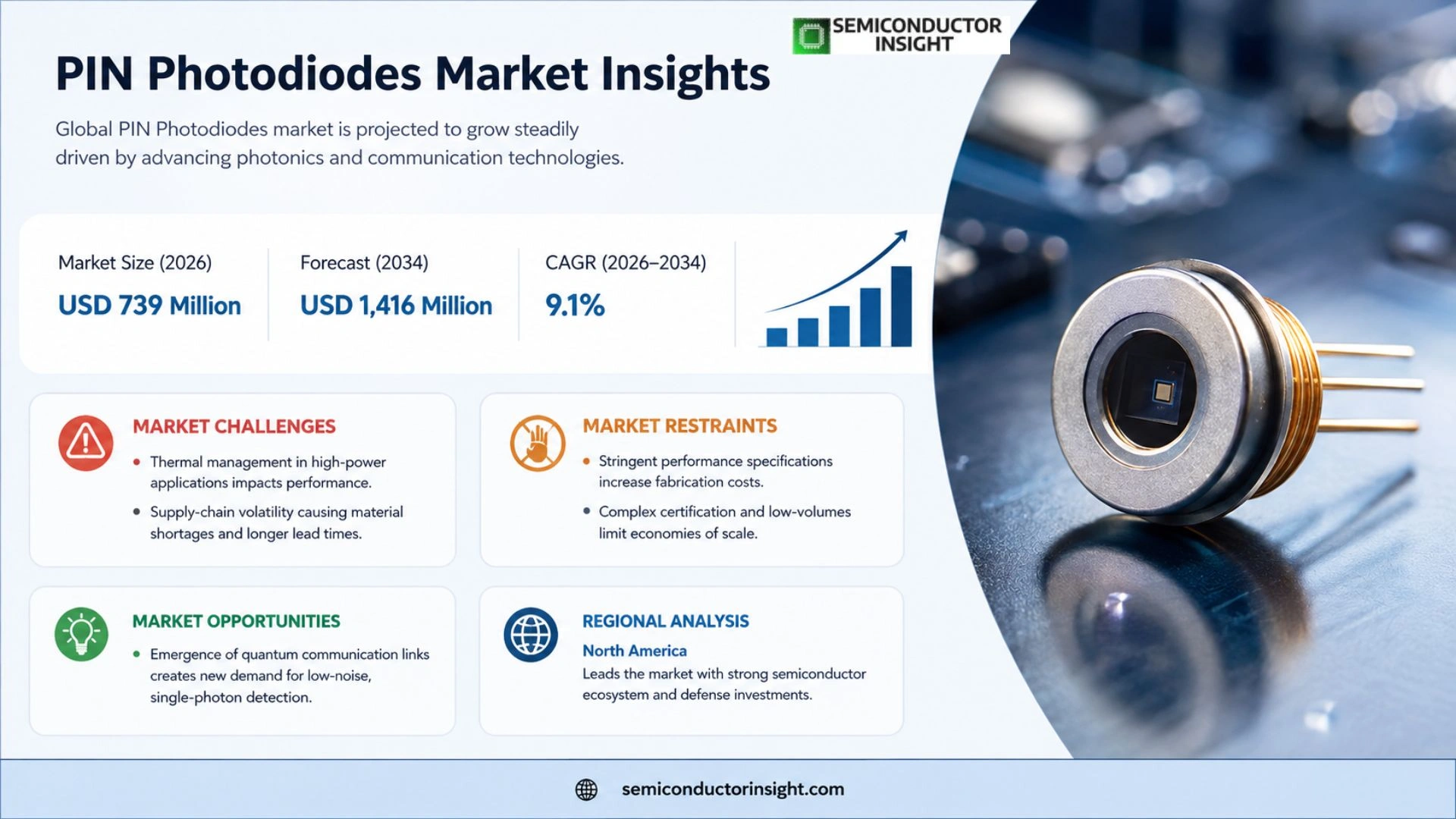
Global PIN Photodiodes market is projected to grow from USD 739 million in 2026 to USD 1416 million by 2034, exhibiting a CAGR of 9.1% during the forecast period.
PIN photodiodes are semiconductor photodetectors built on a P‑I‑N structure composed of a p‑type layer, an intrinsic low‑doped layer, and an n‑type layer, designed to convert incident light into electrical current with high efficiency. Compared with conventional PN devices, PIN photodiodes benefit from a wider depletion region and lower junction capacitance, which generally enables faster response, better linearity, and stronger suitability for high‑speed detection. Commercially the category mainly includes silicon PIN photodiodes and InGaAs PIN photodiodes; silicon devices serve the visible and near‑infrared spectrum while InGaAs extends coverage into short‑wave infrared. Typical product forms comprise bare die, metal‑can packages, ceramic packages, surface‑mount packages, array devices and detector formats integrated with amplifiers or ASICs.
The market is experiencing growth because demand is rising across industrial automation, automotive LiDAR systems, medical diagnostics & vital‑sign monitoring, optical communications and test‑and‑measurement equipment. Moreover advancements in packaging technology and the push for broader wavelength coverage are expanding application opportunities. Recent initiatives by leading players illustrate this trend: Hamamatsu Photonics introduced a low‑dark‑current InGaAs series in 2023; MACOM launched silicon PIN arrays for data centre interconnects early 2024; Broadcom expanded its surface‑mount portfolio; Lumentum and ams‑OSRAM are broadening offerings to meet automotive safety standards.
MARKET DRIVERS
Rising Demand for High‑Speed Optical Links
The surge in data‑center interconnects and 5G backhaul has forced equipment manufacturers to adopt receivers that can handle gigabit‑per‑second streams. PIN photodiodes meet this need because of their low junction capacitance and fast response, enabling tighter link budgets. This technical advantage is compelling vendors to replace older avalanche devices, thereby expanding the addressable market.
Growth of Integrated Photonic Platforms
Silicon photonics foundries increasingly embed PIN structures directly onto chips, cutting assembly steps and improving reliability. The integration trend shortens time‑to‑market for optical modules, prompting semiconductor firms to allocate design resources toward PIN photodiodes. As a result, the supply chain is reconfiguring to support higher volumes at lower unit costs.
➤ Manufacturers that align wafer‑scale testing with PIN devices see up to a 15 % reduction in overall module cost.
Together, these forces generate a feedback loop: lower costs spur broader adoption, which then drives further investment in process optimization. For customers, the net effect is a more predictable total cost of ownership, encouraging migration from legacy technologies.
MARKET CHALLENGES
Thermal Management in High‑Power Applications
When PIN photodiodes operate near their rated optical power, excess heat can deteriorate responsivity and accelerate dark‑current growth. System designers must therefore incorporate active cooling or select materials with superior thermal conductivity, adding complexity and expense to product development.
Other Challenges
Supply‑Chain Volatility
The reliance on high‑purity germanium and indium‑gallium‑arsenide wafers ties PIN Photodiodes market to fluctuations in semiconductor raw‑material inventories. Recent geopolitical tensions have already prompted lead times to extend beyond typical forecasts, pressuring OEMs to hold larger safety stocks.
MARKET RESTRAINTS
Stringent Performance Specifications
Telecommunication standards such as IEC 61753‑3 mandate ultra‑low jitter and linearity across wide wavelength ranges. Meeting these thresholds often requires multi‑layer anti‑reflection coatings and precise epitaxial control, inflating fabrication overhead and limiting price‑competitive entry.
Furthermore, the certification process for aerospace and defense applications adds another layer of testing, which can extend product launch timelines by several months. Companies that cannot allocate dedicated validation resources may find their offerings excluded from lucrative contracts.
Finally, the niche nature of some custom wavelength solutions means that production runs remain low‑volume, preventing economies of scale that would otherwise lower unit costs for broader markets.
MARKET OPPORTUNITIES
Emergence of Quantum Communication Links
Quantum key distribution (QKD) rlies on single‑photon detection at telecom wavelengths. Recent breakthroughs in low‑noise PIN structures make them viable alternatives to superconducting nanowire detectors for certain link distances, opening a new revenue stream for suppliers willing to adapt their designs for quantum‑grade performance.
In parallel, the automotive sector is standardizing eye‑safety compliant LiDAR arrays that leverage near‑infrared PIN photodiodes for range finding. Early adopters reporting enhanced reliability are prompting tier‑one OEMs to issue roadmap specifications that embed PIN technology into next‑generation driver‑assist systems.
Investors should monitor the convergence of these trends, as they suggest that PIN Photodiodes Market growth will be driven less by incremental upgrades and more by entirely new application domains that demand the unique blend of speed, linearity, and robustness these devices provide.
PIN Photodiodes Market Trends
Performance Edge Fuels Broadening Adoption
The worldwide PIN Photodiodes Market was valued at roughly $739 million in 2025 and is forecast to reach about $1,416 million by 2034, reflecting a compound annual growth rate of 9.1 %. Sales volume that year hit 219.56 million pieces, with an average transaction price of $3.69 per unit. The intrinsic‑layer architecture,p‑type, intrinsic, n‑type,delivers a wide depletion region and low junction capacitance, translating into fast response times, linear output, and high quantum efficiency. These technical merits keep the device central to legacy sectors such as industrial sensing, optical encoders, and basic communication links, while also opening doors to emerging high‑performance uses.
Other Trends
Automotive LiDAR and Medical Diagnostics Accelerate Specification Rises
Automotive manufacturers are demanding tighter dark‑current limits, smaller footprints, and temperature‑stable performance to meet autonomous‑driving safety standards. Simultaneously, medical‑diagnostic equipment is pushing for ultra‑low noise and extended wavelength coverage to improve vital‑sign monitoring and imaging. These pressures shift supplier focus from pure volume production toward differentiated packaging, rigorous reliability testing, and co‑development with OEMs. Companies that can align design‑in cycles with certification requirements are beginning to capture higher‑margin contracts, even as the overall market remains volume‑driven.
Competitive Landscape Tilts Toward Value‑Added Services
Standard silicon PIN devices compete in a price‑transparent arena where large‑scale manufacturers battle on cost and yield. Margins in that segment are increasingly protected by superior packaging technologies,metal‑can, ceramic, surface‑mount, and array formats,and by the ability to offer long‑term reliability data. In contrast, InGaAs offerings, which serve near‑infrared and short‑wave infrared applications, command premium pricing but require longer design cycles and stricter certification, especially in aerospace and high‑speed communication contexts. This bifurcated demand pattern ensures that while overall volume growth stays moderate, the higher‑value niche continues to deliver resilient, sustainable expansion for firms that invest in application‑specific innovation.
COMPETITIVE LANDSCAPE
Key Industry Players
PIN Photodiodes Market – Competitive Overview 2025‑2034
Hamamatsu Photonics remains the dominant force, leveraging its deep heritage in high‑performance silicon and InGaAs PIN devices. The company’s extensive portfolio,ranging from bare die to surface‑mount modules,covers the full wavelength spectrum demanded by automotive LiDAR, optical‑communication transceivers, and medical‑monitoring equipment. Hamamatsu’s competitive edge stems from its advanced epitaxial growth lines, stringent quality‑control processes, and a global certification network that shortens design‑in cycles for OEMs. By coupling robust wafer‑scale yield with differentiated packaging options (ceramic and metal‑can), Hamamatsu sustains healthy margins despite price pressure in the commodity segment. Its ability to co‑develop application‑specific variants, such as low‑dark‑current InGaAs arrays for short‑wave infrared sensing, positions it as the go‑to supplier for high‑value contracts.
Beyond the market leader, a constellation of midsize and niche players intensifies competition. MACOM Technology Solutions, Broadcom, and Lumentum focus on integrating PIN diodes with RF‑compatible ASICs to serve high‑speed data‑center links, while ams‑OSRAM and OSI Optoelectronics specialize in compact surface‑mount packages for consumer electronics and industrial sensors. Excelitas Technologies and TE Connectivity capitalize on ruggedized ceramic solutions for aerospace and defense, whereas Dexerials, Vishay, and Ushio concentrate on high‑volume automotive encoder modules. Emerging entrants such as DOWA Electronics Materials, onsemi, Albis Optoelectronics, Everlight Electronics, and Chunghwa Leading Photonics Tech Ltd. are expanding their silicon‑based line‑ups to capture cost‑sensitive segments, while niche firms like LASER COMPONENTS Detector Group, SiFotonics Technologies, Marktech Optoelectronics, and KODENSHI CORP. differentiate through custom wavelength tuning and ultra‑low capacitance designs for specialized instrumentation.
List of Key PIN Photodiodes Companies Profiled
- Hamamatsu Photonics
- MACOM Technology Solutions
- Broadcom
- Lumentum
- ams‑OSRAM
- OSI Optoelectronics
- Excelitas Technologies
- TE Connectivity
- Dexerials
- Vishay Intertechnology
- Ushio
- DOWA Electronics Materials
- onsemi
- Albis Optoelectronics
- Everlight Electronics
- Chunghwa Leading Photonics Tech Ltd.
- LASER COMPONENTS Detector Group
- SiFotonics Technologies Co., Ltd.
- Marktech Optoelectronics
- KODENSHI CORP.
Segment Analysis:
| Segment Category | Sub-Segments | Key Insights |
| By Type |
|
Silicon PIN Photodiodes remain the core foundation of the market due to their broad wavelength coverage and cost‑effective manufacturing.
|
| By Application |
|
Industrial and instrumentation continues to dominate application demand because of its longstanding reliance on robust, low‑cost detectors.
|
| By End User |
|
Automotive OEMs are emerging as a high‑growth end‑user segment, driven by the acceleration of advanced driver‑assistance systems.
|
| By Package Type |
|
Surface‑mount packages are gaining traction as the preferred form factor for compact system integration.
|
| By Wavelength Range |
|
Visible & near‑infrared remains the dominant wavelength corridor because it aligns with the bulk of existing optical architectures.
|
Regional Analysis: PIN Photodiodes Market
North America
Leading manufacturers are channeling capital into wafer‑scale integration to shrink footprints and reduce thermal budgets. This shift reflects a need to serve automotive lidar modules, where system-level size and weight limits drive component consolidation. By embedding PIN structures directly onto silicon platforms, OEMs aim to lower assembly costs and improve yield consistency across product families.
Recent disruptions in specialty‑gallium arsenide wafers have prompted North American firms to diversify sourcing. Strategic stockpiling of critical substrates and closer collaboration with domestic material suppliers are emerging as risk‑mitigation tactics. These measures help sustain production schedules for defense contracts that have little tolerance for delays.
Federal export controls on high‑frequency photonic components influence design choices, especially for equipment destined for overseas defense customers. Firms navigate a complex matrix of licensing requirements, balancing compliance with the desire to capture lucrative international markets through dual‑use product lines.
Beyond traditional telecom, new demand is surfacing from quantum‑key‑distribution networks and high‑resolution medical imaging. These niches value the low‑dark‑current characteristics of PIN photodiodes, encouraging vendors to tailor device architectures for ultra‑low noise performance.
Europe
European markets exhibit a balanced mix of legacy telecom operators and burgeoning autonomous‑vehicle pilots. The EU’s emphasis on green‑technology subsidies fuels adoption of optical interconnects in data‑center upgrades, where energy efficiency is paramount. Concurrently, cross‑border research consortia are exploring hybrid silicon‑germanium PIN structures to bridge the performance gap with III‑V devices, aiming to keep Europe competitive without heavy reliance on external supply chains.
Asia‑Pacific
Asia‑Pacific’s rapid industrialization and sizable consumer electronics base create a distinct demand profile for PIN photodiodes. Nations such as Japan and South Korea leverage deep expertise in high‑speed optical transceivers, while China accelerates its push into autonomous mobility, prompting domestic fabs to scale up production. However, fragmented standards and variable quality assurance across the region introduce challenges for multinational OEMs seeking consistent component performance.
South America
In South America, the market is still nascent, but recent governmental incentives for fiber‑to‑the‑home deployments are expanding the pool of potential buyers. Local telecom providers are modernizing backbone networks, and a handful of regional manufacturers are testing low‑cost PIN designs to meet price‑sensitive specifications. The pace of growth will hinge on broader economic stability and the ability to attract foreign technology partners willing to share advanced process know‑how.
Middle East & Africa
Middle East & Africa presents a heterogenous landscape where oil‑rich economies invest heavily in satellite‑communication infrastructure, driving demand for rugged photodiodes capable of withstanding harsh environments. Meanwhile, African nations prioritize connectivity projects funded by international development agencies, creating opportunities for affordable, high‑reliability PIN solutions. Market participants must navigate varying regulatory climates and limited local manufacturing capacity, often opting for strategic partnerships with established global suppliers.
Report Scope
This market research report provides a comprehensive analysis of the PIN Photodiodes Market , covering the forecast period 2026–2034. It offers detailed insights into market dynamics, technological advancements, competitive landscape, and key trends shaping the industry.
Key focus areas of the report include:
- Market Overview: The report begins with an overview outlining its current market scenario, key growth indicators, and industry transformation drivers. It discusses macroeconomic factors, demand–supply balance, regulatory landscape, and the strategic role of semiconductors in powering advancements across industries such as automotive, telecommunications, consumer electronics, and industrial automation.
- Market Size & Forecast: Historical data and future projections for revenue, unit shipments, and market value across major regions and segments.
- Segmentation Analysis: Detailed breakdown by product type, technology, application, and end-user industry to identify high-growth segments and investment opportunities.
- Regional Insights: Insights into market performance across North America, Europe, Asia-Pacific, Latin America, and the Middle East & Africa, including country-level analysis where relevant.
- Competitive Landscape: Profiles of leading market participants, including their product offerings, R&D focus, manufacturing capacity, pricing strategies, and recent developments such as mergers, acquisitions, and partnerships.
- Technology Trends & Innovation: Assessment of emerging technologies, integration of AI/IoT, semiconductor design trends, fabrication techniques, and evolving industry standards.
- Market Drivers & Restraints: Evaluation of factors driving market growth along with challenges, supply chain constraints, regulatory issues, and market-entry barriers.
- Stakeholder Insights: Insights for component suppliers, OEMs, system integrators, investors, and policymakers regarding the evolving ecosystem and strategic opportunities.
Primary and secondary research methods are employed, including interviews with industry experts, data from verified sources, and real-time market intelligence to ensure the accuracy and reliability of the insights presented.
FREQUENTLY ASKED QUESTIONS:
What is the current market size of PIN Photodiodes Market?
-> PIN Photodiodes market is projected to grow from USD 739 million in 2026 to USD 1416 million by 2034, exhibiting a CAGR of 9.1%
Which key companies operate in PIN Photodiodes Market?
-> Key players include Hamamatsu Photonics, MACOM Technology Solutions, Broadcom, Lumentum, ams-OSRAM, OSI Optoelectronics, Excelitas Technologies, TE Connectivity, Dexerials, Vishay Intertechnology, Ushio, DOWA Electronics Materials, onsemi, Albis Optoelectronics, Everlight Electronics, Chunghwa Leading Photonics Tech Ltd., LASER COMPONENTS Detector Group, SiFotonics Technologies Co., Ltd., Marktech Optoelectronics, KODENSHI CORP.
What are the key growth drivers?
-> Key growth drivers include rising demand for high‑speed optical communications, expansion of automotive LiDAR systems, growth in industrial automation sensors, increasing adoption in medical diagnostics and vital‑sign monitoring, and broader deployment of optoelectronic components in aerospace and security imaging.
Which region dominates the market?
-> Asia‑Pacific leads the market owing to strong automotive, consumer electronics, and semiconductor manufacturing bases, while North America and Europe remain important secondary markets.
What are the emerging trends?
-> Emerging trends include integration of PIN photodiodes with ASICs and amplifiers, development of array and surface‑mount packages, expansion of InGaAs devices for short‑wave infrared applications, and focus on miniaturized, low‑dark‑current packages for medical and LiDAR use‑cases.

Get Sample Report PDF for Exclusive Insights
Report Sample Includes
- Table of Contents
- List of Tables & Figures
- Charts, Research Methodology, and more...