OIS Controller IC Market Insights
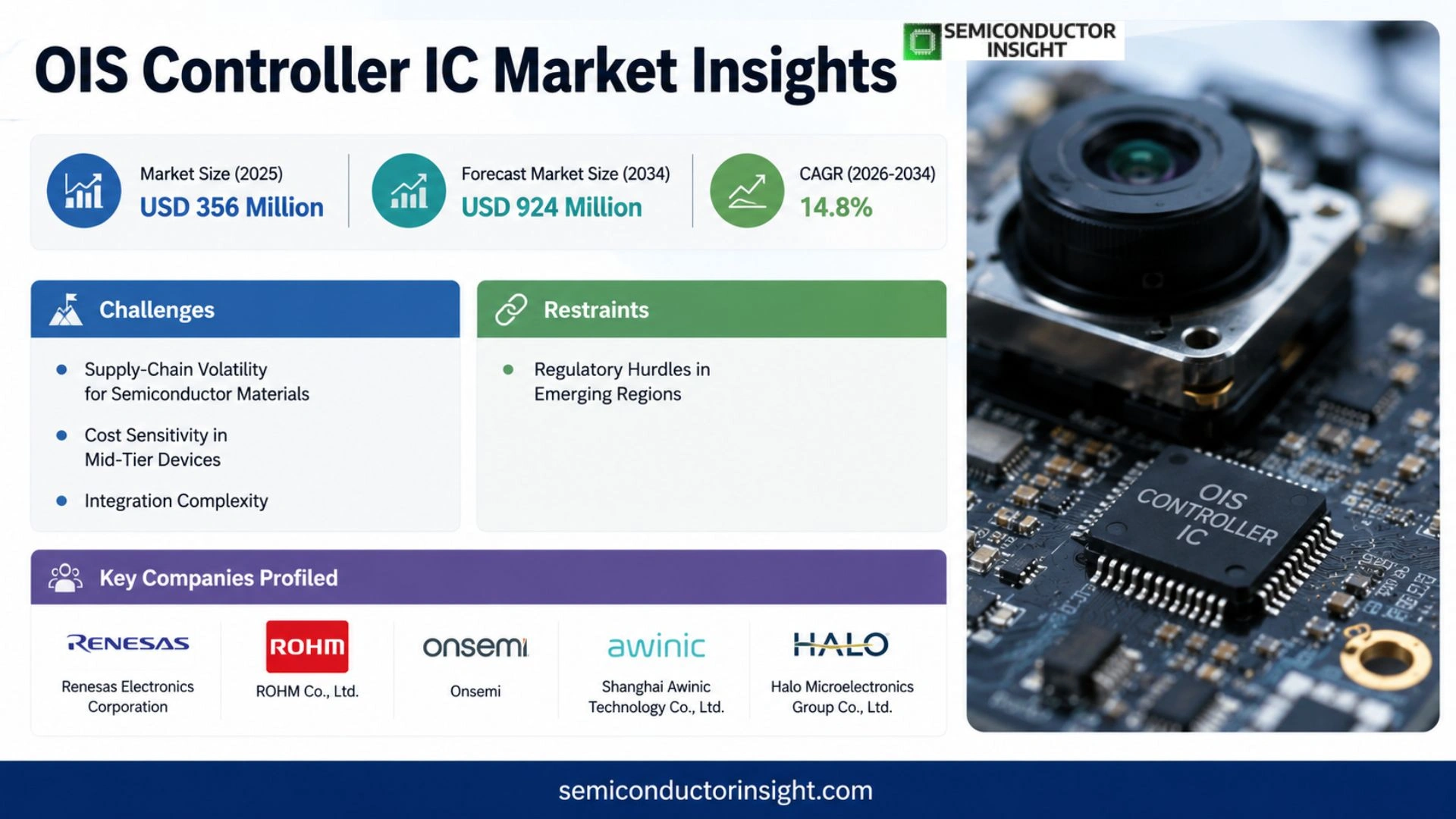
OIS Controller IC market size was valued at USD 356 million in 2025 and is expected to reach USD 924 million by 2034, reflecting a CAGR of 14.8 % over the forecast period.
An OIS controller IC serves as the core control and drive chip inside mobile imaging modules. It ingests gyroscope data or Hall‑sensor feedback generated during handheld motion, computes real‑time compensation, and drives miniature actuators such as VCMs, piezoelectric or SMA devices to shift lenses or other optical elements, thereby suppressing blur in low‑light photography, telephoto capture and video recording. Official product pages show that these chips have progressed from simple drivers to system‑level solutions that embed a CPU or DSP, flash/EEPROM memory, ADCs, communication interfaces, Hall‑signal processing, PID algorithms and H‑bridge drivers.
The upward trajectory stems from the proliferation of high‑resolution sensors, multi‑camera arrays and folded telephoto modules that demand tighter stabilization within ever smaller footprints and lower power budgets. Companies such as Renesas Electronics, onsemi, Shanghai Awinic Technology, Halo Microelectronics and MEMSIC are expanding their portfolios with combined OIS/AF controllers and single‑chip eOIS designs that integrate Hall sensing and closed‑loop control. As smartphones continue to prioritize night‑mode imaging and video stability, manufacturers that can deliver higher precision while reducing component count are gaining competitive advantage.
MARKET DRIVERS
Advanced Imaging Requirements in Mobile Devices
Manufacturers of premium smartphones are prioritising higher‑resolution sensors that can capture sharp images in low‑light settings. To meet these expectations, they are integrating optical image stabilization (OIS) modules that rely on precision controller ICs. The shift toward larger sensor formats amplifies the need for finely tuned control loops, making OIS Controller IC Market a critical supplier for next‑generation camera stacks.
Growth of Wearables and AR Platforms
Wearable headsets and augmented‑reality glasses embed compact camera units where space is at a premium. Designers choose OIS controller chips that combine low power draw with high‑speed actuation, enabling stable visual feeds without compromising battery life. This niche application layer is prompting OEMs to source specialised ICs, widening the market beyond traditional mobile phones.
➤ Industry analysts note that the convergence of computational photography and immersive display technologies is accelerating demand for integrated OIS solutions.
Automotive camera systems, particularly in driver‑assistance modules, are also adopting OIS to mitigate vibration from road conditions. By delivering clearer feeds to image‑processing algorithms, these controller ICs help improve object‑detection reliability, opening an additional revenue stream for suppliers.
MARKET CHALLENGES
Supply‑Chain Volatility for Semiconductor Materials
Fluctuations in wafer‑fab capacity and the scarcity of high‑purity substrates translate into longer lead times for OIS controller manufacturers. End‑users consequently face inventory‑risk pressures, prompting some to hedge with alternative stabilization technologies.
Other Challenges
Cost Sensitivity in Mid‑Tier Devices
Mid‑range smartphones balance feature sets against price points. Incorporating an OIS controller adds bill‑of‑materials pressure, leading manufacturers to evaluate whether the perceived image‑quality benefit justifies the expense.
Integration Complexity
Merging OIS controller ICs with existing sensor‑fusion architectures demands careful firmware coordination. Misalignment can cause latency spikes, undermining the seamless user experience that high‑end devices promise.
MARKET RESTRAINTS
Regulatory Hurdles in Emerging Regions
Some jurisdictions impose stringent electromagnetic‑compatibility testing for camera modules, extending certification timelines for OIS controller ICs. Firms that lack local regulatory expertise may defer market entry, curtailing growth potential in those territories.
MARKET OPPORTUNITIES
Integration of AI‑Driven Stabilization Algorithms
Embedding lightweight AI models directly within the controller IC can enable predictive actuation, reducing reliance on mechanical feedback loops. Companies that pioneer such System‑on‑Chip solutions could capture premium segments and differentiate their offering in a crowded marketplace.
OIS Controller IC Market Trends
Integration of System‑Level Functions Elevates Chip Value
OIS Controller IC is no longer a peripheral driver; it has evolved into a compact computing node that merges sensing, processing and actuation. Modern devices embed a CPU or DSP, flash memory, ADCs, and sophisticated communication interfaces alongside traditional H‑bridge drivers. This convergence enables real‑time compensation of gyroscope, Hall or position feedback with a precision that supports high‑resolution sensors, multi‑camera arrays and folded telephoto optics. For smartphone manufacturers, the shift translates into tighter control over blur reduction, faster focus transitions and a lower overall power budget, because a single silicon die now replaces several discrete components. The result is a smaller module footprint, which is crucial as designers push thickness limits while adding more lenses and larger image sensors.
Other Trends
Convergence of OIS and Autofocus Capabilities
Two distinct roadmaps dominate the product landscape. The first combines optical image stabilization with open‑loop autofocus in a single silicon platform, trimming bill of materials and simplifying board layout. By handling both vibration correction and focus actuation, the combined chip reduces the number of external Hall sensors and driver stages, delivering a measurable gain in assembly throughput. The second pathway focuses on ultra‑compact eOIS solutions that embed Hall sensing, drive circuitry and closed‑loop control in an ultra‑small WLCSP package. These chips meet the aggressive thickness targets of emerging thin‑form devices such as augmented‑reality glasses and pocket‑sized drones, where every millimeter of board space is at a premium. Both strategies reflect customer demand for higher precision, faster response times and tighter integration without sacrificing power efficiency.
Supply‑Chain Concentration and Emerging Application Frontiers
The ecosystem remains heavily anchored in East Asia, with Japanese firms supplying high‑end control logic, Korean players leveraging close ties to the mobile OEM base, and Chinese vendors accelerating their presence in closed‑loop, high‑precision designs. This geographic concentration creates both collaboration opportunities and competitive pressure, as each region strives to differentiate through algorithmic tuning, memory integration and package miniaturization. Beyond smartphones, the expanding portfolio of AI‑enabled imaging terminals,folded telephoto modules, smart glasses, consumer drones and immersive VR headsets,requires OIS Controller ICs that can operate under tighter power envelopes while delivering sub‑micron actuation accuracy. Companies that can extend their control algorithms to accommodate varied actuation mechanisms (VCM, piezo, SMA) are positioned to capture a larger share of these nascent markets, turning what was once a niche stabilization component into a core enabler of next‑generation visual experiences.
COMPETITIVE LANDSCAPE
Key Industry Players
OIS Controller IC Market – Competitive Overview
Renesas Electronics leads the high‑performance segment, largely because its OIS controllers embed 32‑bit DSP cores, on‑chip memory and multi‑axis H‑bridge drivers. The firm’s deep MEMS heritage and close partnerships with flagship smartphone makers allow it to dictate specifications for emerging folded‑telephoto modules. ROHM follows closely, leveraging a vertically integrated supply chain that spans sensor‑level design to final module qualification. Both companies benefit from longstanding relationships with Korean OEMs, which translate into recurring volume contracts and faster time‑to‑market for system‑level solutions. Their product portfolios illustrate a shift from pure driver chips toward fully programmable control nodes, a transition that reinforces barriers to entry for newcomers.
Beyond the incumbents, a cluster of specialized vendors is intensifying competition on cost, integration depth and form‑factor. onsemi differentiates itself with a focus on low‑power eOIS devices that fit within sub‑1 mm package envelopes, catering to ultra‑slim flagships. Shanghai Awinic and Halo Microelectronics aggressively broaden their addressable market by adding open‑loop AF capabilities and AI‑ready sensor interfaces, a strategy that resonates with mid‑tier manufacturers seeking single‑chip consolidation. MEMSIC, Southchip and Dongwoon Anatech pursue niche applications such as drone vision and AR glasses, where multi‑axis precision outweighs pure volume considerations. These firms often pair their silicon with extensive reference designs, lowering adoption barriers for emerging OEMs and gradually eroding the dominance of the traditional Japanese and Korean players.
List of Key OIS Controller IC Companies Profiled
- Renesas Electronics Corporation
- ROHM Co., Ltd.
- onsemi
- Shanghai Awinic Technology Co., Ltd.
- Halo Microelectronics Group Co., Ltd.
- MEMSIC Semiconductor Co., Ltd.
- Southchip Semiconductor Technology Co., Ltd.
- Dongwoon Anatech Co., Ltd.
- SK Hynix (Imaging Solutions)
- Qualcomm Technologies, Inc.
- Sensata Technologies (Imaging Division)
- Analog Devices, Inc.
- Infineon Technologies AG
Segment Analysis:
| Segment Category | Sub-Segments | Key Insights |
| By Type |
|
System‑Level Controllers are increasingly the core intelligence within mobile imaging modules.
|
| By Application |
|
Smartphone Imaging drives the most diverse application set for OIS controllers.
|
| By End User |
|
OEM Integration shapes product road‑maps across the value chain.
|
| By Control Method |
|
Control Architecture is a decisive factor for performance differentiation.
|
| By Compensation Axis |
|
Axis Configuration reflects the evolving optical architectures.
|
Regional Analysis: OIS Controller IC Market
Asia‑Pacific
Massive rollout of flagship and mid‑range handsets fuels demand for tighter image stabilization, prompting chipmakers to embed OIS controllers within tighter silicon footprints. The regional design culture, which prizes rapid iteration, aligns well with OEMs’ need for quick feature updates, reinforcing the region’s leadership.
Tier‑1 automotive suppliers are sourcing OIS controller ICs to enhance camera reliability for lane‑keeping and pedestrian detection. The proximity of semiconductor fabs to key vehicle assembly hubs accelerates co‑development cycles, making the region a focal point for automotive vision solutions.
Diversified foundry capacity across China, Taiwan, and South Korea mitigates single‑source risk, enabling smoother component flow even under geopolitical strain. This resilience translates into consistent availability for OIS controller IC manufacturers.
Robust patent activity around mixed‑signal architecture and low‑power design underscores a competitive environment where intellectual property becomes a strategic lever for market share expansion.
North America
North America retains a strong foothold in OIS Controller IC Market by leveraging its deep R&D infrastructure and early‑stage adoption of high‑resolution imaging across consumer and industrial devices. U.S. semiconductor firms, supported by venture capital, prioritize advanced packaging techniques that enable three‑dimensional integration, a factor that appeals to premium‑segment manufacturers. The region’s stringent compliance regimes also push suppliers toward higher reliability standards, influencing component selection in professional camera systems. Although manufacturing volumes are modest compared with Asia‑Pacific, the emphasis on innovation and brand differentiation sustains a lucrative niche for firms that can deliver ultra‑low latency control loops and robust temperature performance.
Europe
European markets contribute nuanced demand for OIS controller ICs, driven by a blend of consumer electronics, automotive safety, and industrial imaging applications. The continent’s regulatory environment emphasizes data security and environmental compliance, prompting designers to favor ICs with energy‑efficient architectures. Collaborative ecosystems in Germany and France, where automotive OEMs partner closely with chip designers, foster bespoke solutions for advanced driver‑assistance cameras. Additionally, the growth of medical imaging devices in the region creates a peripheral demand for precise stabilization, expanding the market’s application breadth beyond traditional photography.
South America
South America’s OIS controller IC market is still maturing, yet rising smartphone penetration and nascent automotive electronics initiatives are reshaping its trajectory. Regional distributors increasingly source from Asian manufacturers, benefiting from cost advantages while seeking localized support for integration. Countries such as Brazil and Chile are initiating programs to enhance local assembly capabilities, which could gradually shift the supply chain closer to end‑users and stimulate modest design activity within the region.
Middle East & Africa
The Middle East & Africa region exhibits a heterogeneous demand pattern for OIS controller ICs. In the Gulf states, high‑end consumer device adoption creates a niche for premium stabilization solutions, while emerging markets in sub‑Saharan Africa prioritize affordable smartphones where integration efficiency matters. Telecom infrastructure projects, especially those introducing 5G, indirectly boost demand for advanced imaging modules in IoT and surveillance devices. Although the overall market size remains limited, the region’s strategic investments in technology hubs hint at a slow yet steady expansion of OIS Controller IC ecosystem.
Report Scope
This market research report provides a comprehensive analysis of the OIS Controller IC Market , covering the forecast period 2026–2034. It offers detailed insights into market dynamics, technological advancements, competitive landscape, and key trends shaping the industry.
Key focus areas of the report include:
- Market Overview: The report begins with an overview outlining its current market scenario, key growth indicators, and industry transformation drivers. It discusses macroeconomic factors, demand–supply balance, regulatory landscape, and the strategic role of semiconductors in powering advancements across industries such as automotive, telecommunications, consumer electronics, and industrial automation.
- Market Size & Forecast: Historical data and future projections for revenue, unit shipments, and market value across major regions and segments.
- Segmentation Analysis: Detailed breakdown by product type, technology, application, and end-user industry to identify high-growth segments and investment opportunities.
- Regional Insights: Insights into market performance across North America, Europe, Asia-Pacific, Latin America, and the Middle East & Africa, including country-level analysis where relevant.
- Competitive Landscape: Profiles of leading market participants, including their product offerings, R&D focus, manufacturing capacity, pricing strategies, and recent developments such as mergers, acquisitions, and partnerships.
- Technology Trends & Innovation: Assessment of emerging technologies, integration of AI/IoT, semiconductor design trends, fabrication techniques, and evolving industry standards.
- Market Drivers & Restraints: Evaluation of factors driving market growth along with challenges, supply chain constraints, regulatory issues, and market-entry barriers.
- Stakeholder Insights: Insights for component suppliers, OEMs, system integrators, investors, and policymakers regarding the evolving ecosystem and strategic opportunities.
Primary and secondary research methods are employed, including interviews with industry experts, data from verified sources, and real-time market intelligence to ensure the accuracy and reliability of the insights presented.
FREQUENTLY ASKED QUESTIONS:
What is the current market size of OIS Controller IC Market?
-> OIS Controller IC market is expected to reach USD 924 million by 2034, reflecting a CAGR of 14.8 % over the forecast period.
Which key companies operate in OIS Controller IC Market?
-> Key players include Dongwoon Anatech Co., Ltd., ROHM Co., Ltd., onsemi, Renesas Electronics Corporation, Shanghai Awinic Technology Co., Ltd., Halo Microelectronics Group Co., Ltd., MEMSIC Semiconductor Co., Ltd., Southchip Semiconductor Technology Co., Ltd.
What are the key growth drivers?
-> Key growth drivers include rising demand for high‑resolution smartphone cameras, multi‑camera systems, AI‑enhanced imaging, the need for low‑light and video stability, and the transition toward system‑level OIS controllers with integrated CPUs/DSPs and advanced compensation algorithms.
Which region dominates the market?
-> Asia dominates OIS Controller IC market, driven by a strong East Asian supply‑chain, major smartphone OEMs, and leading semiconductor manufacturers in Japan, South Korea, and China.
What are the emerging trends?
-> Emerging trends include the convergence of OIS and autofocus (OIS‑and‑AF) in single chips, single‑chip eOIS solutions with integrated Hall sensing and H‑bridge drivers, expansion into folded telephoto modules, AI glasses, drones, VR devices, and broader adoption in mobile vision terminals beyond smartphones.
Get Sample Report PDF for Exclusive Insights
Report Sample Includes
- Table of Contents
- List of Tables & Figures
- Charts, Research Methodology, and more...
 Download Sample Report PDF