Microdisplay Plane Market Insights
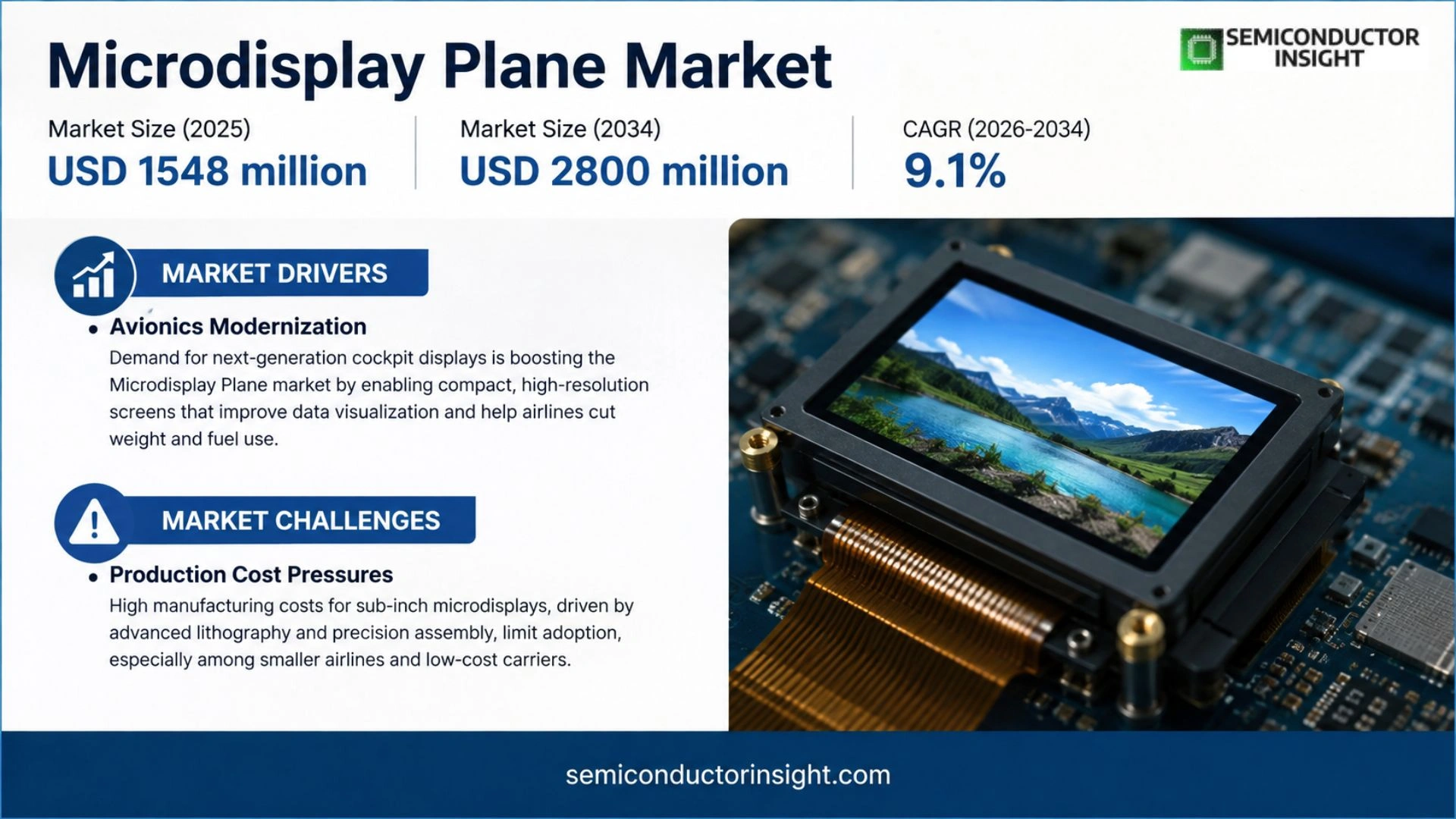
Microdisplay Plane market size was valued at USD 1548 million in 2026 and is projected to reach USD 2800 million by 2034, exhibiting a CAGR of 9.1% during the forecast period.
Microdisplay plane usually refers to display panels with a diagonal dimension of less than 1 inch (2.54 cm). It is commonly employed in optical engines where the generated images serve as sources for optical systems. The core challenge of micro‑display technology lies in integrating the display image unit, image‑processing unit, and driving circuitry onto a silicon‑based integrated circuit.
The market is experiencing rapid growth due to several factors, including continuous technological iteration, expanding application scenarios such as AR/VR headsets, automotive HUDs, and smart wearables, and cost reductions driven by AI‑enabled manufacturing of eight‑inch silicon substrates. Industry collaboration is deepening, with chip makers partnering closely with panel manufacturers to improve self‑sufficiency of backplane wafers and vapor‑deposition materials. Companies are increasingly offering full‑stack solutions,combining display panels, optical systems, and software,thereby creating new revenue streams while standardization and yield improvements push the market toward broader commercialization.
MARKET DRIVERS
Avionics Modernization
The push for next‑generation cockpit displays is reshaping Microdisplay Plane market. Aircraft manufacturers are favoring compact, high‑resolution panels that free up panel real‑estate while delivering richer visual data to pilots. This shift allows airlines to reduce weight, improve fuel efficiency, and meet emerging safety standards.
UAV and Defense Adoption
Unmanned aerial systems are increasingly equipped with miniature visual sensors for reconnaissance and targeting. Defense procurement programs prioritize microdisplays that can survive vibration, temperature extremes, and limited power budgets. Consequently, manufacturers are accelerating product roadmaps to meet those robust specifications.
➤ Integrating microdisplays into legacy airframes often requires redesign of wiring harnesses, creating a secondary market for retro‑fit solutions.
Beyond original equipment, aftermarket upgrade cycles are gaining momentum as airlines seek to extend the service life of older fleets. The willingness to invest in rejuvenated display units translates into recurring revenue streams for suppliers.
MARKET CHALLENGES
Production Cost Pressures
Fabricating sub‑inch microdisplays involves advanced lithography and precision assembly, which keep unit costs high. Smaller airlines and low‑cost carriers often find these prices prohibitive, slowing adoption across the broader commercial segment.
Other Challenges
Regulatory Certification
Obtaining airworthiness approvals for new display technologies can extend product launch timelines by months, if not years. The certification burden discourages some OEMs from fast‑tracking innovative designs.
MARKET RESTRAINTS
Supply‑Chain Fragility
Key raw materials such as arsenide and specialized glass substrates are sourced from a limited pool of suppliers. Disruptions,whether geopolitical or natural,can tighten inventories, raising lead times and squeezing margins for manufacturers operating in Microdisplay Plane market.
MARKET OPPORTUNITIES
Enhanced Cockpit Augmentation
Emerging augmented‑reality (AR) concepts for pilots rely on ultra‑compact, high‑brightness microdisplays to overlay flight data directly onto the field of view. Suppliers that can deliver displays meeting strict luminance and latency benchmarks stand to capture a premium segment of future cockpit upgrades.
Microdisplay Plane Market Trends
Technology Convergence and Performance Leap
The microdisplay plane segment is shifting from niche optical engines to a mainstream component in immersive devices. In 2026 the sector produced roughly 13.95 million units at an average price of US$ 121.5, delivering a revenue base of US$ 1.55 billion. The blend of silicon‑based OLED and emerging micro‑LED architectures is tightening the resolution‑brightness gap, allowing 8K pixel densities and luminance levels suitable for outdoor augmented‑reality (AR) head‑up displays. This performance uplift is not merely technical; it reshapes product economics by making high‑end visual experiences affordable enough for mass‑market launch. Analysts note that the annual growth rate of 9.1 % reflects both the maturation of manufacturing yields and the entry of tier‑1 automotive OEMs seeking compact, energy‑efficient HUDs.
Other Trends
Cost Compression Through Silicon Scale
Recent advances in 8‑inch silicon wafer processing have cut per‑unit fab costs by approximately 18 % compared with the 6‑inch baseline used in 2020. AI‑enhanced inspection and automated defect repair are driving yield improvements that push unit economics toward consumer‑grade price points. As wafer throughput rises, suppliers are consolidating back‑end steps,such as vapor‑deposition of emissive layers,within the same fab footprint, reducing logistical overhead. The resulting price elasticity is evident in the AR device market, where flagship headsets have slipped below the ¥1,000 threshold, spurring broader adoption across education and enterprise training programs.
Application Diversification Beyond XR
While extended‑reality remains a headline driver, the microdisplay plane’s form factor is unlocking new revenue streams in automotive and smart‑wearable sectors. High‑brightness micro‑LED panels are being integrated into next‑generation digital headlights, delivering pattern‑projected illumination without additional optics. Simultaneously, thin‑film silicon LCD variants are finding a niche in health‑monitoring wearables that require low‑power, high‑contrast displays for biometric read‑outs. This widening of use cases forces manufacturers to adopt a “display + optical system + solution” business model, bundling driver ICs, calibration software, and system‑level integration services. Companies that can align their supply chain to support both volume XR modules and low‑volume automotive safety kits are positioning themselves for resilient growth as regulatory pressures push for more sophisticated in‑cab visual assistance.
COMPETITIVE LANDSCAPE
Key Industry Players
Microdisplay Plane Market – Competitive Overview
The market is anchored by a handful of large‑scale manufacturers whose vertical integration gives them control over wafer fabrication, back‑plane processing, and final module assembly. Sony leads the high‑resolution silicon‑based OLED segment, leveraging its legacy in consumer electronics to command premium pricing for XR headset modules. Samsung Display follows with a strong emphasis on large‑area silicon‑based LCD and emerging micro‑LED offerings, benefitting from its massive semiconductor ecosystem. Epson continues to dominate the DLP‑based microdisplay niche, supplying optical engines to industrial projectors and some AR headsets. These three firms together account for roughly one‑third of global shipments, shaping pricing trends and setting performance benchmarks that smaller competitors must match.
Beyond the top tier, a diverse set of specialists injects innovation across form‑factor, brightness, and power‑efficiency dimensions. Himax Technologies and eMagin focus on compact silicon‑on‑insulator designs that enable ultra‑thin automotive HUDs. Kopin and MicroLEDI Microdisplays have accelerated micro‑LED pilot lines, targeting high‑brightness AR glasses for defense and enterprise use. Regional champions such as BOE Technology Group in China and Texas Instruments in the United States are expanding their silicon back‑plane capabilities, while niche players like Raontech, JBD (Jade Bird Display), and SeeYA Technology pursue niche markets ranging from smart wearables to low‑cost consumer VR. The collective push toward standardized 8‑inch wafer processes and AI‑guided yield optimization is flattening cost curves, allowing these mid‑size firms to compete on both price and functionality.
List of Key Microdisplay Plane Companies Profiled
- Sony Corporation
- Samsung Display
- Epson Corporation
- Himax Technologies
- eMagin Corporation
- Kopin Corporation
- MicroLEDI Microdisplays
- JBD (Jade Bird Display)
- BOE Technology Group
- Fraunhofer IPMS
- Yunnan OLiGHTEK
- Texas Instruments
- Raontech
- SeeYA Technology
- MicroOLED
Segment Analysis:
| Segment Category | Sub-Segments | Key Insights |
| By Type |
|
Silicon‑based OLED
|
| By Application |
|
AR/VR Headsets
|
| By End User |
|
Professional XR Developers
|
| By Technology Integration |
|
Monolithic Silicon Integration
|
| By Value Chain Role |
|
System Integrators
|
Regional Analysis: Microdisplay Plane Market
North America
Defense procurement cycles that prioritize low‑profile sensor suites, coupled with the push for electric propulsion in commercial aircraft, elevate the appeal of compact, high‑contrast micro‑displays. Customer expectations for real‑time data overlays further intensify demand for displays that combine brightness with minimal latency.
Federal aviation authorities have issued guidance encouraging the adoption of advanced avionics that meet stringent electromagnetic compatibility criteria. This regulatory tone nudges manufacturers toward micro‑display solutions that satisfy both safety and performance benchmarks, smoothing the path to certification.
Recent breakthroughs in organic light‑emitting diode (OLED) micro‑displays enable thinner form factors without compromising luminance. Integration workshops held by aerospace clusters are accelerating knowledge transfer, allowing OEMs to embed these displays within legacy cockpit architectures more seamlessly.
A handful of incumbents dominate the supply chain, yet emerging start‑ups are leveraging silicon‑photonic techniques to undercut cost structures. This competitive tension is likely to spur consolidation among tier‑one suppliers aiming to broaden their portfolio across military and civilian platforms.
Europe
European aerospace firms are navigating a landscape where stringent emission standards intersect with ambitious digital cockpit initiatives. The region’s strong emphasis on sustainability drives manufacturers to seek micro‑display options that consume less power while delivering sufficient brightness for low‑light operations. Collaborative research programs funded by the European Union promote cross‑border innovation, allowing smaller players to contribute niche optics expertise. As airlines pursue fleet modernization, the demand for retrofit‑compatible displays that integrate with existing avionics architectures is growing, prompting OEMs to embed modular designs that simplify installation and reduce downtime.
Asia‑Pacific
In Asia‑Pacific, rapid expansion of commercial air traffic creates a fertile market for lightweight display solutions that support higher seat‑density aircraft. Governments are investing heavily in aerospace parks that house both design houses and component manufacturers, fostering a supply chain that can quickly adapt to evolving standards. The region’s focus on indigenous technology development reduces reliance on imported components, encouraging local firms to develop proprietary micro‑display modules tailored to tropical operating environments where temperature stability is critical.
South America
South American carriers are increasingly interested in upgrading regional jets to improve passenger experience without incurring substantial weight penalties. Micro‑display technologies, with their slim profiles, present an attractive option for retrofit projects aimed at enhancing cabin informational displays. Meanwhile, defense ministries are allocating resources toward modernizing surveillance aircraft, leading to a modest but discernible uptick in demand for ruggedized micro‑displays capable of withstanding high‑vibration conditions.
Middle East & Africa
The Middle East & Africa region exhibits a dual trend: high‑value defense contracts alongside burgeoning private aviation markets. Wealth‑driven demand for state‑of‑the‑art cockpit interfaces encourages airlines to adopt micro‑display panels that offer superior visual fidelity. Concurrently, defense contractors in the Gulf are commissioning bespoke display solutions to meet unique mission profiles, such as long‑duration reconnaissance over desert terrain, where durability and low power draw are paramount. In Africa, emerging low‑cost carrier models are beginning to explore micro‑display integration as a means to differentiate service offerings while managing operating costs.
Report Scope
This market research report provides a comprehensive analysis of the Microdisplay Plane Market , covering the forecast period 2026–2034. It offers detailed insights into market dynamics, technological advancements, competitive landscape, and key trends shaping the industry.
Key focus areas of the report include:
- Market Overview: The report begins with an overview outlining its current market scenario, key growth indicators, and industry transformation drivers. It discusses macroeconomic factors, demand–supply balance, regulatory landscape, and the strategic role of semiconductors in powering advancements across industries such as automotive, telecommunications, consumer electronics, and industrial automation.
- Market Size & Forecast: Historical data and future projections for revenue, unit shipments, and market value across major regions and segments.
- Segmentation Analysis: Detailed breakdown by product type, technology, application, and end-user industry to identify high-growth segments and investment opportunities.
- Regional Insights: Insights into market performance across North America, Europe, Asia-Pacific, Latin America, and the Middle East & Africa, including country-level analysis where relevant.
- Competitive Landscape: Profiles of leading market participants, including their product offerings, R&D focus, manufacturing capacity, pricing strategies, and recent developments such as mergers, acquisitions, and partnerships.
- Technology Trends & Innovation: Assessment of emerging technologies, integration of AI/IoT, semiconductor design trends, fabrication techniques, and evolving industry standards.
- Market Drivers & Restraints: Evaluation of factors driving market growth along with challenges, supply chain constraints, regulatory issues, and market-entry barriers.
- Stakeholder Insights: Insights for component suppliers, OEMs, system integrators, investors, and policymakers regarding the evolving ecosystem and strategic opportunities.
Primary and secondary research methods are employed, including interviews with industry experts, data from verified sources, and real-time market intelligence to ensure the accuracy and reliability of the insights presented.
FREQUENTLY ASKED QUESTIONS:
What is the current market size of Microdisplay Plane Market?
-> Microdisplay Plane market is expected to reach USD 2800 million by 2034, at a CAGR of 9.1% during the forecast period.
Which key companies operate in Microdisplay Plane Market?
-> Key players include Sony, Samsung Display, Epson, MicroOLED, Himax Technologies, eMagin, Kopin Corporation, MICLEDI Microdisplays, Raontech, JBD (Jade Bird Display), SeeYA Technology, BOE Technology Group, Fraunhofer IPMS, Yunnan OLiGHTEK, Texas Instruments.
What are the key growth drivers?
-> Key growth drivers include technological iteration, expanding application scenarios such as AR/VR, smart wearables, automotive HUDs, high‑performance silicon‑based OLED and Micro LED technologies, AI‑powered intelligent manufacturing, cost reductions from 8‑inch silicon substrate production, and rising consumer demand driven by lower‑priced AR devices.
Which region dominates the market?
-> Asia‑Pacific currently leads Microdisplay Plane market due to strong manufacturing capacity, rapid adoption in consumer electronics, automotive displays, and extensive AR/VR deployments.
What are the emerging trends?
-> Emerging trends include ultra‑high resolution silicon‑based OLEDs, mass‑produced Micro LED panels for high‑brightness AR glasses and automotive head‑up displays, 8K resolution and thin‑form‑factor designs, and AI‑driven process optimization that lowers unit costs and accelerates consumer‑grade adoption.

Get Sample Report PDF for Exclusive Insights
Report Sample Includes
- Table of Contents
- List of Tables & Figures
- Charts, Research Methodology, and more...