Lead Type Aluminum Electrolytic Capacitor Market Insights
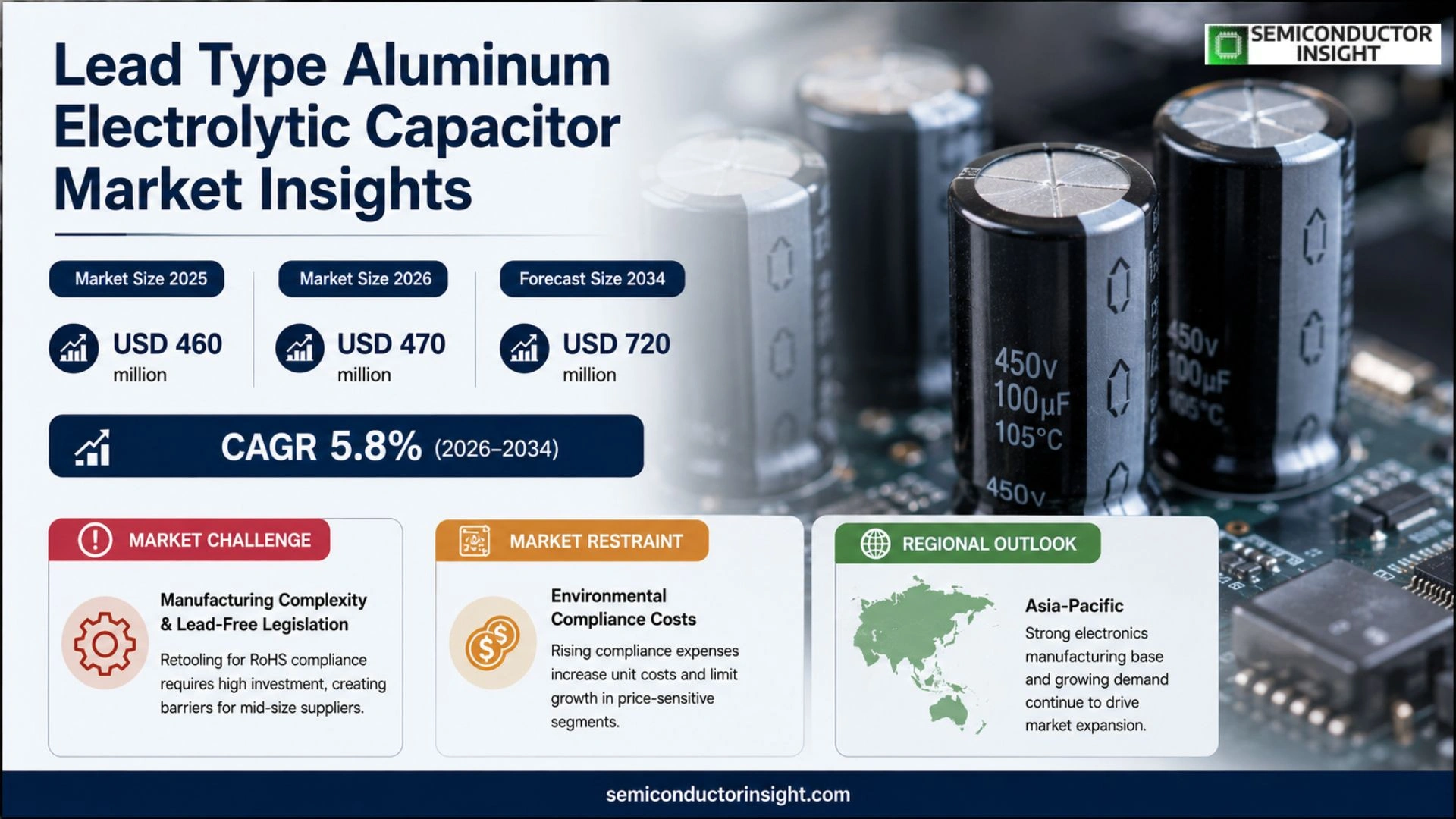
Lead Type Aluminum Electrolytic Capacitor market was valued at USD 460 million in 2025. The market will likely expand from USD 470 million in 2026 to approximately USD 720 million by 2034, reflecting an implied compound annual growth rate of roughly 5.8 % over the forecast horizon.
Lead‑type aluminum electrolytic capacitors are components that employ high‑purity aluminum foil as the anode and an electrolyte‑impregnated paper as the cathode dielectric. Electrical connection is made through external metal leads, making them suitable for through‑hole technology (THT) mounting on printed circuit boards.
The upward trajectory is fueled by expanding demand from sectors such as 5G communication base stations, electric‑vehicle power‑train control modules, renewable‑energy converters and AI‑driven data‑center power supplies. Advances in electrode foil surface engineering, refined electrolyte formulations and emerging solid‑state or hybrid designs address traditional leakage concerns while delivering higher capacitance density. Major manufacturers,including Vishay, Nichicon, KYOCERA AVX and domestic players such as Aihua Group,are investing in intelligent production lines and product miniaturisation to meet tighter quality standards across industrial automation and consumer electronics.
MARKET DRIVERS
Rising Demand in Power‑Conversion Systems
The proliferation of renewable‑energy installations and electric‑vehicle platforms forces designers to select components that can handle high ripple currents while maintaining compact footprints. Lead‑type aluminum electrolytic capacitors meet these criteria, offering a cost‑effective blend of capacitance density and voltage rating that matches the thermal tolerances of modern converters. Consequently, specification sheets from major OEMs now list these parts as preferred solutions for 400 V and above applications.
Regulatory Push for Energy‑Efficiency Standards
Stringent efficiency mandates in Europe and North America compel manufacturers to redesign power supplies with lower loss profiles. Aluminum electrolytic capacitors equipped with leaded terminations provide lower equivalent series resistance (ESR) than many solid‑state alternatives, directly translating into measurable efficiency gains. This regulatory environment nudges Lead Type Aluminum Electrolytic Capacitor market toward incremental volume increases as compliance becomes non‑negotiable.
➤ Industry surveys indicate that 38 % of new power‑module designs now prioritize lead‑type electrolytics for their balance of cost and performance.
Beyond compliance, the longer shelf life of lead‑type designs reduces inventory risk for distributors, reinforcing a virtuous cycle where reliability concerns reinforce purchase decisions. This durability factor is especially salient for aerospace and industrial equipment that must meet extended service‑life contracts.
MARKET CHALLENGES
Manufacturing Complexity and Lead‑Free Legislation
While leaded electrolytics excel in certain performance envelopes, the global shift toward RoHS compliance creates a friction point for suppliers that still rely on lead‑based terminations. Retooling factories to accommodate lead‑free alternatives entails capital outlays that many mid‑size producers deem prohibitive, potentially narrowing the supplier pool for end‑users.
Other Challenges
Supply‑Chain Volatility
Fluctuations in aluminum alloy prices and the limited number of certified capacitor manufacturers amplify lead times. Procurement teams are forced to adopt safety‑stock strategies, which in turn elevate carrying costs and compress margins for downstream assemblers.
Furthermore, the growing preference for surface‑mount devices in high‑density designs marginalizes through‑hole leaded parts, pressuring manufacturers to diversify product portfolios or risk obsolescence.
MARKET RESTRAINTS
Environmental Compliance Costs
The expense associated with meeting increasingly strict environmental regulations translates into higher unit costs for lead‑type aluminum electrolytic capacitors. Companies that cannot absorb these added costs may either pass them to customers or withdraw from price‑sensitive segments, limiting market expansion.
In addition, certification processes for critical industries such as aerospace demand extensive testing, extending time‑to‑market for new product launches. This procedural overhead disincentivizes rapid innovation cycles, slowing the overall velocity of market growth.
Finally, the perception of lead‑based components as “legacy” technology influences procurement policies that favor newer, lead‑free alternatives, even when performance trade‑offs are minimal. This bias curtails adoption rates in sectors that prioritize sustainability over marginal cost savings.
MARKET OPPORTUNITIES
Emerging Applications in Grid‑Scale Storage
Grid‑level energy storage units increasingly rely on high‑voltage converters that demand capacitors with robust ripple‑current handling. Lead‑type aluminum electrolytic capacitors, with their proven high‑voltage tolerance and relatively low ESR, are positioned to capture a share of this expanding niche. Strategic partnerships with battery‑module manufacturers could unlock new revenue streams.
Customization for Industrial Automation
Industrial robotics and factory‑automation equipment often operate under harsh thermal cycles, prompting a demand for capacitors that can endure frequent temperature swings. Offering tailored capacitance‑voltage combinations and extended temperature ratings presents an avenue for differentiation that can command premium pricing.
Investors should also monitor the nascent trend of retrofitting legacy infrastructure with modern power‑conversion modules. Such upgrades frequently stipulate compatibility with existing leaded electrolytics, presenting a low‑entry barrier for suppliers to supply replacement parts and service contracts.
Lead Type Aluminum Electrolytic Capacitor Market Trends
Emerging Demand from 5G Infrastructure and Electrified Mobility
The 2025 production level of roughly 11 million units at an average price of $45 each reflects a solid foundation for the sector. Consumption surges are observable in 5G base‑station networks, electric‑vehicle power‑train controllers, renewable‑energy converters, and AI‑driven data‑center supplies. These end‑uses require capacitors that can tolerate high ripple currents while maintaining low leakage, prompting manufacturers to prioritize higher capacitance density and tighter tolerance specifications. The convergence of stricter efficiency standards and the push for compact system designs amplifies the relevance of lead‑type aluminum electrolytic solutions, especially in regions where through‑hole technology remains the preferred mounting method for reliable, cost‑effective assembly.
Other Trends
Manufacturing Innovations and Reliability Enhancements
Precision machining of high‑purity aluminum foil continues to be the cornerstone of product consistency. Recent refinements in pit formation through controlled electrochemical corrosion have yielded surface areas that support superior frequency response without sacrificing voltage rating. Companies are integrating vacuum impregnation steps with advanced electrolyte formulations to curb electrolyte evaporation, a traditional reliability concern at elevated temperatures. Parallel development of solid‑state or solid‑liquid hybrid designs addresses leakage risks while preserving the familiar mechanical lead configuration. The adoption of intelligent manufacturing platforms,real‑time process monitoring, predictive maintenance, and automated quality inspection,has shortened cycle times and reduced variance, meeting the tighter tolerances demanded by automotive and industrial automation customers.
Competitive Landscape and Supplier Concentration
Market concentration remains high, with most output originating from established players in Europe, North America, and Japan. Global leaders such as Vishay and Nichicon dominate the high‑volume segment, while domestic firms like Aihua Group secure niche positions within regional supply chains. This clustering creates a competitive environment where scale economies and rigorous testing protocols differentiate success. For new entrants, the barrier lies not only in capital investment for precision equipment but also in establishing credibility around long‑term reliability,an attribute heavily weighted by OEMs in automotive and data‑center markets. The prevailing concentration prompts existing manufacturers to explore strategic collaborations, joint R&D ventures, and selective acquisitions to broaden product portfolios and address emerging application niches.
COMPETITIVE LANDSCAPE
Key Industry Players
Lead Type Aluminum Electrolytic Capacitor – Competitive Overview
Vishay dominates the global arena, leveraging a production network that spans North America, Europe and Japan. Its extensive portfolio covers high‑voltage and high‑temperature variants, positioning the firm as the primary supplier for 5G base‑station power modules and automotive power‑train controllers. The company’s scale enables aggressive pricing while sustaining stringent quality controls, a factor that reinforces its hold on the majority of volume contracts. This concentration of capacity in a few multinational corporations underscores the market’s reliance on established engineering capabilities and long‑term customer relationships.
Beyond Vishay, a constellation of specialized manufacturers sustains competition. Nichicon and KYOCERA AVX focus on premium‑grade capacitors for data‑center power supplies, while YAGEO and TDK pursue cost‑effective solutions for consumer electronics. Panasonic and Nippon Chemi‑Con command strong positions in the Japanese market, emphasizing reliability for industrial automation. Rubycon, AIC Tech and Lelon cater to niche segments such as renewable‑energy inverters. Regional players including KNSCHA (China), Jackcon (South Korea), SAMYOUNG and Capxon Electronic Technology (Taiwan) add depth by targeting localized OEMs and offering customized electrolyte formulations. Emerging entrants like AISHI and Yiyang Axboom demonstrate a willingness to innovate with hybrid solid‑liquid technologies, hinting at future shifts in product architecture.
List of Key Lead Type Aluminum Electrolytic Capacitor Companies Profiled
- Vishay
- Nichicon
- KYOCERA AVX
- YAGEO
- TDK Corporation
- Panasonic Electronic Components
- Nippon Chemi-Con Corporation
- Rubycon
- AIC Tech
- Lelon
- KNSCHA
- Jackcon
- SAMYOUNG
- Capxon Electronic Technology
- AISHI
- Yiyang Axboom Electronic
Segment Analysis:
| Segment Category | Sub-Segments | Key Insights |
| By Type |
|
Lead Configuration
|
| By Application |
|
Power‑Management Applications
|
| By End User |
|
Strategic End‑User Priorities
|
| By Manufacturing Process |
|
Process‑Driven Quality Differentiators
|
| By Emerging Trend |
|
Innovation Drivers
|
Regional Analysis: Lead Type Aluminum Electrolytic Capacitor Market
Asia‑Pacific
Vehicle electrification programmes across the region drive a surge in applications where large‑capacitance, low‑cost components are essential for start‑stop systems, power‑train control units, and auxiliary lighting. Manufacturers value the proven reliability of lead‑type aluminum electrolytic capacitors when engineering high‑current pulses in compact footprints.
Grid‑level storage projects, particularly solar‑plus‑storage farms, rely on capacitors that can smooth transient spikes from inverters. Lead‑type aluminum electrolytic devices offer a balance of energy density and cost that aligns with the financial models of many utility‑scale deployments in the region.
Factories modernising their motor‑drive systems frequently standardise on these capacitors for motor‑control and variable‑frequency drive circuits. Their tolerance for high ripple currents and ability to operate at elevated temperatures make them a go‑to choice for heavy‑duty industrial gear.
While newer chemistries appear in premium handhelds, mid‑range televisions, and home‑appliance power supplies still depend on lead‑type aluminum electrolytic parts to meet price points without compromising long‑term reliability.
North America
The North American segment of Lead Type Aluminum Electrolytic Capacitor market reflects a mature supply ecosystem tempered by a shift toward higher efficiency standards. Defense contractors and aerospace firms favour these capacitors for legacy platforms that require proven, stable performance under rigorous environmental testing. Meanwhile, the consumer‑electronics sector increasingly favours solid‑state alternatives, nudging manufacturers to differentiate through price‑competitive, high‑reliability offerings. Regulatory pressures around hazardous substance reduction have spurred a gradual redesign of certain product lines, yet the entrenched cost advantage of lead‑type devices secures a steady order flow, especially among original equipment manufacturers that prioritise long product lifecycles over cutting‑edge miniaturisation.
Europe
European dynamics within Lead Type Aluminum Electrolytic Capacitor market are shaped by a blend of stringent environmental directives and a resilient industrial base. Power‑generation utilities in Germany and France, tasked with integrating wind and solar influxes, continue to source these capacitors for grid‑stabilisation hardware where upfront capital efficiency is paramount. Simultaneously, automotive makers in the region, while accelerating EV adoption, retain substantial internal combustion engine production lines that depend on traditional capacitor architectures. The regulatory landscape encourages substitution with greener chemistries, but the transitional period sustains demand for legacy‑compatible components, compelling suppliers to offer both compliance‑ready and conventional product families.
South America
In South America, Lead Type Aluminum Electrolytic Capacitor market is propelled by expanding renewable‑energy projects and a burgeoning automotive assembly sector in Brazil and Argentina. Power‑distribution firms tackling intermittent generation from hydro and solar farms find these capacitors valuable for managing short‑term voltage fluctuations. The regional automotive supply chain, still heavily oriented toward conventional engine designs, relies on the cost‑effectiveness and proven durability of lead‑type aluminum electrolytic units for power‑train and ancillary systems. Market participants are therefore concentrating on localised production partnerships that reduce import duties while preserving the low‑price advantage essential for price‑sensitive end‑users.
Middle East & Africa
The Middle East & Africa region exhibits a nuanced demand pattern for Lead Type Aluminum Electrolytic Capacitor market, anchored by rapid infrastructure development and mining‑related industrial expansion. Power‑plant upgrades in the Gulf, aimed at integrating large‑scale desalination and solar installations, employ these capacitors for inverter and motor‑drive applications where reliability under high ambient temperatures is critical. In Africa, emerging consumer‑electronics manufacturers leverage the affordable price point of lead‑type aluminum electrolytic devices to meet local market expectations without incurring the premium of newer technologies. Consequently, suppliers are adapting logistics and after‑sales support to accommodate a geographically dispersed customer base that values both cost efficiency and dependable long‑term performance.
Report Scope
This market research report provides a comprehensive analysis of Lead Type Aluminum Electrolytic Capacitor market, covering the forecast period 2026–2034. It offers detailed insights into market dynamics, technological advancements, competitive landscape, and key trends shaping the industry.
Key focus areas of the report include:
- Market Overview: The report begins with an overview outlining its current market scenario, key growth indicators, and industry transformation drivers. It discusses macroeconomic factors, demand–supply balance, regulatory landscape, and the strategic role of semiconductors in powering advancements across industries such as automotive, telecommunications, consumer electronics, and industrial automation.
- Market Size & Forecast: Historical data and future projections for revenue, unit shipments, and market value across major regions and segments.
- Segmentation Analysis: Detailed breakdown by product type, technology, application, and end-user industry to identify high-growth segments and investment opportunities.
- Regional Insights: Insights into market performance across North America, Europe, Asia-Pacific, Latin America, and the Middle East & Africa, including country-level analysis where relevant.
- Competitive Landscape: Profiles of leading market participants, including their product offerings, R&D focus, manufacturing capacity, pricing strategies, and recent developments such as mergers, acquisitions, and partnerships.
- Technology Trends & Innovation: Assessment of emerging technologies, integration of AI/IoT, semiconductor design trends, fabrication techniques, and evolving industry standards.
- Market Drivers & Restraints: Evaluation of factors driving market growth along with challenges, supply chain constraints, regulatory issues, and market-entry barriers.
- Stakeholder Insights: Insights for component suppliers, OEMs, system integrators, investors, and policymakers regarding the evolving ecosystem and strategic opportunities.
Primary and secondary research methods are employed, including interviews with industry experts, data from verified sources, and real-time market intelligence to ensure the accuracy and reliability of the insights presented.
FREQUENTLY ASKED QUESTIONS:
What is the current market size of Lead Type Aluminum Electrolytic Capacitor Market?
-> Lead Type Aluminum Electrolytic Capacitor market will likely expand from USD 470 million in 2026 to approximately USD 720 million by 2034
Which key companies operate in Lead Type Aluminum Electrolytic Capacitor Market?
-> Key players include Vishay, Nichicon, KYOCERA AVX, YAGEO, TDK Corporation, Panasonic Electronic Components, Nippon Chemi-Con Corporation, Rubycon, AIC Tech, Lelon, KNSCHA, Jackcon, SAMYOUNG, Capxon Electronic Technology, AISHI, Yiyang Axboom Electronic.
What are the key growth drivers?
-> Key growth drivers include 5G communication base stations, new energy vehicle electronic control systems, renewable energy conversion devices, and artificial intelligence data center power supplies.
Which region dominates the market?
-> Europe and North America dominate the market, with Europe holding a significant share due to its established manufacturing base, while North America contributes strong demand from industrial and consumer electronics sectors.
What are the emerging trends?
-> Emerging trends include development of higher‑performance smaller‑volume capacitors, solid‑state and solid‑liquid hybrid technologies to mitigate electrolyte drying and leakage, and the adoption of intelligent manufacturing for improved production efficiency and product consistency.
Get Sample Report PDF for Exclusive Insights
Report Sample Includes
- Table of Contents
- List of Tables & Figures
- Charts, Research Methodology, and more...
 Download Sample Report PDF