
Industrial Grade PDA Barcode Scanner Market Insights
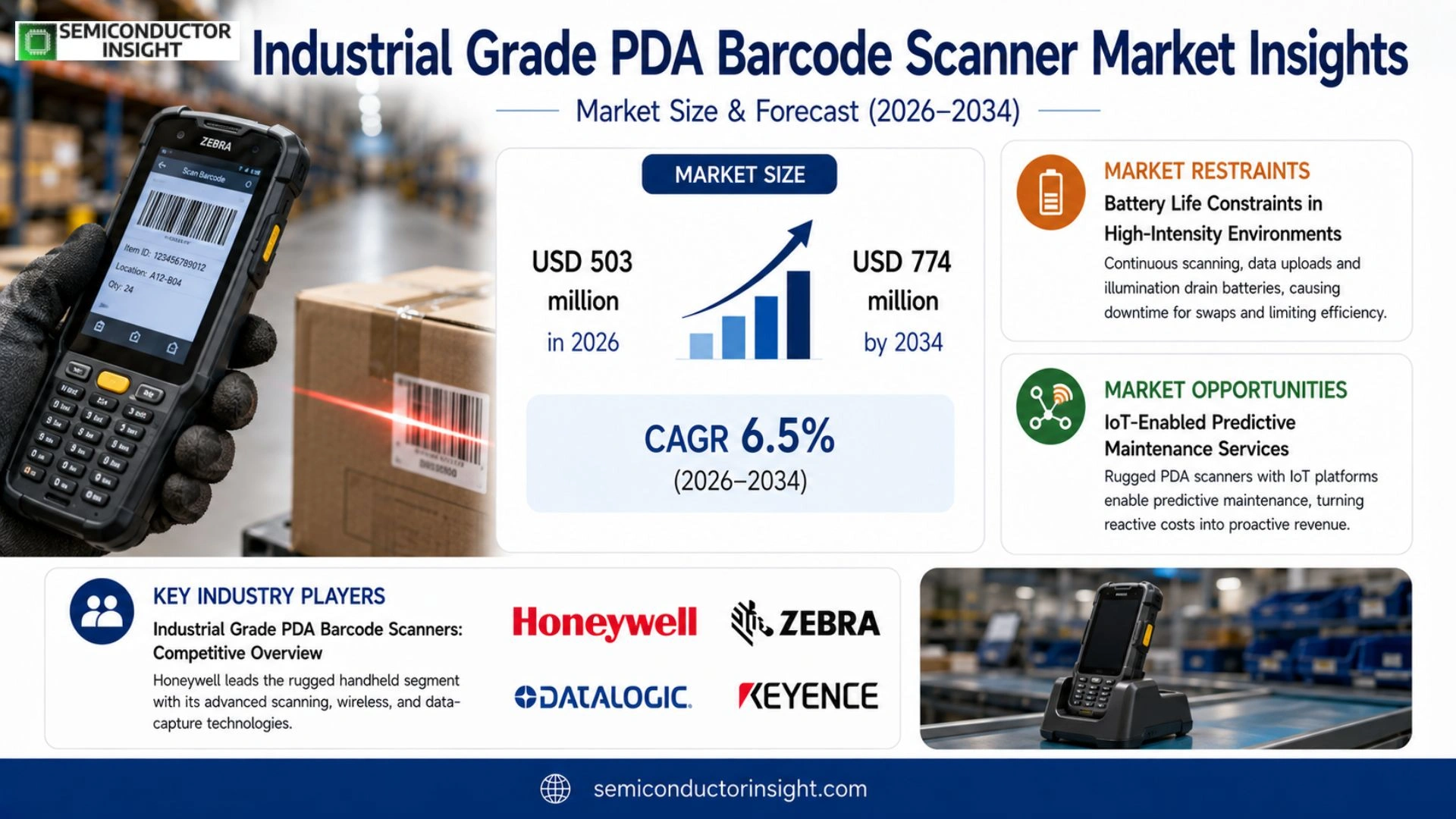
Industrial Grade PDA Barcode Scanner market is projected to grow from USD 503 million in 2026 to USD 774 million by 2034, exhibiting a CAGR of 6.5% during the forecast period.
An Industrial Grade PDA Barcode Scanner is a rugged handheld data collection device that integrates a barcode‑scanning module with an industrial mobile computer (PDA), designed for use in harsh working environments. Compared with consumer smartphones, it features reinforced housing, drop resistance, wide operating temperature range, long battery life and high ingress‑protection ratings (typically IP65‑IP68). These devices enable real‑time data capture and wireless transmission in logistics, warehousing, manufacturing, retail operations and field services.
The market is experiencing rapid growth due to several factors, including digital‑transformation initiatives across supply chains, expanding e‑commerce fulfillment networks and increasing adoption of smart‑factory solutions. Furthermore, advances in Android‑based platforms, 5G connectivity and integrated RFID/vision scanning technologies are enhancing device functionality. Leading manufacturers such as Newland Digital Technology, Urovo Technology, Honeywell, Zebra Technologies and Datalogic are broadening their portfolios through product innovation and strategic collaborations.
MARKET DRIVERS
Warehouse Automation and Real‑Time Visibility
Enterprises are increasingly integrating handheld data capture devices to streamline order‑to‑shipment cycles. Industrial Grade PDA Barcode Scanner Market benefits from this shift because scanners that combine rugged design with on‑board processing reduce manual entry errors and accelerate inventory reconciliation. As distribution centers target sub‑hour dock‑to‑stock times, the demand for devices that can withstand drops, temperature swings, and dust while delivering instant data grows markedly.
Regulatory Compliance and Traceability Requirements
Stringent traceability mandates in sectors such as pharmaceuticals, aerospace, and food safety compel firms to adopt barcode solutions capable of reading high‑density codes under harsh conditions. Industrial Grade PDA units equipped with advanced imaging algorithms enable compliance with serialization standards, lowering the risk of costly recalls. The financial impact of non‑compliance has turned accurate scanning into a budget‑line item rather than an optional upgrade.
➤ “Companies that replace legacy scanners with rugged PDA platforms report up to a 15% reduction in labor hours per shift.”
Beyond compliance, the rise of edge‑computing architectures encourages on‑device analytics. When scanners process data locally, latency drops and network bandwidth consumption shrinks, delivering immediate insights to floor managers. This capability fuels investment cycles, as operators recognize that a single handheld can replace multiple ground‑level devices while delivering richer operational intelligence.
MARKET CHALLENGES
High Capital Outlay for Enterprise‑Scale Deployments
Although rugged PDA scanners extend device lifespans, the upfront cost per unit remains substantially higher than that of consumer‑grade alternatives. Large distributors must weigh the ROI of a capital‑intensive rollout against incremental productivity gains, especially when budgeting cycles are constrained by broader supply‑chain disruptions.
Other Challenges
Integration Complexity
Legacy warehouse management systems often rely on proprietary communication protocols. Aligning new handhelds with existing middleware can require custom firmware or middleware bridges, stretching implementation timelines and demanding specialized engineering resources.
MARKET RESTRAINTS
Battery Life Constraints in High‑Intensity Environments
Even the most robust handhelds face endurance limits when operating under continuous scanning, frequent data uploads, and bright‑field illumination. Facilities that run 24/7 shifts encounter downtimes for battery swaps, which erodes the efficiency gains expected from automation.
Manufacturers are attempting to mitigate this issue through larger capacity cells and rapid‑charge technologies, yet the trade‑off between battery size and device ergonomics continues to restrict adoption in tightly spaced aisles where handheld comfort is paramount.
Moreover, the need for periodic firmware updates to address emerging security vulnerabilities adds another layer of operational overhead, compelling IT departments to allocate resources that might otherwise support expansion projects.
MARKET OPPORTUNITIES
IoT‑Enabled Predictive Maintenance Services
The convergence of rugged PDA scanners with Internet‑of‑Things platforms opens a niche for subscription‑based predictive maintenance offerings. By streaming sensor data such as temperature, vibration, and usage cycles, vendors can anticipate component wear and schedule service before failure occurs, turning a traditionally reactive cost into a proactive revenue stream.
Another avenue lies in vertical specialization. Tailoring scanner firmware to address unique coding standards of sectors like heavy equipment leasing or medical device tracking can command premium pricing and foster deeper client relationships. As regulatory bodies tighten traceability mandates, providers that deliver pre‑certified, sector‑specific solutions will capture disproportionate market share.
Finally, the expansion of 5G networks within industrial parks promises near‑instantaneous data transfer, reducing reliance on intermittent Wi‑Fi coverage. Companies that position their scanners to leverage low‑latency 5G connectivity can differentiate their offerings with real‑time analytics, positioning themselves as strategic partners rather than mere equipment suppliers.
Industrial Grade PDA Barcode Scanner Market Trends
Shift Toward Android‑Based, 5G‑Enabled Devices
Manufacturers are accelerating the migration from legacy Windows platforms to Android operating systems, a move driven by the need for faster app development cycles and broader ecosystem support. The integration of 5G modules is no longer a differentiator but a baseline requirement, enabling near‑real‑time data transmission in sprawling warehouse environments. This confluence of software openness and high‑speed connectivity reduces latency in inventory updates, which directly lowers order‑fulfilment errors and improves labour efficiency. Companies that adopt Android‑5G combos early gain leverage in securing contracts with logistics providers that prioritize digital transparency.
Other Trends
Convergence of RFID and Vision Scanning
Beyond conventional 1D laser and 2D imagers, vendors are embedding RFID antennas and computer‑vision cameras into the same rugged chassis. The hybrid approach addresses use‑cases where barcodes deteriorate or become unreadable, such as in cold‑chain storage. RFID tags facilitate bulk reads without line‑of‑sight, while vision algorithms verify product placement. This dual capability is prompting OEMs to redesign antenna placement and power management, resulting in slightly heavier units but offering a clear value proposition for manufacturers seeking end‑to‑end traceability.
Price‑Performance Optimization Through Component Consolidation
Recent supply‑chain constraints have forced manufacturers to reassess component sourcing. By consolidating processors, memory modules, and wireless chips onto a single System‑on‑Chip (SoC), producers achieve cost reductions of 10‑15 % while maintaining drop‑resistance ratings of IP68. The lower bill‑of‑materials translates into more competitive pricing for mid‑tier customers, yet the gross profit margin remains comfortably within the 20‑40 % band historically observed. This pricing elasticity encourages broader adoption in sectors such as field services and healthcare, where budgetary pressures previously limited deployment.
COMPETITIVE LANDSCAPE
Key Industry Players
Industrial Grade PDA Barcode Scanners: Competitive Overview and Market Positioning
Honeywell dominates the rugged handheld segment, leveraging its extensive portfolio of integrated scanning, wireless, and data‑capture technologies. The company’s ability to bundle enterprise‑grade software with hardware has cemented its role as the preferred supplier for large logistics operators and manufacturers that demand high‑availability devices. Market concentration remains moderate, with the top five firms accounting for roughly one‑third of global shipments in 2025. This balance reflects both the premium pricing power of established brands and the ongoing need for specialized solutions that can survive harsh industrial conditions, such as IP68 sealing and drop‑test compliance.
Beyond the market leaders, a cohort of niche innovators is reshaping the value chain. Newland and Urovo, both headquartered in China, concentrate on cost‑effective Android‑based models that appeal to mid‑size distributors seeking rapid deployment. Zebra and Datalogic differentiate through advanced imaging engines and seamless integration with warehouse management systems, targeting high‑throughput environments. Meanwhile, companies like Keyence, Chainway, and CipherLab focus on modular designs that accommodate RFID or 5G upgrades, positioning themselves for manufacturers adopting smart‑factory standards. The diversity of strategies,from aggressive price competition to technology‑centric differentiation,creates a dynamic competitive set where partnerships and OEM agreements are becoming as influential as outright market share.
List of Key Industrial Grade PDA Barcode Scanner Companies Profiled
- Honeywell
- Zebra Technologies
- Newland Digital Technology
- Urovo Technology
- Datalogic
- Keyence
- Chainway
- DENSO WAVE
- Panasonic
- Casio
- Unitech
- Shenzhen Supoin Technology
- CipherLab
- Bluebird
Segment Analysis:
| Segment Category | Sub-Segments | Key Insights |
| By Type |
|
Touch Screen Type is emerging as the preferred form factor for operators seeking intuitive interaction and rapid data entry.
|
| By Application |
|
Warehouse Logistics drives the most compelling use cases for rugged PDA scanners.
|
| By End User |
|
Logistics Operators value the device for its durability and real‑time data capture.
|
| By Technology |
|
2D Imager Scanners are gaining traction for their flexibility.
|
| By Connectivity |
|
5G Cellular connectivity is reshaping field deployments.
|
Regional Analysis: Industrial Grade PDA Barcode Scanner Market
North America
Stringent occupational safety standards in the United States compel manufacturers to select scanners that meet ruggedness certifications, influencing supplier selection and encouraging the development of devices with enhanced sealing and drop‑resistance features.
Integration with enterprise resource planning (ERP) systems is becoming a decisive factor, as firms look to eliminate manual data entry errors and accelerate order‑to‑delivery cycles through automated barcode capture.
End‑users favor devices that combine extended battery life with high‑resolution imaging, enabling continuous operation on busy warehouse floors without frequent recharging interruptions.
The market sees intense rivalry among a handful of established OEMs and emerging niche players, each leveraging proprietary software ecosystems to lock in enterprise contracts.
Europe
European manufacturers are aligning their procurement strategies with sustainability mandates, seeking scanners that incorporate recyclable materials and energy‑efficient components. The region’s fragmented regulatory environment, with varying CE markings and electrical safety directives, pushes vendors to offer modular designs that can be easily adapted to local compliance standards. Moreover, the rise of omnichannel retail in Western Europe is compelling logistics providers to deploy handheld devices that can seamlessly switch between 1D and 2D barcode formats, supporting both legacy inventory tags and newer QR‑based tracking labels. These trends elevate the importance of firmware flexibility, as firms require rapid updates to accommodate evolving market requirements without extensive hardware overhauls. Suppliers that can deliver scalable software platforms alongside robust hardware are gaining traction, positioning themselves as strategic partners rather than mere component sellers.
Asia‑Pacific
In Asia‑Pacific, rapid expansion of e‑commerce fulfillment centers is reshaping the demand profile for Industrial Grade PDA Barcode Scanners. Operators are handling higher SKUs per shift, prompting a shift toward devices with faster decoding algorithms and multi‑frequency scanners capable of reading densely packed barcodes. The region’s cost‑sensitivity balances the appetite for advanced features, leading manufacturers to offer tiered product lines that retain core durability while varying peripheral capabilities. Additionally, growing investment in smart factory initiatives encourages integration of scanners with IoT gateways, allowing real‑time transmission of scan data to centralized monitoring dashboards. Companies that can thread together rugged hardware, low‑latency connectivity, and open‑API ecosystems are better positioned to capture market share amid this transformation.
South America
South American logistics firms are confronting challenges linked to infrastructure variability, which places a premium on handhelds that can operate reliably in high‑humidity and temperature‑fluctuating environments. The market is witnessing a gradual shift from conventional barcode readers to fully integrated PDA solutions that combine scanning with on‑device computing, reducing dependence on external terminals. This evolution is driven by a desire to improve labor productivity and reduce floor‑space constraints in crowded warehouses. Local distributors are also playing an influential role, often customizing device firmware to align with region‑specific inventory coding practices, thereby enhancing user acceptance and reducing training overhead.
Middle East & Africa
The Middle East & Africa region is experiencing incremental adoption of industrial handheld scanners, largely spurred by large‑scale infrastructure projects and the modernization of port operations. Harsh desert climates demand devices with superior thermal management and dust‑proof sealing, prompting OEMs to engineer enhanced cooling solutions and reinforced chassis. In parallel, the emergence of cloud‑based supply‑chain platforms across the Gulf Cooperation Council (GCC) economies is encouraging the deployment of scanners that support seamless data synchronization across geographically dispersed sites. Business leaders in the region are therefore evaluating solutions not only on ruggedness but also on their ability to integrate with global visibility tools that underpin cross‑border trade efficiency.
Report Scope
This market research report provides a comprehensive analysis of the Industrial Grade PDA Barcode Scanner Market , covering the forecast period 2026–2034. It offers detailed insights into market dynamics, technological advancements, competitive landscape, and key trends shaping the industry.
Key focus areas of the report include:
- Market Overview: The report begins with an overview outlining its current market scenario, key growth indicators, and industry transformation drivers. It discusses macroeconomic factors, demand–supply balance, regulatory landscape, and the strategic role of semiconductors in powering advancements across industries such as automotive, telecommunications, consumer electronics, and industrial automation.
- Market Size & Forecast: Historical data and future projections for revenue, unit shipments, and market value across major regions and segments.
- Segmentation Analysis: Detailed breakdown by product type, technology, application, and end-user industry to identify high-growth segments and investment opportunities.
- Regional Insights: Insights into market performance across North America, Europe, Asia-Pacific, Latin America, and the Middle East & Africa, including country-level analysis where relevant.
- Competitive Landscape: Profiles of leading market participants, including their product offerings, R&D focus, manufacturing capacity, pricing strategies, and recent developments such as mergers, acquisitions, and partnerships.
- Technology Trends & Innovation: Assessment of emerging technologies, integration of AI/IoT, semiconductor design trends, fabrication techniques, and evolving industry standards.
- Market Drivers & Restraints: Evaluation of factors driving market growth along with challenges, supply chain constraints, regulatory issues, and market-entry barriers.
- Stakeholder Insights: Insights for component suppliers, OEMs, system integrators, investors, and policymakers regarding the evolving ecosystem and strategic opportunities.
Primary and secondary research methods are employed, including interviews with industry experts, data from verified sources, and real-time market intelligence to ensure the accuracy and reliability of the insights presented.
FREQUENTLY ASKED QUESTIONS:
What is the current market size of Industrial Grade PDA Barcode Scanner Market?
-> Industrial Grade PDA Barcode Scanner market is projected to grow from USD 503 million in 2026 to USD 774 million by 2034, exhibiting a CAGR of 6.5%
Which key companies operate in Industrial Grade PDA Barcode Scanner Market?
-> Key players include Newland Digital Technology, Urovo Technology, Honeywell, SEUIC Technologies, Zebra Technologies, Keyence, Chainway, DENSO WAVE, Datalogic, Wuxi Idata Technology, Casio, Panasonic, Unitech, Shenzhen Supoin Technology, CipherLab, Bluebird.
What are the key growth drivers?
-> Key growth drivers include digital transformation, e‑commerce expansion, smart factory initiatives, adoption of Android‑based platforms, 5G connectivity, and integration of RFID/vision scanning solutions.
Which region dominates the market?
-> Asia is the fastest‑growing region, driven by strong demand in logistics, warehousing, and manufacturing sectors.
What are the emerging trends?
-> Emerging trends include Android‑based operating systems, 5G enabled devices, integrated RFID and vision scanning capabilities, and increased emphasis on real‑time data capture for industrial digitalization.

Get Sample Report PDF for Exclusive Insights
Report Sample Includes
- Table of Contents
- List of Tables & Figures
- Charts, Research Methodology, and more...
