Indium Tin Oxide (ITO) Sputtering Targets Market Insights
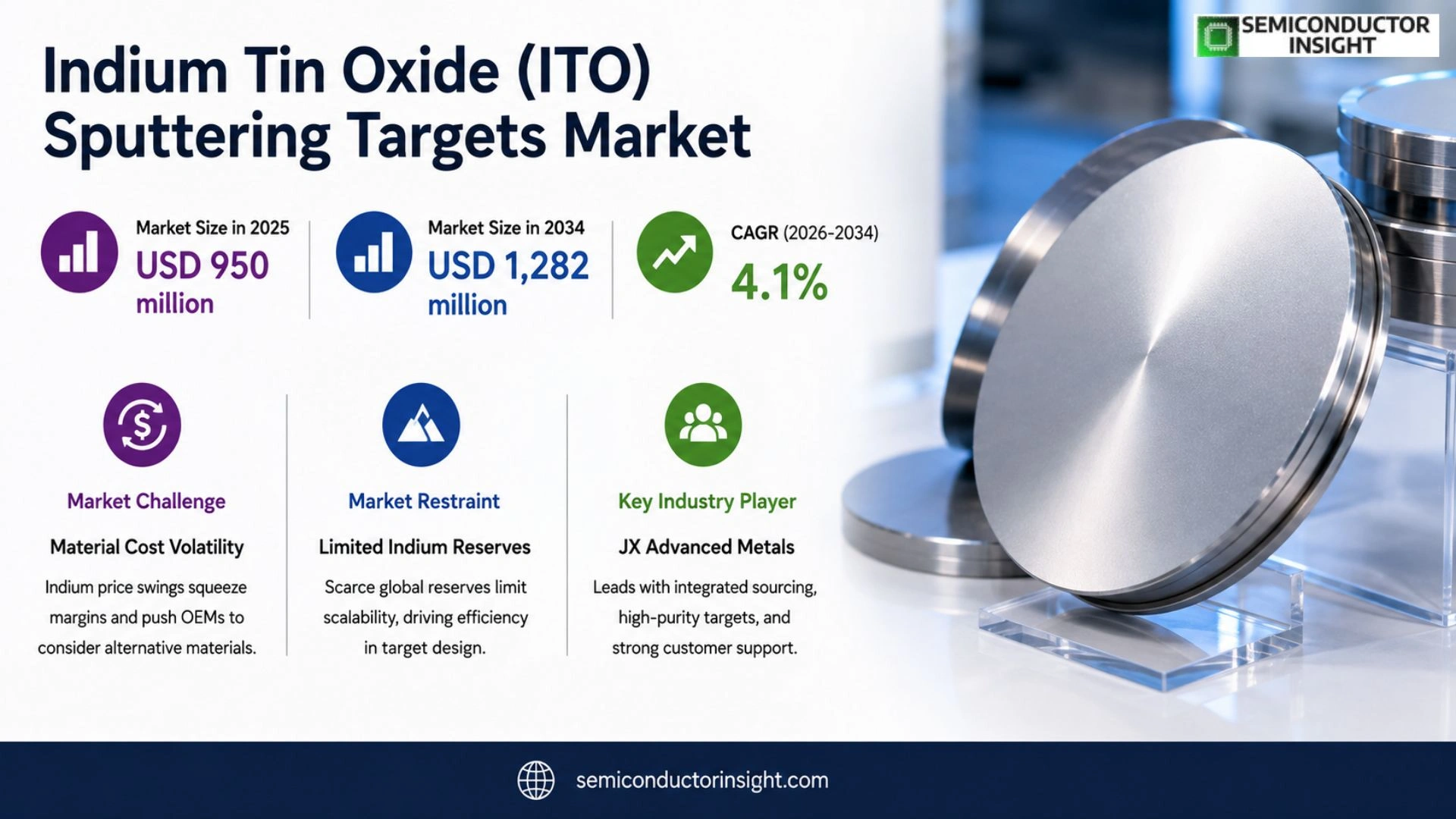
Indium Tin Oxide (ITO) Sputtering Targets market size was valued at USD 950 million in 2025 and is projected to reach USD 1 282 million by 2034, exhibiting a CAGR of 4.1% during the forecast period.
Indium Tin Oxide sputtering target (ITO) is widely used in the formation of electrically transparent thin films, which adopt direct current magnetron sputtering process for electrodes in flat panel displays, solar cells, gas sensors and so on.
The market’s expansion stems from the growth of display and optoelectronics sectors. Continuous upgrades in LCD, OLED and touch‑enabled devices increase demand for high‑performance transparent conductive films, directly boosting consumption of ITO targets. Moreover, growing applications in solar cells, smart devices and wearable electronics broaden the use of ITO films. Trends toward larger panel sizes, more advanced fabrication processes and stricter uniformity requirements encourage manufacturers to adopt high‑purity, high‑density ITO sputtering targets, supporting sustained growth.
MARKET DRIVERS
Rising demand for transparent conductors
The proliferation of high‑resolution touch panels and thin‑film photovoltaics has pushed manufacturers to seek conductive coatings that combine low resistivity with high optical transmission. Indium Tin Oxide (ITO) Sputtering Targets Market benefits because ITO remains the benchmark material that satisfies these dual requirements while integrating smoothly into existing line‑up equipment.
Advances in sputtering technology
Recent refinements in magnetron sputtering,such as pulsed‑DC and high‑power impulse modes,have lifted target utilization rates and trimmed scrap. These process improvements translate into lower per‑unit cost for end‑users, encouraging broader adoption across sectors ranging from automotive head‑up displays to medical imaging sensors.
➤ Industry adoption accelerates as yield improves, reinforcing the value proposition of ITO sputtering solutions.
Concurrent regulatory pressures favoring energy‑efficient devices reinforce the trend; manufacturers that can demonstrate compliance through superior transparent electrodes gain a competitive edge, further cementing the market’s upward trajectory.
MARKET CHALLENGES
Material cost volatility
Indium’s price has exhibited pronounced swings in response to mining output fluctuations and speculative trading. When cost spikes, end‑product margins compress, prompting some OEMs to explore alternative conductive oxides despite their inferior performance metrics.
Other Challenges
Supply chain constraints
The concentration of indium processing capacity in a limited number of regions creates logistical bottlenecks. Delays in raw material delivery ripple through the target fabrication schedule, affecting lead times for high‑volume customers.
MARKET RESTRAINTS
Limited indium reserves
Global indium reserves are modest relative to long‑term demand forecasts for electronics and display technologies. This scarcity imposes a ceiling on production scalability, compelling manufacturers to optimise target designs for material efficiency rather than pursuing volume‑driven expansion.
MARKET OPPORTUNITIES
Emerging applications in flexible displays
Flexible and roll‑able screens require conductive films that retain performance under mechanical strain. ITO sputtering targets tailored for low‑stress deposition enable manufacturers to meet these stringent durability criteria, opening a niche where premium pricing is defensible.
The integration of ITO layers into next‑generation smart windows and transparent antennas also presents a growth corridor. Companies that align R&D efforts with these use‑cases stand to capture differentiated market share as the ecosystem matures.
Indium Tin Oxide (ITO) Sputtering Targets Market Trends
Display Technology Evolution Fuels Target Demand
The shift toward ultra‑high‑definition and larger‑format panels is reshaping the specifications that manufacturers require from sputtering targets. Engineers are now prioritising targets that deliver tighter control over film thickness and surface uniformity, because any deviation translates directly into visual artifacts on next‑generation OLED and LCD screens. Consequently, suppliers are investing in advanced ceramic processing routes that minimize impurity levels and enhance target density. This technical tightening creates a virtuous loop: as display makers push pixel counts, the need for premium ITO targets rises, prompting vendors to refine their production lines and broaden capacity.
Other Trends
Solar Energy Integration Expands Application Base
Photovoltaic modules are increasingly incorporating transparent conductive layers to improve light capture while providing electrical routing for bifacial cell designs. The adoption of ITO films in these layers is accelerating because they combine high conductivity with minimal optical loss. As utility‑scale solar farms adopt higher‑efficiency cell architectures, the volume of ITO sputtering targets required for coating glass substrates is expected to climb modestly. This trend nudges traditional display‑focused manufacturers to diversify product portfolios, allocating more furnace time to solar‑grade targets and revising pricing models to reflect the longer production runs.
Material Purity and Target Form Innovation
Customers are showing a clear preference for high‑purity, low‑tin formulations that reduce scattering centers in the deposited film. At the same time, the industry is experimenting with rotary‑target designs that enable continuous sputtering, thereby cutting cycle times for large‑area substrates. These innovations are not merely technical footnotes; they influence capital‑expenditure decisions across the supply chain. Facilities that can swap between planar and rotary configurations without sacrificing target integrity gain a competitive edge, while end‑users benefit from lower per‑unit costs and improved throughput. The combined emphasis on purity and form factor signals a strategic move toward more flexible, cost‑effective production ecosystems within Indium Tin Oxide (ITO) Sputtering Targets Market.
COMPETITIVE LANDSCAPE
Key Industry Players
Competitive forces shaping the ITO sputtering targets market
JX Advanced Metals anchors the market with a vertically integrated model that couples raw‑material sourcing, high‑purity target fabrication, and downstream customer support. Its global footprint,spanning North America, Europe, and Asia‑Pacific,enables it to respond swiftly to the varying specifications demanded by flat‑panel display makers and photovoltaic firms. Mitsui Mining & Smelting leverages its extensive indium mining operations to secure a cost‑advantage in the supply chain, positioning itself as a preferred supplier for high‑volume OEMs. Materion (Heraeus), with a strong emphasis on research‑driven product differentiation, offers composite ITO targets that address the tighter uniformity tolerances of next‑generation OLED displays. The concentration of these three entities accounts for a sizable share of worldwide shipments, creating a competitive environment where scale, material security, and technical innovation are decisive factors.
Beyond the tier‑one firms, a diverse set of specialized manufacturers adds depth to the market. ULVAC, Inc. supplies precision‑engineered rotary targets that cater to high‑throughput sputtering lines, while LT Metal and Vital Group focus on low‑to‑medium volume niches such as smart‑sensor applications. Companies like Advanced Nano Products Co., Ltd and Wuhu Yingri Technology have built reputations for rapid prototyping and customized alloy compositions, often attracting start‑up display innovators. Solar Applied Materials Technology, Longhua Technology, Omat Advanced Materials, Fujian Acetron New Materials Co., Ltd, Angstrom Sciences, and Changsha Xinkang round out the ecosystem, each delivering distinct value propositions,whether through aggressive pricing, regional service networks, or niche‑segment expertise,that collectively sustain a competitive yet collaborative marketplace.
List of Key Indium Tin Oxide (ITO) Sputtering Targets Companies Profiled
- JX Advanced Metals
- Mitsui Mining & Smelting
- Materion (Heraeus)
- ULVAC, Inc.
- LT Metal
- Vital Group
- Advanced Nano Products Co., Ltd
- Wuhu Yingri Technology
- Solar Applied Materials Technology
- Longhua Technology
- Omat Advanced Materials
- Fujian Acetron New Materials Co., Ltd
- Angstrom Sciences
- Changsha Xinkang
- Materion (Heraeus)
Segment Analysis:
| Segment Category | Sub-Segments | Key Insights |
| By Type |
|
Planar Target
|
| By Application |
|
Flat Panel Display
|
| By End User |
|
Display Manufacturers
|
| By Target Form |
|
ITO Ceramic Targets
|
| By Tin Content |
|
Medium‑Tin ITO Targets
|
Regional Analysis: Indium Tin Oxide (ITO) Sputtering Targets Market
The bulk of target output resides in coastal industrial parks where wafer‑scale sputtering lines operate at capacities exceeding several thousand units per month, enabling economies of scale that traditional players elsewhere struggle to match.
Close proximity between indium ore processing facilities and target manufacturers shortens logistics chains, reducing exposure to transport disruptions and volatile freight costs.
University‑industry partnerships in Japan and South Korea are piloting next‑generation target alloys that promise higher transparency while maintaining low resistivity.
Regional standards on material purity and environmental emissions drive continual upgrades to target‑fabrication processes, indirectly raising the bar for product quality worldwide.
North America
In the United States and Canada, the market is shaped by a mature display‑panel sector that values consistency and traceability above sheer volume. Domestic manufacturers often prioritize certifications and long‑term service agreements, meaning that target suppliers focus on reproducibility and robust quality‑management systems. Emerging applications in smart‑glass architecture and medical imaging are encouraging a modest shift toward custom‑spec targets, prompting a few niche players to expand their R&D labs. While cost pressures are evident, the willingness to pay a premium for predictability keeps the region competitive.
Europe
European demand reflects a blend of high‑end consumer electronics and a growing emphasis on sustainability. Companies operating under strict EU environmental directives invest in recycling‑friendly sputtering processes, which in turn influences target composition choices. The region’s strong heritage in precision optics creates a market niche for ultra‑high‑purity ITO targets used in scientific instrumentation. Collaborative platforms such as EU Horizon projects foster cross‑border research, allowing smaller firms to access cutting‑edge methodologies without scaling up full production lines.
South America
Growth in Brazil and Colombia is driven primarily by expanding renewable‑energy installations that incorporate transparent conductive coatings on solar‑panel enclosures. Local manufacturers are still reliant on imported targets, but recent government incentives for high‑tech imports have encouraged a handful of joint ventures to set up modest assembly lines. The market remains price‑sensitive, yet the gradual up‑skilling of the workforce hints at a longer‑term capability build‑out.
Middle East & Africa
In the Gulf Cooperation Council states, the ITO target market is linked to rapid deployment of smart‑city infrastructure, where transparent displays are embedded in public façades. Partnerships with Asian suppliers dominate, but local authorities are commissioning pilot projects that test in‑house target refurbishment to reduce reliance on external sources. Sub‑Saharan nations exhibit nascent demand, mainly tied to telecommunications upgrades, suggesting a future where basic supply channels may evolve into more specialized arrangements.
Report Scope
This market research report provides a comprehensive analysis of the Indium Tin Oxide (ITO) Sputtering Targets Market , covering the forecast period 2026–2034. It offers detailed insights into market dynamics, technological advancements, competitive landscape, and key trends shaping the industry.
Key focus areas of the report include:
- Market Overview: The report begins with an overview outlining its current market scenario, key growth indicators, and industry transformation drivers. It discusses macroeconomic factors, demand–supply balance, regulatory landscape, and the strategic role of semiconductors in powering advancements across industries such as automotive, telecommunications, consumer electronics, and industrial automation.
- Market Size & Forecast: Historical data and future projections for revenue, unit shipments, and market value across major regions and segments.
- Segmentation Analysis: Detailed breakdown by product type, technology, application, and end-user industry to identify high-growth segments and investment opportunities.
- Regional Insights: Insights into market performance across North America, Europe, Asia-Pacific, Latin America, and the Middle East & Africa, including country-level analysis where relevant.
- Competitive Landscape: Profiles of leading market participants, including their product offerings, R&D focus, manufacturing capacity, pricing strategies, and recent developments such as mergers, acquisitions, and partnerships.
- Technology Trends & Innovation: Assessment of emerging technologies, integration of AI/IoT, semiconductor design trends, fabrication techniques, and evolving industry standards.
- Market Drivers & Restraints: Evaluation of factors driving market growth along with challenges, supply chain constraints, regulatory issues, and market-entry barriers.
- Stakeholder Insights: Insights for component suppliers, OEMs, system integrators, investors, and policymakers regarding the evolving ecosystem and strategic opportunities.
Primary and secondary research methods are employed, including interviews with industry experts, data from verified sources, and real-time market intelligence to ensure the accuracy and reliability of the insights presented.
FREQUENTLY ASKED QUESTIONS:
What is the current market size of Indium Tin Oxide (ITO) Sputtering Targets Market?
-> Indium Tin Oxide (ITO) Sputtering Targets market is projected to reach USD 1 282 million by 2034, exhibiting a CAGR of 4.1% during the forecast period.
Which key companies operate in Indium Tin Oxide (ITO) Sputtering Targets Market?
-> Key players include JX Advanced Metals, Mitsui Mining & Smelting, LT Metal, Vital Group, Ulvac, Inc., Advanced Nano Products Co., Ltd, Wuhu Yingri Technology, Solar Applied Materials Technology, Longhua Technology, Omat Advanced Materials, Fujian Acetron New Materials Co., Ltd, Materion (Heraeus), Angstrom Sciences, and Changsha Xinkang.
What are the key growth drivers?
-> Growth is driven by the rapid expansion of the display and optoelectronics sectors, continuous upgrades in LCD and OLED technologies, increasing demand for touch‑enabled devices, and broader adoption of ITO films in solar cells, smart devices, and wearable electronics. Larger panel sizes and higher film‑uniformity requirements also stimulate demand for high‑purity, high‑density ITO sputtering targets.
Which region dominates the market?
-> Asia‑Pacific leads the market, propelled by large‑scale display manufacturing hubs in China, Japan, and South Korea, while North America and Europe remain significant secondary markets.
What are the emerging trends?
-> Emerging trends include the development of ultra‑high‑purity ITO targets for next‑generation flexible displays, integration of ITO layers in advanced photovoltaic modules, and the pursuit of environmentally‑friendly manufacturing processes to reduce waste and energy consumption.

Get Sample Report PDF for Exclusive Insights
Report Sample Includes
- Table of Contents
- List of Tables & Figures
- Charts, Research Methodology, and more...
 Download Sample Report PDF