
High Precision Chip Resistor Market Insights
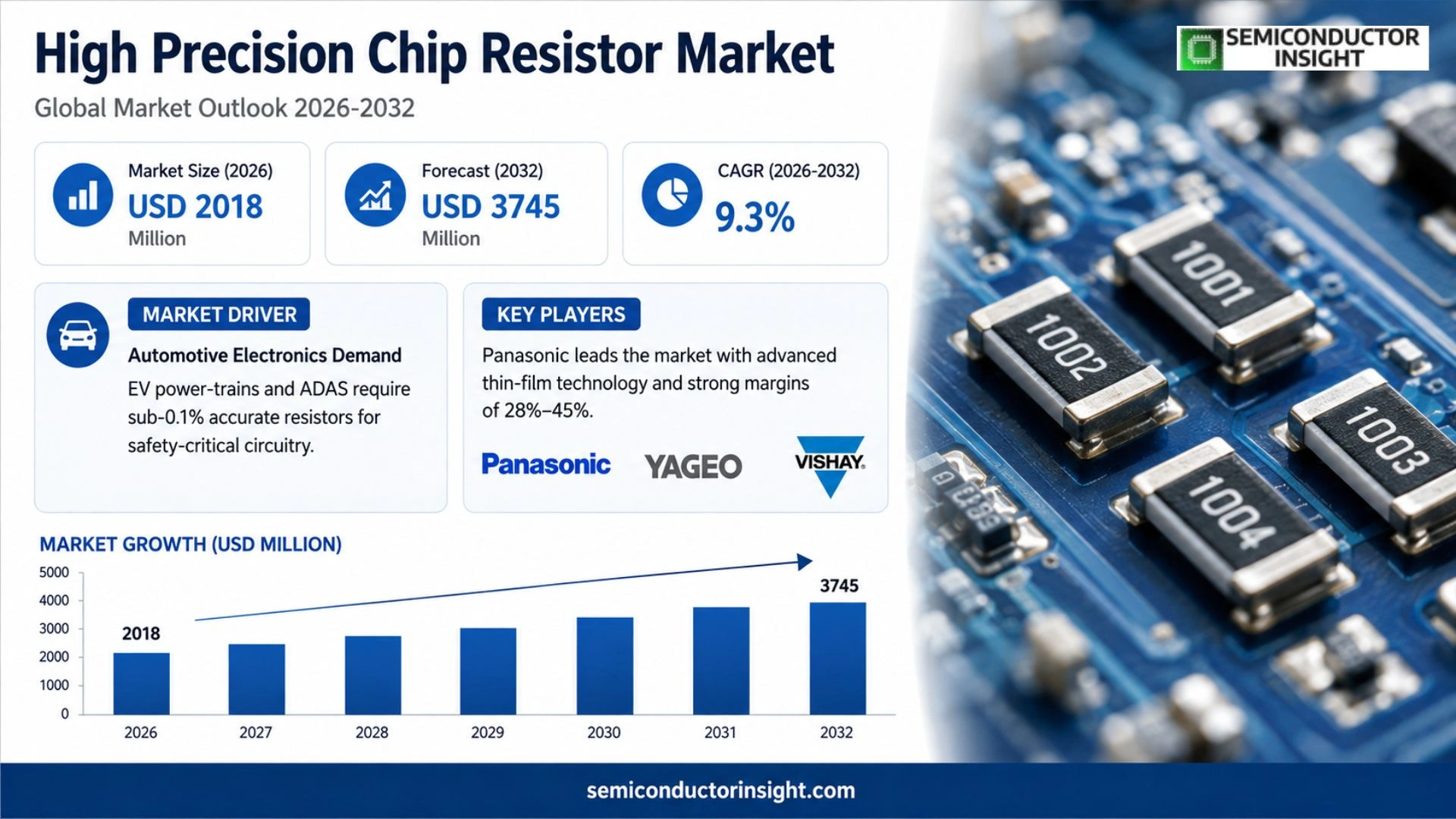
High Precision Chip Resistor market is projected to grow from USD 2018 million in 2026 to USD 3745 million by 2036, exhibiting a CAGR of 9.3% during the forecast period.
A High Precision Chip Resistor is a surface‑mount passive electronic component designed to provide highly accurate resistance values with tight tolerance and low temperature coefficient for precision electronic circuits.
The market is experiencing rapid growth due to several factors, including increased demand for automotive electrification, advanced driver assistance systems, and industrial sensing applications. Additionally, tighter accuracy requirements and higher reliability standards are driving adoption across telecommunications, medical devices, and instrumentation sectors. Initiatives by key players are also expected to fuel expansion; for instance, Panasonic announced a new thin‑film deposition line in March 2024, while Yageo launched an ultra‑low‑TCR product family targeting automotive OEMs. Other notable companies operating in this space include APC, Bourns, ROHM Semiconductor, Vishay Intertechnology, KOA Speer Electronics, Susumu, TT Electronics plc, Stackpole Electronics, Caddock Electronics, Walsin Technology Corporation, Murata Manufacturing, TDK Corporation and Kyocera AVX.
MARKET DRIVERS
Automotive Electronics Demand
The shift toward electric power‑train architectures and advanced driver‑assistance systems is forcing OEMs to adopt components with tighter tolerance and lower temperature coefficient. High Precision Chip Resistor Market suppliers that can guarantee sub‑0.1 % accuracy are gaining preference because any drift directly impacts safety‑critical circuitry.
Industrial Automation Expansion
Factories embracing Industry 4.0 are installing more sensors and control modules. These nodes require resistors that maintain performance under continuous high‑frequency switching. Vendors offering rugged, high‑stability designs are therefore seeing stronger order books.
➤ Manufacturers that integrate laser‑trimmed trimming processes improve yield while keeping cost per part competitive.
Beyond the two primary catalysts, the rise of renewable‑energy converters and telecom edge equipment adds layers of demand. Each segment prizes low‑noise, precision components, creating a diversified revenue base for participants in High Precision Chip Resistor Market.
MARKET CHALLENGES
Escalating Raw‑Material Costs
Nickel‑chromium and fine‑metal film compositions have experienced price volatility due to constrained mining outputs. The upward pressure squeezes margins for manufacturers that cannot renegotiate supplier contracts quickly.
Other Challenges
Regulatory Compliance Burden
Stringent electromagnetic‑interference (EMI) regulations in Europe and North America demand additional testing, extending time‑to‑market for new resistor families.
MARKET RESTRAINTS
Limited Differentiation Among Suppliers
Many producers rely on similar thin‑film technologies, making it difficult for end‑users to justify premium pricing. Without distinct performance metrics, contract negotiations often revert to price competition.
In addition, the long design cycles of aerospace and medical equipment lock in component selections years in advance, restricting the ability of newer entrants to capture market share quickly.
MARKET OPPORTUNITIES
Miniaturization of Portable Devices
Smart‑wearables and handheld medical diagnostics are trending toward footprints under 0.5 mm × 0.5 mm. Companies that can deliver high‑precision resistors at these scales stand to win sizeable design wins, especially where power‑consumption margins are razor‑thin.
Emerging Markets Adoption
Rapid infrastructure upgrades in Southeast Asia and Latin America are prompting local manufacturers to source domestically produced, high‑reliability components. Establishing production lines closer to these growth hubs can reduce lead times and mitigate tariff impacts, unlocking a new revenue corridor for High Precision Chip Resistor Market.
High Precision Chip Resistor Market Trends
Automotive Electrification Boosts High Precision Chip Resistor Market
The shift toward electric power‑train architectures and advanced driver‑assistance systems has raised the tolerance for resistance drift in automotive modules. Manufacturers now require resistors with tolerance tighter than ±0.01 % and temperature coefficients as low as ±5 ppm/°C to preserve sensor fidelity and power‑stage stability. In 2025 the average unit price hovered around US$0.085, while sales volume reached roughly 26 billion units, underscoring the scale of adoption. Thin‑film deposition coupled with laser trimming delivers the required precision, and firms that can guarantee consistent yield are securing long‑term supply contracts with tier‑one OEMs. The upstream supply chain,ceramic substrates, resistive films, and precious‑metal pastes,has become more integrated, reducing lead times and protecting margins that sit between 28 % and 45 %.
Other Trends
Industrial Automation and Sensing
Factory‑floor controllers and condition‑monitoring equipment increasingly rely on high‑precision resistors to maintain calibration across wide temperature ranges. The demand for devices rated at ±0.05 % tolerance and ±10 ppm/°C TCR has risen by an estimated 12 % annually, driven by the need for predictive maintenance analytics. Suppliers that invest in automated laser‑trimming stations can achieve tighter process control, translating into lower reject rates and improved gross margins. This segment also benefits from the broader push toward Industry 4.0, where data integrity is a prerequisite for real‑time decision making.
Supply‑Chain Resilience as a Competitive Lever
Recent disruptions in raw‑material logistics have prompted major players,Panasonic, Yageo, ROHM, Vishay,to diversify their upstream sources and stockpile critical inputs such as high‑purity metal pastes. By establishing regional buffer inventories, these firms reduce exposure to transportation bottlenecks and can offer customers more reliable lead‑time commitments. The strategic focus on supply‑chain robustness is reshaping pricing dynamics, as firms with stable pipelines can sustain margins even when commodity costs fluctuate. For downstream users in telecommunications and medical devices, predictable resistor availability translates into shorter product‑development cycles and faster time‑to‑market.
COMPETITIVE LANDSCAPE
Key Industry Players
High Precision Chip Resistor Market: Competitive Overview
Panasonic dominates the high‑precision chip resistor arena, leveraging its deep thin‑film deposition know‑how to sustain margins that hover between 28 % and 45 %. Its ability to lock in long‑term supply contracts with automotive OEMs and medical device makers creates a defensible market position, while its global production footprint balances cost efficiency with stringent quality controls. The firm’s focus on laser‑trim precision and automated testing translates into low failure rates, a decisive advantage for customers who cannot tolerate drift in resistance values. Consequently, Panasonic not only captures the bulk of revenue but also sets performance benchmarks that shape supplier expectations across the value chain.
Beyond the market leader, a cohort of specialized firms injects competitive tension by targeting niche tolerances or regional segments. Yageo and Vishay Intertechnology excel in offering ±0.01 % tolerance parts, catering to instrumentation and aerospace applications where thermal stability is paramount. Murata and TDK advance thin‑film materials that push temperature coefficients toward ±5 ppm/°C, appealing to advanced driver‑assistance systems. Smaller challengers such as KOA Speer, Susumu, and TT Electronics carve out steady share by providing customized packaging and rapid prototype cycles for industrial automation customers. The fragmented nature of these players fosters a landscape where innovation speed, yield consistency, and supply reliability become the primary differentiators.
List of Key High Precision Chip Resistor Companies Profiled
- Panasonic
- Yageo
- Vishay Intertechnology
- Murata Manufacturing
- TDK Corporation
- KOA Speer Electronics
- Susumu
- TT Electronics plc
- Stackpole Electronics
- Caddock Electronics
- Walsin Technology Corporation
- ROHM Semiconductor
- Kyocera AVX
- APC
- Bourns
Segment Analysis:
| Segment Category | Sub-Segments | Key Insights |
| By Type |
|
Thin Film
|
| By Application |
|
Automotive Electronics
|
| By End User |
|
Automotive OEMs
|
| By Temperature Coefficient |
|
±5 ppm/°C
|
| By Resistance Tolerance |
|
±0.01 %
|
Regional Analysis: High Precision Chip Resistor Market
Asia‑Pacific
Production facilities across the region have embraced wafer‑level processing that permits tighter resistance spreads. Foundries increasingly operate dual‑track lines,one dedicated to mass‑volume parts, another to bespoke, low‑volume high‑tolerance devices,allowing them to satisfy divergent customer needs without sacrificing yield.
Multi‑sourcing strategies anchored by regional logistics hubs reduce exposure to geopolitical shocks. Companies routinely maintain safety stocks in Singapore and Hong Kong, ensuring uninterrupted flow of raw materials such as thin‑film ceramics and high‑purity metal inks.
R&D centers are prioritising ultra‑low inductance geometries and temperature‑compensated alloys, driven by the rise of high‑frequency communication modules. Collaborative projects between universities and manufacturers accelerate concept validation, shortening time‑to‑market for next‑generation resistor families.
Harmonised standards from IEC and regional bodies streamline certification pathways. Governments in Japan and South Korea have introduced voluntary compliance programs that encourage manufacturers to exceed baseline tolerance specifications, reinforcing overall market quality.
North America
North America remains a critical arena for High Precision Chip Resistor Market, where demand is anchored by aerospace, defense, and data‑center infrastructure. End‑users require components that can endure rigorous thermal cycling and maintain stability under high‑frequency signalling, prompting tier‑one suppliers to differentiate through extended reliability testing. The region’s strong intellectual‑property framework encourages domestic firms to develop proprietary resistor geometries, adding a layer of competitive advantage that offsets higher labor costs. As 5G roll‑out accelerates, manufacturers are adapting their design libraries to accommodate tighter impedance budgets, reinforcing the strategic importance of this market segment for North American players.
Europe
European participants in High Precision Chip Resistor Market benefit from a legacy of stringent quality norms and a mature automotive supply chain. Regulations surrounding emissions and safety push automotive OEMs to adopt resistors with exceptionally low drift, driving suppliers to refine laser‑trimming processes. In addition, the continent’s emphasis on sustainability has spurred initiatives to reduce waste in resistor fabrication, prompting a shift toward recyclable substrate materials. Collaborative research programmes funded by the EU foster cross‑border innovation, allowing smaller firms to tap into shared testing facilities and accelerate product introductions across the region.
South America
South America is witnessing a gradual infusion of high‑precision resistors as renewable‑energy projects and telecom upgrades expand. Power‑grid modernisation efforts demand components that can operate reliably in harsh climatic conditions, leading local distributors to source parts with enhanced moisture resistance. While the market size remains modest, the region’s growing appetite for smart‑metering and IoT deployments creates a niche where specialised resistor portfolios can capture incremental value, particularly when paired with localized after‑sales support.
Middle East & Africa
In the Middle East & Africa, High Precision Chip Resistor Market is buoyed by oil‑field instrumentation and an emerging data‑centre ecosystem. Oil‑production facilities rely on precise resistive networks to monitor pressure and temperature, requiring components that can sustain prolonged exposure to corrosive environments. Meanwhile, new investments in cloud‑computing infrastructure across the Gulf states generate demand for high‑frequency, low‑noise resistors used in networking equipment. Regional distributors are therefore prioritising partnerships with manufacturers that can guarantee consistent tolerance performance while offering flexible logistics to navigate the area’s varied import regulations.
Report Scope
This market research report provides a comprehensive analysis of the High Precision Chip Resistor Market , covering the forecast period 2026–2034. It offers detailed insights into market dynamics, technological advancements, competitive landscape, and key trends shaping the industry.
Key focus areas of the report include:
- Market Overview: The report begins with an overview outlining its current market scenario, key growth indicators, and industry transformation drivers. It discusses macroeconomic factors, demand–supply balance, regulatory landscape, and the strategic role of semiconductors in powering advancements across industries such as automotive, telecommunications, consumer electronics, and industrial automation.
- Market Size & Forecast: Historical data and future projections for revenue, unit shipments, and market value across major regions and segments.
- Segmentation Analysis: Detailed breakdown by product type, technology, application, and end-user industry to identify high-growth segments and investment opportunities.
- Regional Insights: Insights into market performance across North America, Europe, Asia-Pacific, Latin America, and the Middle East & Africa, including country-level analysis where relevant.
- Competitive Landscape: Profiles of leading market participants, including their product offerings, R&D focus, manufacturing capacity, pricing strategies, and recent developments such as mergers, acquisitions, and partnerships.
- Technology Trends & Innovation: Assessment of emerging technologies, integration of AI/IoT, semiconductor design trends, fabrication techniques, and evolving industry standards.
- Market Drivers & Restraints: Evaluation of factors driving market growth along with challenges, supply chain constraints, regulatory issues, and market-entry barriers.
- Stakeholder Insights: Insights for component suppliers, OEMs, system integrators, investors, and policymakers regarding the evolving ecosystem and strategic opportunities.
Primary and secondary research methods are employed, including interviews with industry experts, data from verified sources, and real-time market intelligence to ensure the accuracy and reliability of the insights presented.
FREQUENTLY ASKED QUESTIONS:
What is the current market size of High Precision Chip Resistor Market?
-> High Precision Chip Resistor market is projected to grow from USD 2018 million in 2026 to USD 3745 million by 2034, exhibiting a CAGR of 9.3%
Which key companies operate in High Precision Chip Resistor Market?
-> Key players include Panasonic, APC, Bourns, ROHM Semiconductor, Yageo, Vishay Intertechnology, KOA Speer Electronics, Susumu, TT Electronics plc, Stackpole Electronics, Caddock Electronics, Walsin Technology Corporation, Murata Manufacturing, TDK Corporation, Kyocera AVX, among others.
What are the key growth drivers?
-> Key growth drivers include automotive electrification, advanced driver assistance systems (ADAS), and industrial sensing applications.
Which region dominates the market?
-> Asia dominates High Precision Chip Resistor market, with strong demand from China, Japan, and South Korea driven by automotive and consumer electronics growth.
What are the emerging trends?
-> Emerging trends include advancements in thin‑film deposition technology, tighter tolerance specifications (±0.01%), and increasing focus on long‑term supply consistency for critical applications.

Get Sample Report PDF for Exclusive Insights
Report Sample Includes
- Table of Contents
- List of Tables & Figures
- Charts, Research Methodology, and more...


