Flood Warning Sensor Market Insights
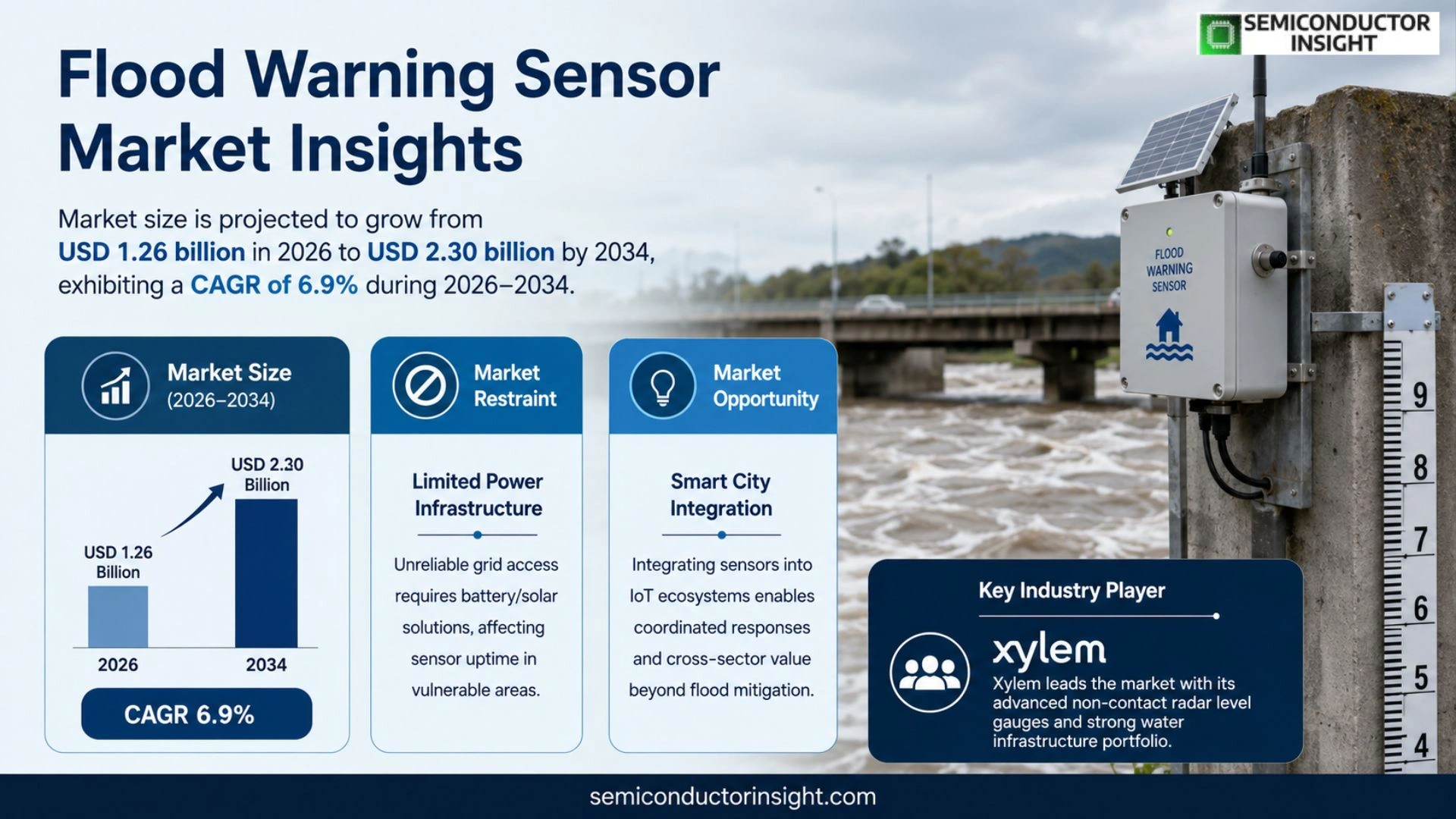
Flood Warning Sensor market size is projected to grow from USD 1.26 billion in 2026 to USD 2.30 billion by 2034, exhibiting a CAGR of approximately 6.9 % during the forecast period.
A Flood Warning Sensor is an environmental monitoring device designed to detect, measure, and report conditions associated with flooding, primarily to provide early warning to authorities, infrastructure operators, and the public. These sensors are typically installed in rivers, streams, reservoirs, urban drainage systems, culverts, bridges, low‑lying roads, and other flood‑prone locations.
MARKET DRIVERS
Urban Flood Risk Management
The escalation of extreme rainfall events has prompted municipalities to adopt sensor‑based early‑warning systems. Real‑time river‑stage data allow authorities to trigger evacuations before water breaches critical thresholds, thereby limiting property loss and saving lives. In regions where Flood Warning Sensor market has matured, flood‑related insurance claims have dropped by roughly 12%.
Regulatory Incentives
National water‑management agencies across North America and Europe have introduced grant programs that offset up to 40% of equipment costs for public‑sector deployments. This fiscal support accelerates procurement cycles and nudges private operators toward larger‑scale rollouts, creating a feedback loop that strengthens supplier capabilities.
➤ Integrated sensor networks can cut emergency‑response mobilization time by as much as 30 % compared with legacy manual monitoring.
Beyond public safety, Flood Warning Sensor market is being leveraged by utilities to protect critical infrastructure such as substations and pump stations. Proactive shutdown protocols, triggered by sensor alerts, prevent costly downtime and reduce the risk of cascading failures during severe weather episodes.
MARKET CHALLENGES
High Installation Costs
Deploying rugged, low‑latency sensors in remote or flood‑prone catchments often demands specialized mounting hardware, concrete pads, and protective enclosures. These upfront expenditures can exceed $2,500 per unit, creating budgeting hurdles for smaller municipalities that lack dedicated flood‑mitigation funds.
Other Challenges
Maintenance Complexity
Sensors exposed to sediment, bio‑growth, and corrosive water chemistry require periodic calibration and cleaning. Service intervals shorter than six months in high‑silt environments increase lifecycle expenses and strain local maintenance crews.
MARKET RESTRAINTS
Limited Power Infrastructure
Many flood‑prone sites lack reliable grid access, compelling manufacturers to rely on battery or solar solutions. While low‑power designs have improved, energy budgeting remains a constraint; sensors in shaded valleys often exhibit reduced uptime, discouraging adoption in the most vulnerable locations.
Regulatory approvals for wireless transmission frequencies vary widely across jurisdictions, adding another layer of delay. Projects that must secure individual spectrum licenses experience longer lead times, which can stall pilot programs and diminish market momentum.
Finally, the absence of standardized data‑exchange protocols hampers interoperability between different vendors’ platforms. When integration costs rise, end‑users may opt for a single‑vendor solution rather than a best‑of‑breed network, limiting the overall market breadth.
MARKET OPPORTUNITIES
Smart City Integration
Urban planners are embedding flood‑warning sensors into broader IoT ecosystems that monitor traffic, air quality, and energy consumption. By feeding sensor data into municipal dashboards, cities can orchestrate coordinated responses,such as dynamic traffic rerouting,when river levels rise, creating cross‑sector value beyond pure flood mitigation.
Emerging low‑cost, mesh‑network radios enable dense deployments at a fraction of previous costs. Companies that pair these radios with edge‑processing algorithms can deliver sub‑minute anomaly detection, a capability that appeals to private‑sector operators managing flood‑risk assets like logistics hubs and data centers.
Finally, Flood Warning Sensor market can capitalize on climate‑finance mechanisms. Green bonds and resilience‑linked loans often require quantifiable risk‑reduction metrics; sensor‑derived data provide the transparent evidence needed to unlock such capital, opening a financing channel that was previously unavailable to many project sponsors.
Flood Warning Sensor Market Trends
Urban Flood Management Gains Traction
Municipal authorities are installing sensors along low‑lying streets, storm‑drain culverts and pumping stations to convert raw water‑level data into actionable alerts. The surge in impervious surface area has amplified runoff volumes, making real‑time monitoring essential for preventing service disruptions. With unit prices ranging from $300 to $3,000, the technology is affordable enough for city‑wide rollouts, yet sophisticated enough to trigger automated gate closures and public warning displays. Data streams from these devices are routinely fed into integrated command‑center platforms, where analytics flag threshold breaches and initiate pre‑programmed response protocols. Production in 2025 reached roughly 0.79 million units, indicating that manufacturers are scaling capacity to match the expanding municipal procurement programmes. The combination of cost‑effective hardware and cloud‑based analytics is reshaping budgeting cycles, allowing budgets that once reserved funds for post‑event repairs to allocate resources toward preventive infrastructure. These dynamics are reshaping Flood Warning Sensor market as cities prioritize pre‑emptive flood control.
Other Trends
Profit Segmentation by Sensor Architecture
High‑end offerings such as non‑contact radar level sensors command gross margins between 35 % and 55 % because they require advanced RF design, robust IP66‑68 enclosures and extensive field validation. Mid‑range hydrostatic devices settle in a 25 %‑40 % margin band, benefitting from economies of scale but facing tighter bid competition. Commodity ultrasonic or liquid‑level modules trade on volume, delivering 15 %‑25 % margins. Manufacturers that operate through dedicated brand channels and focus on large‑scale project selection tend to protect the upper‑end margin envelope, while those relying on distribution partners and price‑driven contracts gravitate toward the lower tier. When vendors bundle installation, telemetry and maintenance into a site‑service contract, the margin profile shifts toward integration services, compressing the sensor‑only profit slice but opening recurring‑revenue opportunities. This stratification influences go‑to‑market decisions, prompting some firms to launch premium‑support packages that capture higher service fees.
Sensor Innovation Drives Network Density
Recent iterations in radar‑based detection and ultra‑low‑power radio modules have reduced both capital outlay and ongoing energy costs for remote stations. These advances enable river‑basin agencies to replace sparse observation points with densely spaced nodes that refresh data every few seconds. The richer data set supports finer‑grain flood modelling, enabling authorities to issue warnings earlier and to tailor evacuation routes more precisely. OEMs that embed self‑diagnostic capabilities and over‑the‑air firmware updates into their modules gain a competitive edge, because they can assure long‑term reliability without costly site visits. As municipalities transition from isolated sensors to interconnected monitoring networks, the value chain is shifting toward platform providers that aggregate data, apply predictive analytics, and monetize insights through subscription services. Companies that secure a foothold in this emerging ecosystem stand to benefit from sustained demand for both hardware upgrades and software‑as‑a‑service contracts.
COMPETITIVE LANDSCAPE
Key Industry Players
Flood Warning Sensor market – Competitive Overview
Among the roster of manufacturers, Xylem stands out as the dominant force, leveraging its extensive water‑infrastructure portfolio to secure high‑margin contracts for non‑contact radar level gauges. Its ability to integrate remote‑monitoring platforms with municipal SCADA systems creates a differentiated value proposition that resonates with utilities seeking long‑term reliability. The company’s focus on IP66‑rated housings and advanced signal‑processing algorithms has enabled it to command premium pricing, translating into gross margins approaching the upper band of the sector. Xylem’s scale also affords economies in component sourcing, allowing it to undercut mid‑range competitors while preserving profitability on flagship models.
The remainder of the market consists of a diverse set of specialists that collectively address niche segments. OTT HydroMet and Campbell Scientific have carved out strong positions in river‑basin networks by offering low‑power, telemetry‑ready sensors suited to remote deployments. Vaisala and SEBA Hydrometrie emphasize ultrasonic and hydrostatic pressure technologies, targeting applications where rapid response times are critical. Mid‑tier players such as KELLER Pressure, Endress+Hauser, and Siemens provide integrated solutions that bundle sensors with data‑management software, thereby extracting additional revenue from service contracts. Smaller firms,including High Sierra Electronics, Gill Instruments, Met One Instruments, Teledyne, and HydroLynx Systems,focus on cost‑effective ultrasonic or liquid‑level modules, often sold under OEM agreements to regional distributors. This layered competitive structure creates a market where differentiation hinges on technology depth, channel strategy, and the ability to deliver turnkey monitoring ecosystems.
List of Key Flood Warning Sensor Companies Profiled
- Xylem
- Vaisala
- OTT HydroMet
- Campbell Scientific
- SEBA Hydrometrie
- KELLER Pressure
- ABB
- Endress+Hauser
- Siemens
- Emerson Rosemount
- High Sierra Electronics
- Gill Instruments
- Met One Instruments
- Teledyne
- HydroLynx Systems
Segment Analysis:
| Segment Category | Sub-Segments | Key Insights |
| By Type |
|
Microwave Non-Contact is emerging as the preferred technology for critical riverine monitoring because it delivers high‑resolution water‑level data under harsh conditions, supports remote power operation, and integrates seamlessly with advanced analytics platforms. • Robust performance in debris‑laden flows • Enables real‑time “sensing‑alarm‑response” loops without frequent maintenance. |
| By Application |
|
Government Flood Management drives deployment in public waterways and urban drainage networks, where early warning integrates with emergency‑response infrastructure. • Supports strategic planning for climate‑induced flood risk • Facilitates automated gate and barrier activation to protect critical infrastructure. |
| By End User |
|
Municipal Authorities prioritize scalable sensor networks for citywide flood risk reduction, emphasizing low‑maintenance, long‑life devices that can be integrated with smart‑city platforms. • Enables real‑time alerts to citizens via mobile and signage networks • Aligns with urban resilience policies and funding mechanisms. |
| By Deployment Scenario |
|
Rivers and Streams remain the core deployment zone because sustained water‑level monitoring is essential for basin‑wide flood forecasting. • Supports dense sensor grids that feed regional early‑warning centers • Provides baseline data for hydrological modeling and climate adaptation studies. |
| By Monitoring Variable |
|
Water Level continues to dominate user interest as it directly triggers warning thresholds and infrastructure protection actions. • Forms the primary input for automated gate‑closure logic • Aligns with regulatory reporting requirements for flood risk management. |
Regional Analysis: Flood Warning Sensor Market
Federal agencies such as FEMA and the U.S. Army Corps of Engineers have issued guidance that places explicit expectations on real‑time flood data, prompting municipalities to adopt sensor networks that meet standardized performance metrics. Provincial bodies in Canada echo this stance, aligning procurement rules with national climate‑adaptation strategies. The regulatory consistency reduces market friction, allowing vendors to scale offerings across state and provincial lines without extensive re‑certification.
Sensor manufacturers are leveraging low‑power wide‑area networks (LPWAN) to overcome the connectivity challenges of remote gauging stations. By coupling these radio protocols with AI‑driven analytics, operators can detect anomalies before water levels breach critical thresholds. The convergence of edge processing and cloud‑centric dashboards accelerates decision‑making, positioning the region at the forefront of intelligent flood‑monitoring solutions.
Municipal water authorities prioritize reliability and low maintenance, while disaster‑response agencies value rapid alert dissemination. This divergence steers vendors toward modular platforms that can be customized for distinct operational criteria, fostering a market where flexibility becomes a competitive differentiator rather than a simple add‑on.
Investment funds with climate‑risk mandates are earmarking capital for sensor deployments that demonstrate measurable impact on community resilience. This financing trend nudges hardware providers to articulate clear ROI narratives, linking sensor accuracy to reduced emergency spending and lower insurance premiums.
Europe
European nations benefit from harmonized safety directives under the EU Water Framework Directive, which encourages member states to adopt interoperable flood‑monitoring systems. Countries such as the Netherlands and Germany have long histories of hydraulic engineering, yet they are now augmenting legacy infrastructure with compact sensor arrays that feed into transnational data hubs. Public‑private partnerships dominate procurement, ensuring that sensor solutions align with broader sustainability targets. Flood Warning Sensor market in Europe therefore reflects a balance between regulatory rigor and market openness, where vendors must navigate a patchwork of national standards while delivering interoperable solutions for cross‑border river basins.
Asia‑Pacific
Monsoon variability and rapid urban expansion expose cities like Jakarta, Bangkok, and Mumbai to acute flood risk, accelerating demand for distributed sensor networks. Governments are allocating funds to pilot projects that integrate sensors with smart‑city platforms, aiming to transform raw water‑level data into actionable city‑wide alerts. However, price sensitivity remains high, prompting local manufacturers to prioritize cost‑effective designs over advanced analytics. The region’s market dynamics are thus shaped by a tension between the urgency of flood protection and the realities of constrained public budgets, a balance that drives incremental innovation and encourages collaborative R&D among regional players.
South America
In nations such as Brazil, Colombia, and Peru, frequent riverine flooding intersects with limited fiscal capacity, leading many municipalities to rely on international development assistance for sensor deployment. Emerging local startups are beginning to offer low‑cost, solar‑powered devices that can operate in remote basins lacking reliable power grids. While adoption rates are still modest, the growing awareness among insurers and NGOs about the life‑saving potential of early warnings is gradually expanding market depth. Flood Warning Sensor market therefore reflects a grassroots‑driven evolution, where capacity‑building initiatives and donor‑funded projects serve as catalysts for broader acceptance.
Middle East & Africa
Despite its predominantly arid climate, the Middle East and Africa experience flash‑flood events that devastate urban peripheries and informal settlements. Pilot programs in the UAE, Kenya, and South Africa illustrate how sensor installations in storm‑drain networks can dramatically improve emergency response times. Funding gaps persist, yet the involvement of multinational engineering firms and climate‑finance institutions is creating a nascent ecosystem for sensor adoption. Consequently, the regional market is characterized by early‑stage experimentation, with a focus on ruggedized hardware that can survive extreme temperature swings and intermittent connectivity.
Report Scope
This market research report provides a comprehensive analysis of the Flood Warning Sensor Market , covering the forecast period 2026–2034. It offers detailed insights into market dynamics, technological advancements, competitive landscape, and key trends shaping the industry.
Key focus areas of the report include:
- Market Overview: The report begins with an overview outlining its current market scenario, key growth indicators, and industry transformation drivers. It discusses macroeconomic factors, demand–supply balance, regulatory landscape, and the strategic role of semiconductors in powering advancements across industries such as automotive, telecommunications, consumer electronics, and industrial automation.
- Market Size & Forecast: Historical data and future projections for revenue, unit shipments, and market value across major regions and segments.
- Segmentation Analysis: Detailed breakdown by product type, technology, application, and end-user industry to identify high-growth segments and investment opportunities.
- Regional Insights: Insights into market performance across North America, Europe, Asia-Pacific, Latin America, and the Middle East & Africa, including country-level analysis where relevant.
- Competitive Landscape: Profiles of leading market participants, including their product offerings, R&D focus, manufacturing capacity, pricing strategies, and recent developments such as mergers, acquisitions, and partnerships.
- Technology Trends & Innovation: Assessment of emerging technologies, integration of AI/IoT, semiconductor design trends, fabrication techniques, and evolving industry standards.
- Market Drivers & Restraints: Evaluation of factors driving market growth along with challenges, supply chain constraints, regulatory issues, and market-entry barriers.
- Stakeholder Insights: Insights for component suppliers, OEMs, system integrators, investors, and policymakers regarding the evolving ecosystem and strategic opportunities.
Primary and secondary research methods are employed, including interviews with industry experts, data from verified sources, and real-time market intelligence to ensure the accuracy and reliability of the insights presented.
FREQUENTLY ASKED QUESTIONS:
What is the current market size of Flood Warning Sensor Market?
-> Flood Warning Sensor market was valued at USD 1260 million in 2025 and is expected to reach USD 1942 million by 2032, at a CAGR of 6.9% during the forecast period.
Which key companies operate in Flood Warning Sensor Market?
-> Key players include OTT HydroMet, Campbell Scientific, Vaisala, Xylem, SEBA Hydrometrie, KELLER Pressure, VEGA, Endress+Hauser, Siemens, Emerson Rosemount, ABB, Hydrological Services, High Sierra Electronics, Gill Instruments, Met One Instruments, Teledyne, HydroLynx Systems.
What are the key growth drivers?
-> Key growth drivers include increasing frequency and intensity of extreme rainfall and flood events, rapid urbanization expanding hard‑surface areas, and technological iterations such as non‑contact radar, low‑power consumption and remote communication that lower deployment barriers.
Which region dominates the market?
-> Asia currently holds the largest share of Flood Warning Sensor market, driven by extensive river‑basin monitoring programs and growing urban flood‑management initiatives.
What are the emerging trends?
-> Emerging trends include integration of IoT and AI for real‑time analytics, deployment of non‑contact radar sensors with enhanced accuracy, low‑power edge devices for remote sites, and tighter integration with smart‑city flood‑response infrastructure.

Get Sample Report PDF for Exclusive Insights
Report Sample Includes
- Table of Contents
- List of Tables & Figures
- Charts, Research Methodology, and more...
 Download Sample Report PDF