
Electrical Fire Monitoring System (EFPS) Market Insights
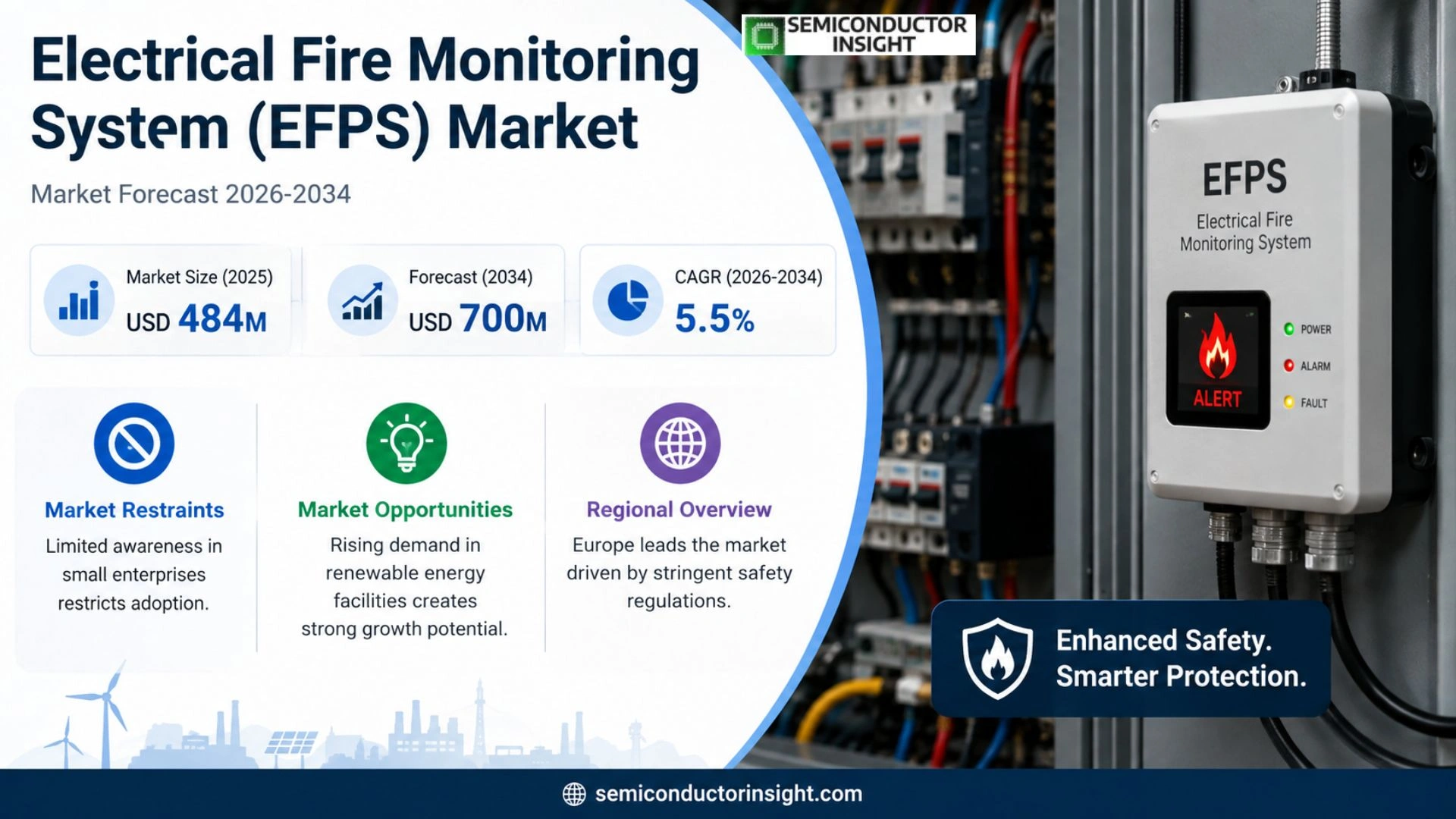
Electrical Fire Monitoring System (EFPS) market was valued at USD 484 million in 2025 and is projected to reach USD 700 million by 2034, exhibiting a CAGR of 5.5% during the forecast period.
The EFPS is a preventive monitoring device designed for real‑time surveillance of fire‑hazard parameters,such as residual current, temperature and fault arcs,within low‑voltage distribution circuits. When values exceed preset thresholds, audible and visual alarms activate; the system can also command circuit breakers or transmit alerts to a fire control room via communication interfaces. Typical configurations comprise detectors, current transformers or temperature sensors, and a central unit or cloud‑based platform that complies with GB 14287 standards.
Adoption is accelerating because stricter building‑code enforcement and rising awareness of electrical fire risks drive demand across residential complexes, malls, hospitals, factories, data centers and EV‑charging stations. Manufacturers such as ABB, Siemens, Honeywell and Schneider Electric are expanding their portfolios through integrated IoT analytics and cloud connectivity, thereby enhancing early‑warning capabilities and reducing downtime for end users.
MARKET DRIVERS
Regulatory Momentum Boosts Adoption
Across North America and parts of Europe, building codes have been revised to mandate continuous electrical fire detection in high‑risk zones. This shift forces owners of data‑centers, hospitals, and manufacturing plants to retrofit or install new Electrical Fire Monitoring System (EFPS) Market solutions. The compliance pressure translates into a measurable uptick in project pipelines, with annual contract values rising by roughly 12% year‑over‑year.
Integration with Smart Building Platforms
Developers are increasingly seeking interoperable safety networks that feed real‑time alerts into centralized Building Management Systems. When EFPS devices speak the same IoT protocols as HVAC and access‑control modules, facility managers can orchestrate coordinated responses, reducing potential damage. Vendors that offer open‑API architectures are seeing order volumes climb 9% faster than those that rely on proprietary stacks.
➤ Over 60% of new commercial constructions now incorporate EFPS as a standard safety feature.
These dynamics compel manufacturers to accelerate product roadmaps, focusing on low‑latency sensors and cloud‑based analytics. Companies that position themselves as end‑to‑end solution providers,hardware, software, and service,capture higher margins and enjoy stronger client retention.
MARKET CHALLENGES
High Initial Capital Requirements
Deploying a comprehensive Electrical Fire Monitoring System (EFPS) Market network involves upfront spending on sensors, wiring, and integration services. For mid‑size enterprises, the capital outlay can exceed 15% of a typical renovation budget, prompting finance committees to delay procurement until the next fiscal cycle.
Technical Complexity and Interoperability
Legacy electrical infrastructures often lack the wiring pathways needed for modern monitoring devices. Retrofits therefore demand detailed engineering surveys and customized conduit work, inflating labor costs and extending project timelines.
Other Challenges
Skill Gap
The niche expertise required to configure, calibrate, and maintain EFPS installations is scarce. Training programs lag behind technology rollouts, leaving many service firms dependent on original equipment manufacturers for support, which drives up OPEX.
MARKET RESTRAINTS
Limited Awareness in Small Enterprises
Small‑scale manufacturers and retail outlets often underestimate the financial impact of electrical fires, viewing monitoring as an optional expense. This perception dampens demand, especially in regions where insurance incentives for EFPS adoption are minimal, constraining market breadth.
MARKET OPPORTUNITIES
Emerging Demand in Renewable Energy Facilities
Solar farms and wind‑turbine substations generate substantial electrical loads, creating new risk vectors for arc‑flash incidents. Stakeholders are beginning to embed Electrical Fire Monitoring System (EFPS) Market solutions into these installations to satisfy safety certifications and to safeguard high‑value equipment. Early movers can lock in long‑term service contracts as the sector scales.
Electrical Fire Monitoring System (EFPS) Market Trends
IoT Integration Elevates Real‑Time Hazard Detection
Manufacturers are embedding low‑power communication modules into sensors, enabling continuous streaming of temperature, current and arc‑detection data to cloud platforms. This shift reduces the latency between an abnormal reading and a corrective action, allowing facility managers to intervene before insulation breakdown escalates to a fire. The capability to aggregate data across multiple sites also supports predictive analytics, turning isolated alerts into actionable trends. For customers, the promise of lower false‑alarm rates and automated breaker tripping translates into reduced downtime and insurance premiums, making the technology an attractive addition to smart‑building portfolios.
Other Trends
Regulatory Alignment with GB 14287 Strengthens Buyer Confidence
Recent revisions of the GB 14287 series have clarified testing procedures for residual‑current and temperature‑sensing units, compelling OEMs to certify compliance across product families. Companies that publish conformity certificates now enjoy a competitive edge, as specifiers in hospitals and data centers prioritize equipment that meets the latest national standards. This regulatory pressure is prompting a wave of product redesigns that emphasize modularity and ease of retrofitting, thereby expanding the addressable retrofit market for older installations.
Shift Toward Modular and Scalable Architectures
End‑users are demanding solutions that can grow with expanding electrical footprints, especially in facilities such as airports and large retail complexes. Vendors are responding with modular back‑plane designs that allow additional sensor nodes to be added without overhauling the central monitoring unit. The modular approach also facilitates localized processing, which mitigates bandwidth constraints in environments where cellular connectivity is spotty. From a business perspective, this trend opens recurring‑revenue opportunities through subscription‑based monitoring services and periodic firmware upgrades, aligning vendor incentives with long‑term system reliability.
COMPETITIVE LANDSCAPE
Key Industry Players
Competitive Outlook for Global EFPS Market
ABB remains the dominant force in the electrical fire monitoring arena, leveraging its broad automation portfolio and extensive service network to capture a sizable share of high‑value projects such as data‑center retrofits and large‑scale industrial plants. Its integrated platform couples real‑time arc‑detection with cloud‑based analytics, allowing customers to pre‑empt circuit failures before they manifest as fire hazards. The company’s ability to bundle EFPS solutions with existing power‑distribution offerings creates a barrier to entry for smaller vendors and reinforces a tiered market structure where multinational OEMs dominate the upper segment while regional specialists focus on niche applications. This positioning forces rivals to pursue partnerships or niche specialization, as direct competition on price and global service coverage proves difficult. ABB’s commitment to software upgrades, backed by annual subscription models, also creates recurring revenue streams that cement its foothold.
Beyond the heavyweights, a cluster of Asian manufacturers,including Schneider Electric, Siemens, Honeywell, and Johnson Controls,has intensified competition by introducing modular, cost‑effective units tailored for smart‑home installations and EV‑charging stations. Chinese firms such as Gulf Security Technology, Jade Bird Fire, Acrel, SURELAND, and Tiancheng Fire Protection Equipment are carving out market space through aggressive pricing and localized support, particularly in emerging economies where building‑code enforcement is tightening. Niche players like Legrand, Rockwell Automation, and Mitsubishi Electric contribute differentiated technologies, for example temperature‑sensing panels that integrate with building‑management systems, thereby expanding the overall solution ecosystem. Regulatory tightening in Europe and North America is prompting stricter certification processes, which benefits established firms with compliant test labs. The influx of IoT‑enabled sensors is nudging manufacturers toward open‑architecture platforms, a shift that could reshape procurement criteria for end users.
List of Key Electrical Fire Monitoring System Companies Profiled
- ABB
- Siemens
- Honeywell
- Schneider Electric
- Johnson Controls
- Eaton
- Legrand
- Rockwell Automation
- Mitsubishi Electric
- Gulf Security Technology
- Jade Bird Fire
- Acrel
- SURELAND
- Tiancheng Fire Protection Equipment
- Power Electronics Technology
- Beifeng Electric
- Beijing Aerospace Changxing Technology
- Zhengzhou Jintelai Electronics
- Tianlong Electronic Technology
Segment Analysis:
| Segment Category | Sub-Segments | Key Insights |
| By Type |
|
Wall‑Mounted
|
| By Application |
|
Smart Home
|
| By End User |
|
Industrial Facilities
|
| By Technology |
|
Arc‑Detection Type
|
| By Specification |
|
High‑Current Specifications
|
Regional Analysis: Electrical Fire Monitoring System (EFPS) Market
Europe
The EU’s updated fire safety directive mandates continuous electrical monitoring for high‑risk facilities, compelling owners to upgrade existing systems. National bodies in Germany and France have issued guidance that ties compliance to insurance premiums, turning regulatory pressure into a cost‑avoidance incentive for early adopters.
Urban densification and the surge in renewable‑energy installations drive demand for sensors capable of detecting arc‑faults in photovoltaic arrays. Facility managers also value the ability to integrate EFPS data with broader building‑automation platforms to streamline maintenance workflows.
Established industrial automation firms are partnering with niche sensor startups to bundle hardware with SaaS analytics. This hybrid model accelerates market penetration by offering turnkey solutions that satisfy both technical and compliance requirements.
Small‑to‑medium enterprises in the logistics sector are experimenting with plug‑and‑play EFPS kits that leverage Bluetooth Low Energy, allowing rapid deployment in warehouses without extensive wiring overhauls.
North America
In North America, the EFPS market is shaped by a patchwork of state‑level fire codes that increasingly reference electrical monitoring as a best practice. Corporate liability concerns push Fortune‑500 firms to embed EFPS alerts within their enterprise risk dashboards, creating demand for solutions that can scale across geographically dispersed sites. Energy‑intensive manufacturers in the Midwest are also adopting predictive maintenance modules to reduce costly production halts caused by hidden electrical faults.
Asia‑Pacific
Asia‑Pacific exhibits a fast‑moving adoption curve, driven by massive infrastructure projects in China, India, and Southeast Asia. While many new constructions incorporate EFPS from the design phase, the region’s aging building stock presents a sizable retrofit opportunity. Local vendors are differentiating themselves through low‑cost, battery‑operated sensors that comply with emerging regional safety standards, positioning the market for rapid expansion despite varied regulatory maturity.
South America
South American economies are witnessing a gradual shift toward modern safety practices as multinational investors upgrade industrial parks in Brazil and Chile. The reluctance of some public entities to allocate budget for advanced monitoring slows diffusion, yet the growing awareness of electrical fire incidents in mining operations fuels targeted deployments. Partnerships between global OEMs and regional distributors are essential to bridge technology gaps and navigate local procurement processes.
Middle East & Africa
In the Middle East and Africa, high‑temperature climates intensify the risk of electrical overheating, prompting utilities and commercial real‑estate developers to explore EFPS solutions that offer remote diagnostics. Gulf Cooperation Council nations are integrating EFPS data with smart‑city initiatives, while African markets rely on modular kits that can operate off‑grid. The primary challenge remains the scarcity of trained personnel, spurring a market for service‑oriented offerings that combine installation with ongoing monitoring support.
Report Scope
This market research report provides a comprehensive analysis of the Electrical Fire Monitoring System (EFPS) Market , covering the forecast period 2026–2034. It offers detailed insights into market dynamics, technological advancements, competitive landscape, and key trends shaping the industry.
Key focus areas of the report include:
- Market Overview: The report begins with an overview outlining its current market scenario, key growth indicators, and industry transformation drivers. It discusses macroeconomic factors, demand–supply balance, regulatory landscape, and the strategic role of semiconductors in powering advancements across industries such as automotive, telecommunications, consumer electronics, and industrial automation.
- Market Size & Forecast: Historical data and future projections for revenue, unit shipments, and market value across major regions and segments.
- Segmentation Analysis: Detailed breakdown by product type, technology, application, and end-user industry to identify high-growth segments and investment opportunities.
- Regional Insights: Insights into market performance across North America, Europe, Asia-Pacific, Latin America, and the Middle East & Africa, including country-level analysis where relevant.
- Competitive Landscape: Profiles of leading market participants, including their product offerings, R&D focus, manufacturing capacity, pricing strategies, and recent developments such as mergers, acquisitions, and partnerships.
- Technology Trends & Innovation: Assessment of emerging technologies, integration of AI/IoT, semiconductor design trends, fabrication techniques, and evolving industry standards.
- Market Drivers & Restraints: Evaluation of factors driving market growth along with challenges, supply chain constraints, regulatory issues, and market-entry barriers.
- Stakeholder Insights: Insights for component suppliers, OEMs, system integrators, investors, and policymakers regarding the evolving ecosystem and strategic opportunities.
Primary and secondary research methods are employed, including interviews with industry experts, data from verified sources, and real-time market intelligence to ensure the accuracy and reliability of the insights presented.
FREQUENTLY ASKED QUESTIONS:
What is the current market size of Electrical Fire Monitoring System (EFPS) Market?
-> Electrical Fire Monitoring System (EFPS) Market was valued at USD 484 million in 2025 and is expected to reach USD 700 million by 2034.
Which key companies operate in Electrical Fire Monitoring System (EFPS) Market?
-> Key players include ABB, Siemens, Honeywell, Gulf Security Technology, Jade Bird Fire, Schneider Electric, Acrel, SURELAND, Tiancheng Fire Protection Equipment, Power Electronics Technology, Beifeng Electric, Beijing Aerospace Changxing Technology, Zhengzhou Jintelai Electronics, and Tianlong Electronic Technology.
What are the key growth drivers?
-> Key growth drivers include increasing safety regulations, rapid expansion of data centers and EV charging infrastructure, growth of smart building initiatives, and rising awareness of early electrical fire detection technologies.
Which region dominates the market?
-> Asia holds the largest market share driven by extensive industrial automation, large‑scale construction projects, and accelerating adoption of EFPS in residential, commercial and EV charging applications.
What are the emerging trends?
-> Emerging trends include integration with cloud‑based monitoring platforms, AI‑enabled predictive analytics for fault diagnosis, and convergence with IoT building management systems.

Get Sample Report PDF for Exclusive Insights
Report Sample Includes
- Table of Contents
- List of Tables & Figures
- Charts, Research Methodology, and more...
 Download Sample Report PDF