Draw-Wire Displacement Sensors Market Insights
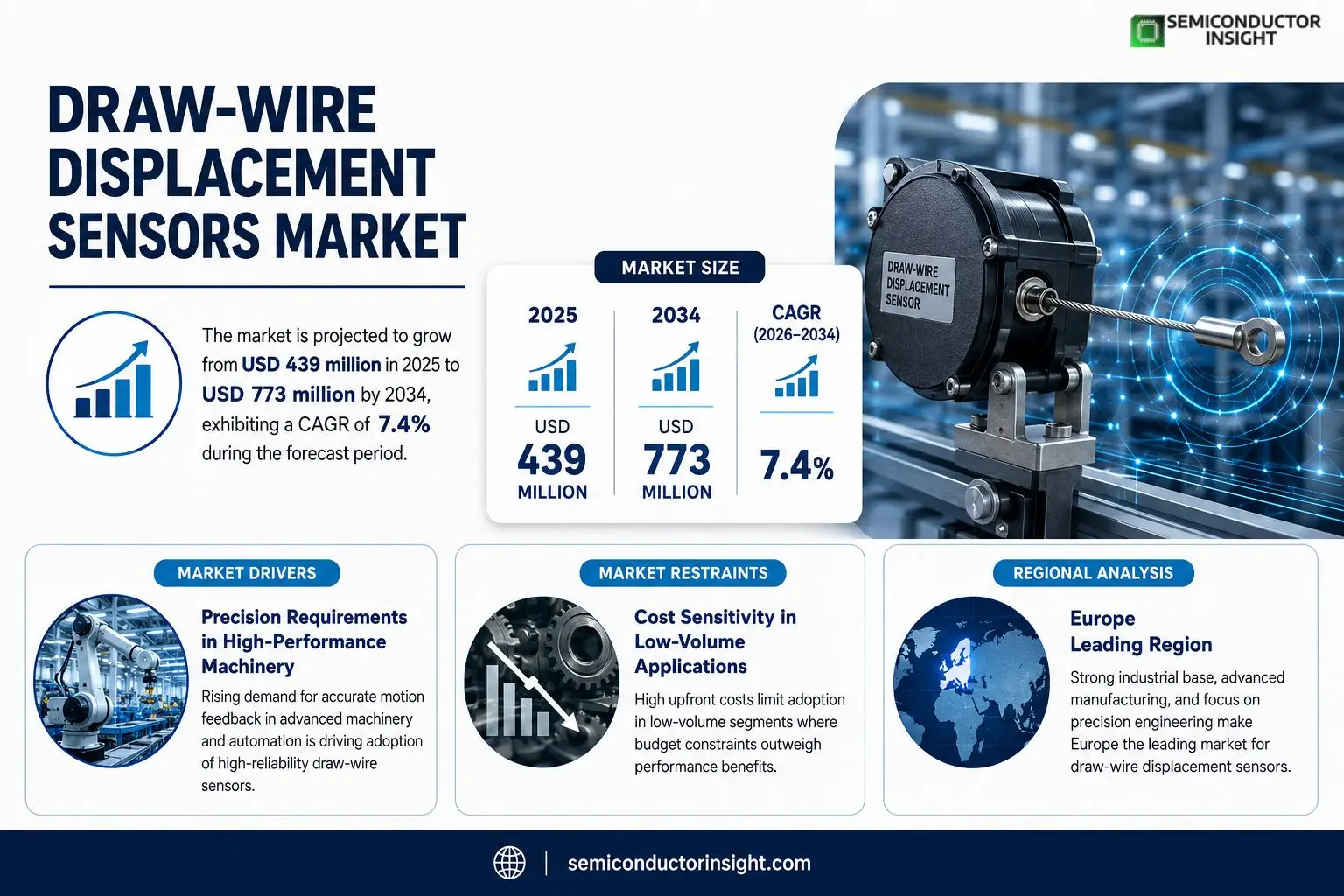
Draw‑Wire Displacement Sensors market was valued at USD 439 million in 2025 and is expected to reach USD 773 million by 2034, reflecting a CAGR of 7.4% over the forecast period.
A Draw‑Wire Displacement Sensor is a linear position measurement device that converts the linear motion of a flexible steel cable into an electrical signal proportional to displacement. It comprises a spring‑loaded retractable wire wound on a drum coupled to a precision rotary sensing element such as an encoder or potentiometer; as the wire extends or retracts, the drum rotation generates an electrical output that mirrors cable travel. The sensors are compact, rugged, and suited for long‑travel measurement in harsh industrial environments, offering analog or digital interfaces for seamless integration into automated systems.The expansion of smart manufacturing, widespread automation of equipment, and ongoing industrial digitalisation are fueling demand for high‑reliability, high‑precision linear measurement devices. Draw‑Wire sensors are gaining traction in heavy machinery, logistics automation, energy monitoring, and infrastructure health projects because of their durability and cost‑effectiveness. However, pressure from emerging technologies such as laser distance meters and optical encoders requires continuous R&D investment; supply‑chain volatility for precision components adds cost uncertainty; and stricter safety certifications raise entry barriers for new entrants.
MARKET DRIVERS
Precision Requirements in High‑Performance Machinery
Manufacturers of CNC equipment, aerospace actuators, and robotics are raising tolerances to sub‑micron levels. Draw-Wire Displacement Sensors Market benefits because these sensors translate linear motion into electrical signals with minimal hysteresis, satisfying the tighter specifications demanded by next‑generation platforms. Clients are willing to allocate premium budgets to devices that guarantee repeatable positioning, reinforcing a shift toward higher‑price, higher‑value sensor solutions.
Shift Toward Closed‑Loop Control Architectures
Industrial automation plants are increasingly adopting closed‑loop feedback loops to reduce cycle time and energy consumption. Draw‑wire sensors, with their linear output and resistance to electromagnetic interference, fit naturally into these architectures. Their ability to deliver real‑time displacement data enables control algorithms to fine‑tune motion profiles, translating into cost savings on wear parts and lower scrap rates for manufacturers.
➤ “Operators report up to a 15% reduction in downtime after integrating draw‑wire displacement sensors into key process stations.”
Regional investments in smart‑factory initiatives, especially in Germany and Japan, are accelerating adoption. When procurement teams prioritize reliability over raw speed, draw‑wire technology emerges as the preferred choice, reinforcing the upward trajectory of the market segment.
MARKET CHALLENGES
Integration Complexity with Legacy Systems
Many facilities still run on analog control hardware that lacks standardized interfaces for modern displacement sensors. Retrofitting draw‑wire units often requires additional signal conditioning modules, inflating installation costs and extending project timelines. This friction slows the rate at which new purchases replace older potentiometric devices.
Other Challenges
Supply‑Chain Volatility
Fluctuations in specialty wire alloys and precision machining capacity can create lead‑time spikes. When component availability contracts, OEMs may be forced to source from higher‑cost suppliers, narrowing margin windows for end users.
MARKET RESTRAINTS
Cost Sensitivity in Low‑Volume Applications
For niche markets such as laboratory instrumentation or small‑batch medical device assembly, the upfront expense of draw‑wire sensors can outweigh the performance benefit. Buyers in these segments often opt for lower‑cost alternatives, limiting market penetration where volume economies of scale are absent.
MARKET OPPORTUNITIES
Emerging Demand in Renewable Energy Infrastructure
Wind turbine pitch control and solar tracker alignment rely on precise linear positioning under harsh environmental conditions. Draw‑wire displacement sensors, with their resistance to temperature extremes and dust ingress, are being evaluated as viable replacements for traditional LVDTs, opening a growth corridor for suppliers willing to certify their products for energy‑sector certifications.
Draw-Wire Displacement Sensors Market Trends
Smart‑Manufacturing Momentum Boosts Sensor Adoption
Draw-Wire Displacement Sensors Market is feeling the ripple effect of factories that are embedding connectivity into every production line. As manufacturers replace legacy mechanical controls with network‑ready equipment, the need for linear position feedback that can survive dust, vibration and temperature swings grows sharply. Draw‑wire sensors answer that demand thanks to their long‑travel capability, rugged construction and the ease of swapping analog or digital outputs into PLCs and edge controllers. The shift toward predictive maintenance also reshapes the value proposition: reliable displacement data feeds algorithms that anticipate wear before a breakdown occurs, translating into measurable uptime gains. Consequently, system integrators are specifying draw‑wire units as the backbone of motion‑control loops in robotics, automated guided vehicles and high‑speed conveyors, where precision and low‑maintenance characteristics are non‑negotiable.
Other Trends
Supply‑Chain Pressures and Technological Competition
While demand accelerates, manufacturers of draw‑wire devices confront tighter raw‑material lead times and rising costs for precision gears and sensing elements. The volatility forces many firms to reassess inventory strategies and to secure second‑source agreements for critical components. At the same time, emerging measurement technologieslaser rangefinders, optical encoders and magnetic scalesare eroding the traditional comfort zone of draw‑wire solutions. To stay relevant, suppliers are investing in higher resolution encoders, digital communication stacks such as Industry 4.0‑compatible bus protocols, and noise‑immunity enhancements. Those who fail to evolve risk losing market share to more technologically aggressive rivals, especially in sectors where accuracy tolerances are tightening.
Expansion into Smart Infrastructure and Data Services
Beyond classic factory floors, Draw-Wire Displacement Sensors Market is branching into city‑scale projects and energy networks. Intelligent transportation systems, bridge health monitoring and utility grid supervision require sensors that can deliver continuous, long‑range displacement readings while withstanding harsh outdoor conditions. Vendors are packaging draw‑wire heads with remote telemetry modules, allowing data to flow into cloud‑based analytics platforms. This trend nudges the industry from pure hardware providers toward hybrid offerings that blend sensor hardware, data aggregation services and condition‑monitoring dashboards. Companies that can orchestrate end‑to‑end solutions stand to capture new revenue streams as municipalities and utility operators prioritize resilient, data‑driven infrastructure.
COMPETITIVE LANDSCAPE
Key Industry Players
Draw‑Wire Displacement Sensors: Competitive Overview
The market is dominated by a few multinational corporations that command the bulk of revenue. TE Connectivity, SICK and Baumer each operate extensive sales networks and invest heavily in integrating digital interfaces such as Ethernet/IP and Modbus into their draw‑wire lines, allowing them to serve OEMs in aerospace, heavy equipment and smart‑factory projects. Their scale grants access to premium raw‑material supplies and the ability to absorb cost fluctuations in precision encoder components. This concentration creates a high entry barrier for newcomers, while also prompting incumbent firms to differentiate through application‑specific firmware and long‑term service contracts.Beyond the tier‑one group, a cohort of specialist manufacturers addresses niche segments where customization and regional support are decisive. Companies such as FIAYE, AK Industries, ASM Sensor, ATEK Sensor Technologies, Firstmark Controls, FUTEK, Micro‑Epsilon, POSITAL, Sensata, SIKO, WayCon, MIRAN and OidEncoder focus on sectors like rail logistics, bridge monitoring and portable inspection rigs. Their product portfolios often emphasize rugged housings, battery‑operated designs or proprietary communication protocols that larger players may not prioritize. This diversity sustains a vibrant ecosystem, enabling end‑users to select solutions aligned with specific environmental or regulatory constraints.
List of Key Draw‑Wire Displacement Sensors Companies Profiled
- TE Connectivity
- SICK
- Baumer
- FIAYE
- AK Industries
- ASM Sensor
- ATEK Sensor Technologies
- Firstmark Controls
- FUTEK
- Micro‑Epsilon
- POSITAL
- Sensata
- SIKO
- WayCon
- MIRAN
- OidEncoder
Segment Analysis:
| Segment Category | Sub-Segments | Key Insights |
| By Type |
|
Mechanical Potentiometric
|
| By Application |
|
Smart Manufacturing
|
| By End User |
|
Industrial Automation
|
| By Technology Trend |
|
Integrated IoT Connectivity
|
| By Market Driver |
|
Smart City Initiatives
|
Regional Analysis: Draw-Wire Displacement Sensors Market
Europe
Leading car manufacturers leverage draw‑wire displacement sensors for chassis calibrations and electronic steering feedback. The push toward higher safety ratings forces deeper integration of precise motion monitoring, prompting suppliers to tailor sensor packages that survive harsh vibration while delivering sub‑micron accuracy. This creates a niche where engineering differentiation translates directly into brand reputation on the road.
Aircraft control surfaces and missile guidance systems demand uncompromising reliability, a hallmark of draw‑wire technology. European defense contractors value the sensor’s linearity across temperature extremes, reinforcing procurement cycles that favor long‑term contracts and rigorous testing regimes. This sector’s procurement cadence sustains a steady flow of specialized sensor variants.
Precision CNC machines and automated assembly lines depend on real‑time position feedback. Draw‑wire displacement sensors feed high‑resolution data to motion controllers, allowing tighter tolerances and reduced scrap rates. Manufacturers in Italy and the UK are customizing sensor housings to fit legacy equipment, extending the useful life of existing production assets.
In minimally invasive surgical tools, the ability to track micro‑movements translates into improved patient outcomes. European med‑tech firms collaborate closely with sensor makers to embed draw‑wire modules within robotic assistants, emphasizing biocompatibility and sterilization resilience as core design drivers.
North America
The North American segment of Draw-Wire Displacement Sensors Market reflects a blend of deep‑tech investment and a consumer‑driven approach to automation. U.S. manufacturers prioritize rapid prototyping, which fuels demand for sensors that can be quickly re‑configured across multiple product lines. Meanwhile, Canadian enterprises focus on integrating draw‑wire sensors into renewable‑energy equipment, where precise blade‑angle monitoring improves turbine efficiency. The region’s venture‑capital ecosystem supports niche startups developing wireless readout solutions, subtly reshaping the traditional wired architecture without sacrificing measurement fidelity.
Asia‑Pacific
Asia‑Pacific exhibits a fast‑evolving landscape where draw‑wire displacement sensors are increasingly embedded in emerging smart‑factory initiatives. China’s expansive manufacturing base seeks cost‑effective sensor designs that retain critical accuracy for high‑volume production lines. Japan’s robotics industry, long a pioneer in precision motion control, continues to demand customized sensor geometries to meet the exacting standards of collaborative robots. In India, the push toward localized component sourcing is encouraging domestic firms to develop in‑house capabilities, reducing dependence on imported sensor modules and fostering a more resilient supply chain.
South America
South American players are capitalizing on growing infrastructure projects, particularly in Brazil and Chile, where draw‑wire displacement sensors support heavy‑equipment monitoring for mining and hydro‑electric installations. The region’s emphasis on extending equipment lifespan drives interest in retrofitting legacy machinery with modern sensor kits. Local distributors are also adapting to fluctuating currency conditions by offering flexible financing models that lower the upfront cost barrier for mid‑size manufacturers seeking precision monitoring solutions.
Middle East & Africa
In the Middle East & Africa, Draw-Wire Displacement Sensors Market is shaped by large‑scale oil‑and‑gas operations and ambitious renewable‑energy programs. Gulf states are integrating draw‑wire sensors into pipeline integrity systems, where accurate displacement data helps pre‑empt leaks under extreme temperature swings. Meanwhile, South Africa’s growing industrial automation sector is experimenting with sensor‑driven predictive maintenance to reduce unplanned downtime in mining equipment, fostering a nascent ecosystem of local integrators and service providers.
Report Scope
This market research report provides a comprehensive analysis of the Draw-Wire Displacement Sensors Market , covering the forecast period 2026–2034. It offers detailed insights into market dynamics, technological advancements, competitive landscape, and key trends shaping the industry.
Key focus areas of the report include:
- Market Overview: The report begins with an overview outlining its current market scenario, key growth indicators, and industry transformation drivers. It discusses macroeconomic factors, demand–supply balance, regulatory landscape, and the strategic role of semiconductors in powering advancements across industries such as automotive, telecommunications, consumer electronics, and industrial automation.
- Market Size & Forecast: Historical data and future projections for revenue, unit shipments, and market value across major regions and segments.
- Segmentation Analysis: Detailed breakdown by product type, technology, application, and end-user industry to identify high-growth segments and investment opportunities.
- Regional Insights: Insights into market performance across North America, Europe, Asia-Pacific, Latin America, and the Middle East & Africa, including country-level analysis where relevant.
- Competitive Landscape: Profiles of leading market participants, including their product offerings, R&D focus, manufacturing capacity, pricing strategies, and recent developments such as mergers, acquisitions, and partnerships.
- Technology Trends & Innovation: Assessment of emerging technologies, integration of AI/IoT, semiconductor design trends, fabrication techniques, and evolving industry standards.
- Market Drivers & Restraints: Evaluation of factors driving market growth along with challenges, supply chain constraints, regulatory issues, and market-entry barriers.
- Stakeholder Insights: Insights for component suppliers, OEMs, system integrators, investors, and policymakers regarding the evolving ecosystem and strategic opportunities.
Primary and secondary research methods are employed, including interviews with industry experts, data from verified sources, and real-time market intelligence to ensure the accuracy and reliability of the insights presented.
FREQUENTLY ASKED QUESTIONS:
What is the current market size of Draw-Wire Displacement Sensors Market?
-> Draw-Wire Displacement Sensors Market was valued at USD 439 million in 2025 and is expected to reach USD 773 million by 2034, growing at a CAGR of 7.4% during the forecast period.
Which key companies operate in Draw-Wire Displacement Sensors Market?
-> Key players include FIAYE, AK Industries, ASM Sensor, ATEK Sensor Technologies, Baumer, ELCIS Encoder, Firstmark Controls, FUTEK, Micro-Epsilon, POSITAL, Sensata, SICK, SIKO, TE Connectivity, WayCon, MIRAN, OidEncoder.
What are the key growth drivers?
-> Key growth drivers include upgrading smart manufacturing, widespread adoption of automated equipment, industrial digitalization, expansion of intelligent transportation and structural health monitoring projects, and integration of digital communication protocols that enhance sensor resolution and reliability.
Which region dominates the market?
-> Asia-Pacific is projected to hold the largest market share, driven by rapid industrial automation, infrastructure development, and strong demand for long‑travel measurement solutions, while Europe remains a significant and mature market.
What are the emerging trends?
-> Emerging trends include integration of IoT connectivity, higher‑resolution digital output interfaces, enhanced noise immunity, and the shift from standalone hardware to comprehensive sensing‑as‑a‑service solutions.

Get Sample Report PDF for Exclusive Insights
Report Sample Includes
- Table of Contents
- List of Tables & Figures
- Charts, Research Methodology, and more...
 Download Sample Report PDF