
Digital Signal Repeaters Market Insights
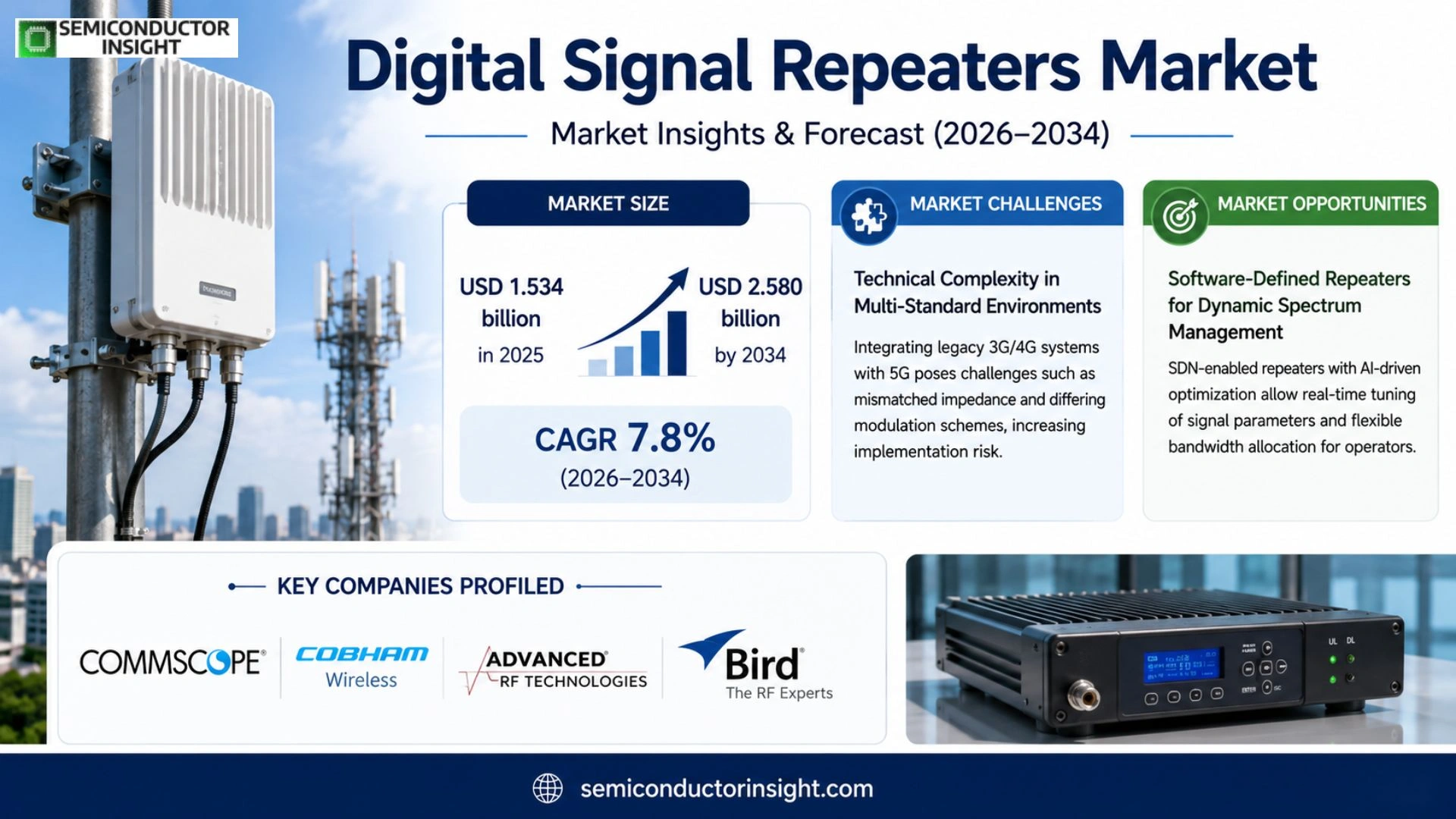
Digital Signal Repeaters market was valued at USD 1.534 billion in 2025 and is forecasted to reach USD 2.580 billion by 2034, reflecting a compound annual growth rate of 7.8% over the period.
Digital Signal Repeaters are electronic communication devices that receive, process, and retransmit digital radio signals to extend coverage, improve signal quality, and mitigate interference. They are commonly deployed in environments where signal penetration is weak or where complex propagation conditions exist.
Growth stems from rising demand for dependable wireless connectivity in dense urban settings and indoor venues, coupled with expanding mobile data traffic and ongoing 5G roll‑out initiatives that heighten the need for coverage‑enhancement solutions. Adoption is especially strong in commercial buildings, transportation hubs, and industrial facilities because repeaters provide better signal integrity and compatibility with modern network standards. Leading manufacturers such as Advanced RF Technologies, Bird Technologies, Cobham Wireless, CommScope, and Westell Technologies continue to broaden their portfolios through product innovation and strategic partnerships.
MARKET DRIVERS
Infrastructure Modernization Across Telecom Networks
The ongoing shift from legacy copper‑based backhaul to fiber‑enabled architectures compels operators to insert Digital Signal Repeaters to preserve signal integrity over longer runs. Capacity constraints in densely populated corridors make repeaters an economical bridge, allowing carriers to defer costly trenching projects while still meeting bandwidth demand.
Growth of Edge Computing and 5G Deployments
Edge‑centric service models rely on tight latency budgets; any degradation in the transport layer erodes the value proposition. Deploying Digital Signal Repeaters close to edge sites reduces attenuation, thereby safeguarding the ultra‑low latency required for applications such as autonomous manufacturing and remote surgery. Reliability gains are a decisive factor for enterprises evaluating private‑network solutions.
➤ “Repeaters have become the silent workhorse that keeps high‑frequency signals clean as networks densify,” notes a senior network architect.
Regulatory encouragement for rural broadband expansion also fuels demand. Policymakers increasingly endorse the reuse of existing conduit alongside repeaters as a cost‑effective method to extend service to underserved locales, creating a policy‑driven incentive for providers to invest in Digital Signal Repeaters market.
MARKET CHALLENGES
Technical Complexity in Multi‑Standard Environments
Operators juggling legacy 3G/4G systems alongside 5G face integration hurdles; mismatched impedance and differing modulation schemes can cause signal distortion if repeaters are not precisely engineered. This technical friction raises implementation risk, prompting some vendors to postpone deployment until standardized solutions mature.
Other Challenges
Cost Sensitivity in Emerging Economies
Capex limitations in fast‑growing markets outside North America and Europe force service providers to scrutinize every line‑item. When the price differential between a repeater‑augmented fiber run and a full‑fiber replacement narrows, procurement committees may favor the latter, dampening short‑term demand for repeaters.
MARKET RESTRAINTS
Reliance on Stable Power Supplies
Digital Signal Repeaters require continuous, clean power; in regions with frequent outages or voltage fluctuations, the risk of equipment failure rises. Providers must invest in backup generators or UPS systems, adding operational overhead that can deter adoption in power‑fragile zones.
Stringent Electromagnetic Compatibility (EMC) Regulations
Compliance with EMC standards varies widely across jurisdictions. A repeater that passes certification in one country may require redesign for another, inflating time‑to‑market and discouraging manufacturers from pursuing certain geographies.
Furthermore, the physical footprint of repeaters, although modest, can clash with space‑constrained conduit networks, especially in historic downtown districts where retrofitting is logistically challenging.
MARKET OPPORTUNITIES
Software‑Defined Repeaters for Dynamic Spectrum Management
The convergence of software‑defined networking (SDN) with repeaters opens a pathway to real‑time optimization of signal parameters. Vendors that embed AI‑driven adjustment engines can offer operators flexible bandwidth allocation, positioning themselves at the forefront of Digital Signal Repeaters market.
Integration with Energy‑Harvesting Technologies
Emerging designs that tap ambient kinetic or solar energy to power repeaters present a compelling value proposition for off‑grid installations. Such self‑sustaining units reduce the total cost of ownership, making repeaters attractive for remote oil‑field telemetry and disaster‑recovery networks.
Finally, partnerships between telecom equipment makers and cloud service providers create bundled offerings where repeaters are positioned as part of an end‑to‑end edge ecosystem. This collaborative model not only differentiates product portfolios but also accelerates adoption across verticals seeking ultra‑reliable connectivity.
Digital Signal Repeaters Market Trends
Urban Coverage Intensification
The surge in dense metropolitan installations has placed pressure on wireless operators to extend reach inside high‑rise structures and underground venues. As 5G antennas proliferate, signal attenuation becomes acute, prompting network planners to layer digital repeaters where macro cells falter. In 2025, manufacturers delivered roughly four million units at an average price of $420, a price point that remains attractive given gross margins ranging from 35 % to 55 % among the leading players. This cost‑performance balance enables carriers to justify incremental deployments without inflating CAPEX, thereby sharpening the overall competitiveness of Digital Signal Repeaters market.
Other Trends
Supply Chain Constraints
Upstream components such as RF chips and power modules have experienced tighter lead times, largely because semiconductor fabs are operating near capacity. This bottleneck translates into modest price pressure on finished repeaters and forces OEMs to prioritize high‑margin product lines. Some manufacturers have responded by securing long‑term agreements with key suppliers, while others are investing in in‑house design of critical modules to reduce reliance on external sources. The resulting variance in inventory turnover rates creates a competitive gap that agile firms can exploit through faster delivery cycles.
Shift Toward Multi‑Band Architecture
Operators increasingly favour repeaters capable of handling multiple frequency bands within a single chassis, a trend that aligns with the broader migration toward spectrum‑agnostic infrastructure. Multi‑band devices simplify site logistics, lower overall equipment counts, and improve spectral efficiency, especially in environments where both legacy 2 G/3 G and emerging 5G carriers coexist. For Digital Signal Repeaters market, this evolution signals a move away from single‑band niche solutions toward versatile platforms that can be re‑programmed as standards evolve. Companies that accelerate development of adaptive algorithms and modular hardware are likely to capture a larger share of future installation projects, while those clinging to fixed‑band designs may see their relevance wane.
COMPETITIVE LANDSCAPE
Key Industry Players
Digital Signal Repeaters Market: Competitive Overview
CommScope dominates the upper tier of the market, leveraging its extensive portfolio of antenna systems and integrated RF solutions to secure contracts with major telecom operators deploying 5G densification projects. Its ability to bundle repeaters with network‑optimization services creates a barrier to entry for smaller firms, concentrating roughly 22 % of global revenue among the top three suppliers. The firm’s strong engineering base and global after‑sales network translate into higher gross margins, reinforcing its position as a preferred vendor for large‑scale public‑safety and transportation infrastructure upgrades.
Beyond the headline players, a cluster of specialized manufacturers sustains market diversity. Companies such as Advanced RF Technologies and Bird Technologies focus on rugged, outdoor‑grade repeaters for rail and highway applications, while DeltaNode Wireless Technology and Fiplex Communications concentrate on compact indoor units designed for commercial office complexes. Emerging entrants like InnoWave and Hytera are carving out niches in private‑wireless networks for factories and logistics hubs, where low‑latency signal reinforcement is critical. This tiered ecosystem ensures that customers can source solutions tailored to distinct power‑output classes, frequency bands, and deployment environments.
List of Key Digital Signal Repeaters Companies Profiled
- CommScope
- Cobham Wireless
- Advanced RF Technologies
- Bird Technologies
- DeltaNode Wireless Technology
- Fiplex Communications
- Microlab
- Shyam Telecom Limited
- Westell Technologies
- InnoWave
- Hytera
- Radiocrafts
Segment Analysis:
| Segment Category | Sub-Segments | Key Insights |
| By Type |
|
Medium Power Repeaters are widely adopted because they balance coverage needs with energy efficiency.
|
| By Application |
|
Telecommunications Networks drive the market due to the constant demand for robust coverage.
|
| By End User |
|
Service Providers prioritize repeaters to enhance network reliability.
|
| By Deployment Environment |
|
Indoor Repeaters dominate because they address the most pressing signal attenuation challenges inside buildings.
|
| By Frequency Band |
|
Dual‑Band Repeaters are preferred for their versatility across multiple network spectrums.
|
Regional Analysis: Digital Signal Repeaters Market
North America
Operators prioritize repeaters that integrate optical‑electrical‑optical conversion with intelligent gain control, enabling dynamic bandwidth provisioning. The shift toward software‑defined networking amplifies the need for repeaters that can be remotely configured, reducing field‑service costs and enhancing network agility.
The Federal Communications Commission’s policies on spectrum refarming and the push for reduced latency in public safety communications drive repeaters to meet stricter emission standards, prompting vendors to certify equipment for compliance across multiple bands.
Recent component shortages have led carriers to favor manufacturers with diversified sourcing strategies. This preference incentivizes the development of modular repeater designs that can accommodate alternative photonic components without compromising performance.
Enterprise datacenter operators and utility providers increasingly view repeaters as enablers of private‑line extensions, prompting a nuanced demand mix that balances high‑capacity back‑haul requirements with cost‑effective short‑reach solutions.
Europe
European telecoms are navigating a transition from legacy copper networks toward fiber‑centric architectures, positioning repeaters as critical bridge assets. The region’s emphasis on sustainability influences procurement choices, with operators favoring low‑power repeaters that meet stringent EU energy‑efficiency directives. Cross‑border initiatives, such as the Pan‑European Gigabit Corridor, stimulate collaborative deployments, compelling vendors to offer equipment compatible with diverse national standards. Moreover, the rise of private 5G networks in manufacturing hubs creates niche demand for repeaters that can maintain signal integrity in dense urban environments while supporting low‑latency use cases.
Asia‑Pacific
Asia‑Pacific’s market dynamism stems from rapid urbanization and divergent development stages across economies. In Japan and South Korea, saturated fiber markets push carriers to fine‑tune existing networks with repeaters that support high‑density wavelength division multiplexing. In contrast, emerging economies such as Indonesia and Vietnam leverage repeaters to extend coverage into archipelagic regions where trenching costs are prohibitive. The competitive landscape is intensified by local manufacturers offering cost‑optimized solutions, prompting multinational players to adopt joint‑venture models that blend price competitiveness with advanced feature sets.
South America
South American operators contend with vast geographic expanses and heterogeneous terrain, making repeaters indispensable for bridging remote communities to national backbones. Public‑private partnerships funded by development banks are channeling capital toward network upgrades, with repeaters selected for their ruggedized enclosures and ability to operate on renewable power sources. Market participants also observe a growing appetite for repeaters that can support both legacy SDH and emerging coherent optical technologies, ensuring a smoother migration pathway for carriers.
Middle East & Africa
In the Middle East, sovereign wealth fund initiatives are accelerating the deployment of ultra‑high‑capacity optical routes, where repeaters serve to amplify signals over extreme distances without compromising signal‑to‑noise ratios. African markets, meanwhile, are experiencing a surge in leapfrog projects that bypass traditional copper phases, directly installing fiber with repeaters to reach peri‑urban locales. The regulatory push for national broadband plans across both regions elevates the strategic importance of repeaters that can be quickly integrated into heterogeneous network inventories, balancing performance with cost constraints.
Report Scope
This market research report provides a comprehensive analysis of the Digital Signal Repeaters Market , covering the forecast period 2026–2034. It offers detailed insights into market dynamics, technological advancements, competitive landscape, and key trends shaping the industry.
Key focus areas of the report include:
- Market Overview: The report begins with an overview outlining its current market scenario, key growth indicators, and industry transformation drivers. It discusses macroeconomic factors, demand–supply balance, regulatory landscape, and the strategic role of semiconductors in powering advancements across industries such as automotive, telecommunications, consumer electronics, and industrial automation.
- Market Size & Forecast: Historical data and future projections for revenue, unit shipments, and market value across major regions and segments.
- Segmentation Analysis: Detailed breakdown by product type, technology, application, and end-user industry to identify high-growth segments and investment opportunities.
- Regional Insights: Insights into market performance across North America, Europe, Asia-Pacific, Latin America, and the Middle East & Africa, including country-level analysis where relevant.
- Competitive Landscape: Profiles of leading market participants, including their product offerings, R&D focus, manufacturing capacity, pricing strategies, and recent developments such as mergers, acquisitions, and partnerships.
- Technology Trends & Innovation: Assessment of emerging technologies, integration of AI/IoT, semiconductor design trends, fabrication techniques, and evolving industry standards.
- Market Drivers & Restraints: Evaluation of factors driving market growth along with challenges, supply chain constraints, regulatory issues, and market-entry barriers.
- Stakeholder Insights: Insights for component suppliers, OEMs, system integrators, investors, and policymakers regarding the evolving ecosystem and strategic opportunities.
Primary and secondary research methods are employed, including interviews with industry experts, data from verified sources, and real-time market intelligence to ensure the accuracy and reliability of the insights presented.
FREQUENTLY ASKED QUESTIONS:
What is the current market size of Digital Signal Repeaters Market?
-> Digital Signal Repeaters market is forecasted to reach USD 2.580 billion by 2034, reflecting a compound annual growth rate of 7.8% over the period.
Which key companies operate in Digital Signal Repeaters Market?
-> Key players include Advanced RF Technologies, Bird Technologies, Cobham Wireless, CommScope, DeltaNode Wireless Technology, Fiplex Communications, Microlab, Shyam Telecom Limited, Westell Technologies.
What are the key growth drivers?
-> Key growth drivers include increasing demand for reliable wireless connectivity in dense urban and indoor environments, expansion of mobile data traffic, 5G deployment, and private wireless networks.
Which region dominates the market?
-> The market shows strong adoption across all major regions, with notable growth in Asia-Pacific, Europe, and North America.
What are the emerging trends?
-> Emerging trends include improved signal quality, interference control, and compatibility with modern network standards such as 5G.

Get Sample Report PDF for Exclusive Insights
Report Sample Includes
- Table of Contents
- List of Tables & Figures
- Charts, Research Methodology, and more...
