DC Rectifier Market Insights
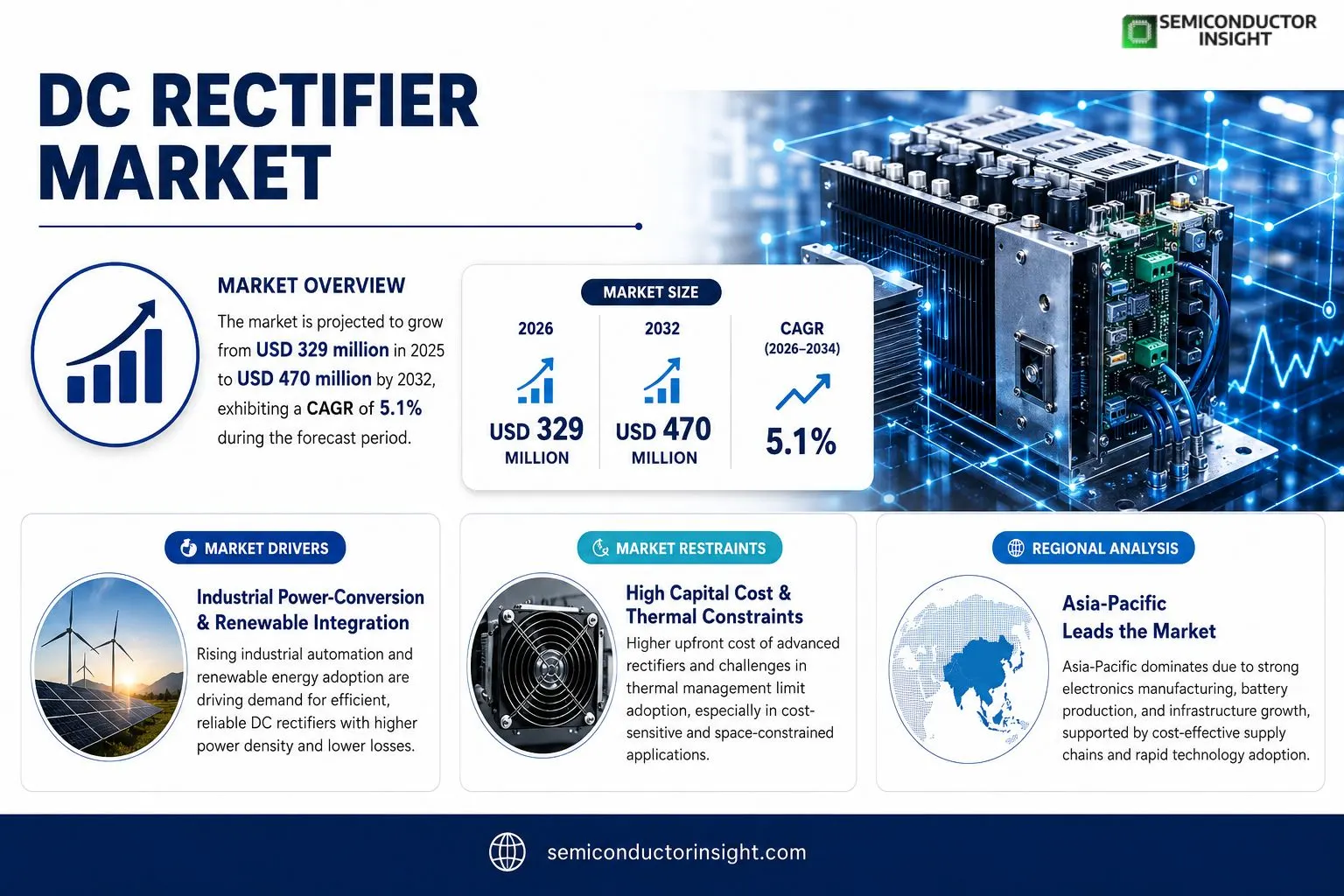
DC Rectifier market size was valued at USD 329 million in 2025 and will reach USD 470 million by 2032, reflecting a compound annual growth rate of 5.1 % over the forecast horizon. In the same year worldwide shipments totaled roughly 880 k units, translating into an average transaction value of approximately USD 410 per unit.
A DC rectifier converts alternating current (AC) into direct current (DC) by permitting current flow in a single direction. This conversion delivers a stable, unidirectional power source that underpins processes such as electroplating, welding, battery formation and other industrial applications where precise voltage regulation and low ripple are essential for product quality and operational efficiency.
MARKET DRIVERS
Industrial Power‑Conversion Demand
The rise of high‑performance manufacturing plants forces equipment designers to select rectifiers capable of handling greater current densities while maintaining tight voltage regulation. DC Rectifier Market suppliers that offer silicon‑carbide (SiC) solutions gain a competitive edge because the lower conduction losses translate directly into higher plant uptime and reduced cooling‑system expenditure.
Renewable‑Energy Integration
Solar‑farm inverters and wind‑turbine converters require robust rectification stages to transform fluctuating AC inputs into stable DC links. As grid‑code compliance tightens, developers prioritize rectifiers with fast dynamic response, prompting a shift toward modular, intelligent units that can be remotely monitored and re‑configured.
➤ Manufacturers that embed diagnostic firmware into rectifier modules report an average 15 % reduction in field service calls, a tangible cost advantage for end users.
Overall, the convergence of Industry 4.0 requirements and clean‑energy mandates creates a fertile environment for innovative rectifier designs, encouraging OEMs to invest in next‑generation topologies that promise higher efficiency and longer service life.
MARKET CHALLENGES
Thermal‑Management Constraints
Even with advances in wide‑bandgap materials, dense power packs still generate significant heat. Operators in confined enclosures struggle to balance cooling capacity against footprint limits, often resorting to oversized heat‑sink assemblies that erode the efficiency gains of modern rectifiers.
Other Challenges
Regulatory Compliance
Emerging electromagnetic‑interference (EMI) standards force designers to incorporate additional filtering stages, adding cost and complexity to otherwise streamlined architectures.
MARKET RESTRAINTS
Capital‑Expenditure Sensitivity
Many end‑users, particularly in developing regions, evaluate equipment based on upfront price rather than lifecycle economics. The higher initial outlay for SiC‑based rectifiers deters adoption despite the documented long‑term savings, slowing overall market penetration.
MARKET OPPORTUNITIES
Smart‑Grid Compatibility
Utilities are piloting micro‑grid projects that require bidirectional power flow and seamless DC‑link management. Rectifier manufacturers that embed communication protocols such as IEC 61850 can position themselves as essential partners in the rollout of resilient, decentralized energy networks.Furthermore, the automotive sector’s shift toward electric drivetrains opens a parallel avenue. High‑current charging stations rely on rectifiers capable of converting utility AC to DC at rates exceeding 350 kW, presenting a sizable, untapped revenue stream for firms that can certify their products to automotive‑grade reliability standards.
DC Rectifier Market Trends
Shift to High‑Efficiency IGBT and Digital Rectifiers
The industry is moving away from legacy silicon‑controlled rectifier (SCR) platforms toward IGBT‑based and high‑frequency switch‑mode designs. IGBT units combine lower conduction losses with fast switching, allowing converters to achieve power factors above 0.95 while occupying a fraction of the space required by older architectures. Digital control loops introduce real‑time waveform shaping, which satisfies the tightening tolerances of modern electronics assembly lines and automotive power modules. Customers in semiconductor manufacturing, EV battery assembly, and precision machining cite reduced heat dissipation and the ability to integrate predictive maintenance telemetry as decisive advantages. This migration is evident in the latest procurement data, where IGBT‑enabled rectifiers account for more than half of new unit orders in 2025, while the average selling price hovers around US$410 per unit.
Other Trends
Electronics and Battery Manufacturing Demand
The surge in consumer‑grade devices and large‑scale energy storage projects fuels a parallel rise in DC power quality requirements. In PCB fabrication and advanced battery formation, operators rely on rectifiers that can deliver low‑ripple, pulse‑reverse capabilities and programmable voltage profiles. The need for tight control stems from yield‑sensitive processes where a few millivolts of deviation can translate into costly rework. Recent production surveys indicate that roughly 880 k units were shipped ly in 2025, with a noticeable shift toward models equipped with integrated digital interfaces that sync directly with Manufacturing Execution Systems (MES). This trend not only expands the addressable market but also creates opportunities for vendors that can bundle firmware upgrades and remote diagnostics with hardware sales.
Energy‑Efficiency, Sustainability and Regulatory Pressure
Environmental legislation across Europe and North America emphasizes reduced carbon footprints and stricter energy‑consumption limits for industrial equipment. Rectifier manufacturers respond by embedding power‑factor correction modules, intelligent cooling strategies, and cloud‑based performance dashboards that enable operators to fine‑tune load profiles in real time. Such features translate into measurable reductions in electricity billsoften 5 % or more per annum for high‑volume plating facilities. The convergence of cost‑saving motives and compliance mandates is prompting a wave of retrofits, where legacy SCR units are replaced with compact, digitally managed IGBT systems. For DC Rectifier Market, this creates a dual growth vector: new equipment sales driven by emerging applications and a sizable upgrade pipeline in established process sectors.
COMPETITIVE LANDSCAPE
Key Industry Players
Competitive Dynamics in the DC Rectifier Market
ABB dominates the upper tier of the DC rectifier arena, leveraging a broad product slate that spans high‑current SCR units to advanced IGBT‑based converters. Its extensive engineering footprint and ongoing digitisation programmes allow the firm to capture demand from automotive battery manufacturers and large‑scale electroplating operations, where precise waveform control and low harmonic distortion are premium requirements. The firm’s ability to bundle rectifiers with energy‑management software creates a defensible position against lower‑cost rivals, while its service network underpins long‑term aftermarket revenue streams. Parallel to ABB, General Electric and Fuji Electric maintain sizable shares by focusing on rugged, water‑cooled platforms suited to heavy‑duty welding and electro‑lysis applications; their scale supports aggressive pricing in mature segments, yet they continue to invest in IGBT migration to satisfy efficiency‑driven customers.Beyond the Tier‑1 incumbents, a suite of specialised manufacturers fuels competitive pressure in niche corridors. Kraft Powercon and Sansha Electric have become go‑to sources for compact, high‑frequency switch‑mode rectifiers favored by PCB assembly lines where board‑space and thermal budget are constrained. Hind Rectifiers and Neeltran excel in supplying air‑cooled SCR solutions for legacy electroplating cells that prioritize robustness over footprint. Regional players such as Nidec Industrial Solutions (Japan) and Dynapower (India) capitalize on localized supply chains to serve emerging battery‑formation plants, delivering customized control algorithms that align with regional energy‑efficiency mandates. This layered landscapewith giants anchoring volume markets and agile specialists targeting application‑specific nichescreates a competitive equilibrium where innovation, service depth, and geographic proximity are decisive factors.
List of Key DC Rectifier Companies Profiled
- ABB
- General Electric
- Fuji Electric
- Kraft Powercon
- Sansha Electric
- Hind Rectifiers
- Neeltran
- Nidec Industrial Solutions
- Dynapower
- Green Power
- Thycon
- Brascoelma
- Xi’an Zhongkai Power Rectifier
Segment Analysis:
| Segment Category | Sub-Segments | Key Insights |
| By Type |
|
IGBT Rectifiers
|
| By Application |
|
Battery Manufacturing
|
| By End User |
|
Electronics Manufacturers
|
| By Technology |
|
Digital Control
|
| By Benefit |
|
Energy Efficiency
|
Regional Analysis: DC Rectifier Market
Manufacturers of assembly‑line equipment are increasingly specifying rectifiers that can sustain sporadic surge currents without compromising efficiency. The trend toward decentralized power architectures pushes vendors to offer compact, plug‑and‑play units that simplify retrofits across legacy plants, reducing downtime and installation cost.
Solar farms and offshore wind installations rely on rectifiers to convert variable DC outputs into grid‑compatible AC. The need for high thermal resilience and low harmonic distortion has accelerated the adoption of wide‑bandgap semiconductor technologies within project specifications.
As hyperscale operators consolidate power distribution, they seek rectifiers that support redundant pathways and seamless switchover. Innovations in digital monitoring enable predictive maintenance, aligning with the industry’s focus on uptime and energy efficiency.
Electric‑vehicle fast‑charging stations and rail traction systems demand rectifiers capable of handling high current pulses. Emerging standards for fast charge dictate tighter voltage regulation, prompting manufacturers to refine control algorithms for quicker response times.
Europe
European markets exhibit a nuanced balance between stringent emissions legislation and a strong legacy of industrial equipment manufacturing. The EU’s Green Deal fuels investments in offshore wind, prompting system integrators to request rectifiers that combine low losses with robust corrosion protection for maritime environments. Simultaneously, German and French automotive suppliers are integrating rectifier modules into electric‑drive prototypes, prioritising compactness to meet vehicle packaging constraints. The region’s emphasis on circular‑economy principles has also led to increased refurbishment activity, where older rectifiers are retrofitted with newer semiconductor blocks to extend lifespan and meet evolving efficiency benchmarks.
Asia-Pacific
Asia‑Pacific remains the largest consumer of newly installed rectifiers, driven by rapid urbanisation and aggressive electrification policies across China, India, and Southeast Asia. Massive infrastructure programs for smart‑grid rollout translate into demand for modular rectifier solutions that can be scaled across diverse voltage tiers. Local manufacturers capitalize on cost‑effective supply chains to produce silicon‑carbide devices that compete with imported silicon alternatives, positioning the region as a burgeoning hub for next‑generation conversion technology. The push for electric‑bus fleets in metropolitan areas further amplifies the need for high‑current, low‑weight rectifiers capable of repeated charge‑discharge cycling.
South America
In South America, DC Rectifier Market is shaped by a mix of mining expansion and renewable‑energy pilots. Countries such as Chile and Peru are integrating rectifiers into copper‑processing facilities to improve power factor and reduce energy bills, while Brazil’s growing solar portfolio requires converters that can handle fluctuating irradiance. Limited domestic semiconductor production spurs partnerships with North American firms, resulting in technology transfers that gradually elevate local design capabilities.
Middle East & Africa
The Middle East & Africa region is witnessing a gradual shift from oil‑centric power models to diversified energy mixes that include solar and desalination projects. In the Gulf Cooperation Council, large‑scale photovoltaic farms depend on rectifiers engineered for high ambient temperatures and sand‑storm resilience. African nations, leveraging international development funds, are deploying micro‑grid solutions where rugged rectifier units provide reliable power to remote communities, underscoring the market’s role in bridging energy access gaps.
Report Scope
This market research report provides a comprehensive analysis of the DC Rectifier Market , covering the forecast period 2026–2034. It offers detailed insights into market dynamics, technological advancements, competitive landscape, and key trends shaping the industry.
Key focus areas of the report include:
- Market Overview: The report begins with an overview outlining its current market scenario, key growth indicators, and industry transformation drivers. It discusses macroeconomic factors, demand–supply balance, regulatory landscape, and the strategic role of semiconductors in powering advancements across industries such as automotive, telecommunications, consumer electronics, and industrial automation.
- Market Size & Forecast: Historical data and future projections for revenue, unit shipments, and market value across major regions and segments.
- Segmentation Analysis: Detailed breakdown by product type, technology, application, and end-user industry to identify high-growth segments and investment opportunities.
- Regional Insights: Insights into market performance across North America, Europe, Asia-Pacific, Latin America, and the Middle East & Africa, include country-level analysis where relevant.
- Competitive Landscape: Profiles of leading market participants, including their product offerings, R&D focus, manufacturing capacity, pricing strategies, and recent developments such as mergers, acquisitions, and partnerships.
- Technology Trends & Innovation: Assessment of emerging technologies, integration of AI/IoT, semiconductor design trends, fabrication techniques, and evolving industry standards.
- Market Drivers & Restraints: Evaluation of factors driving market growth along with challenges, supply chain constraints, regulatory issues, and market-entry barriers.
- Stakeholder Insights: Insights for component suppliers, OEMs, system integrators, investors, and policymakers regarding the evolving ecosystem and strategic opportunities.
Primary and secondary research methods are employed, including interviews with industry experts, data from verified sources, and real-time market intelligence to ensure the accuracy and reliability of the insights presented.
FREQUENTLY ASKED QUESTIONS:
What is the current market size of DC Rectifier Market?
-> DC Rectifier Market was valued at USD 329 million in 2025 and is expected to reach USD 470 million by 2032.
Which key companies operate in DC Rectifier Market?
-> Key players include Sansha Electric, Kraft Powercon, American Plating Power, ABB, General Electric, Fuji Electric, FRIEM, AEG Power Solutions, Neeltran, Nidec Industrial Solutions, Dynapower, Green Power, Hind Rectifiers, Xi’an Zhongkai Power Rectifier, Brascoelma, Thycon.
What are the key growth drivers?
-> Key growth drivers include shift toward high‑efficiency IGBT‑based and digital rectifiers, rising demand from electronics and battery‑manufacturing segments, and increasing emphasis on energy‑efficiency, sustainability, and regulatory compliance.
Which region dominates the market?
-> Asia leads the market, driven by strong demand from electronics manufacturing and battery production, while Europe shows rapid adoption of energy‑efficient rectifier technologies.
What are the emerging trends?
-> Emerging trends include high‑efficiency IGBT and switch‑mode architectures, digital telemetry and adaptive control for energy management, and integration of rectifiers into automated production lines for electronics and EV battery manufacturing.
Get Sample Report PDF for Exclusive Insights
Report Sample Includes
- Table of Contents
- List of Tables & Figures
- Charts, Research Methodology, and more...
 Download Sample Report PDF