
Computerized Flat Knitting Machines Market Insights
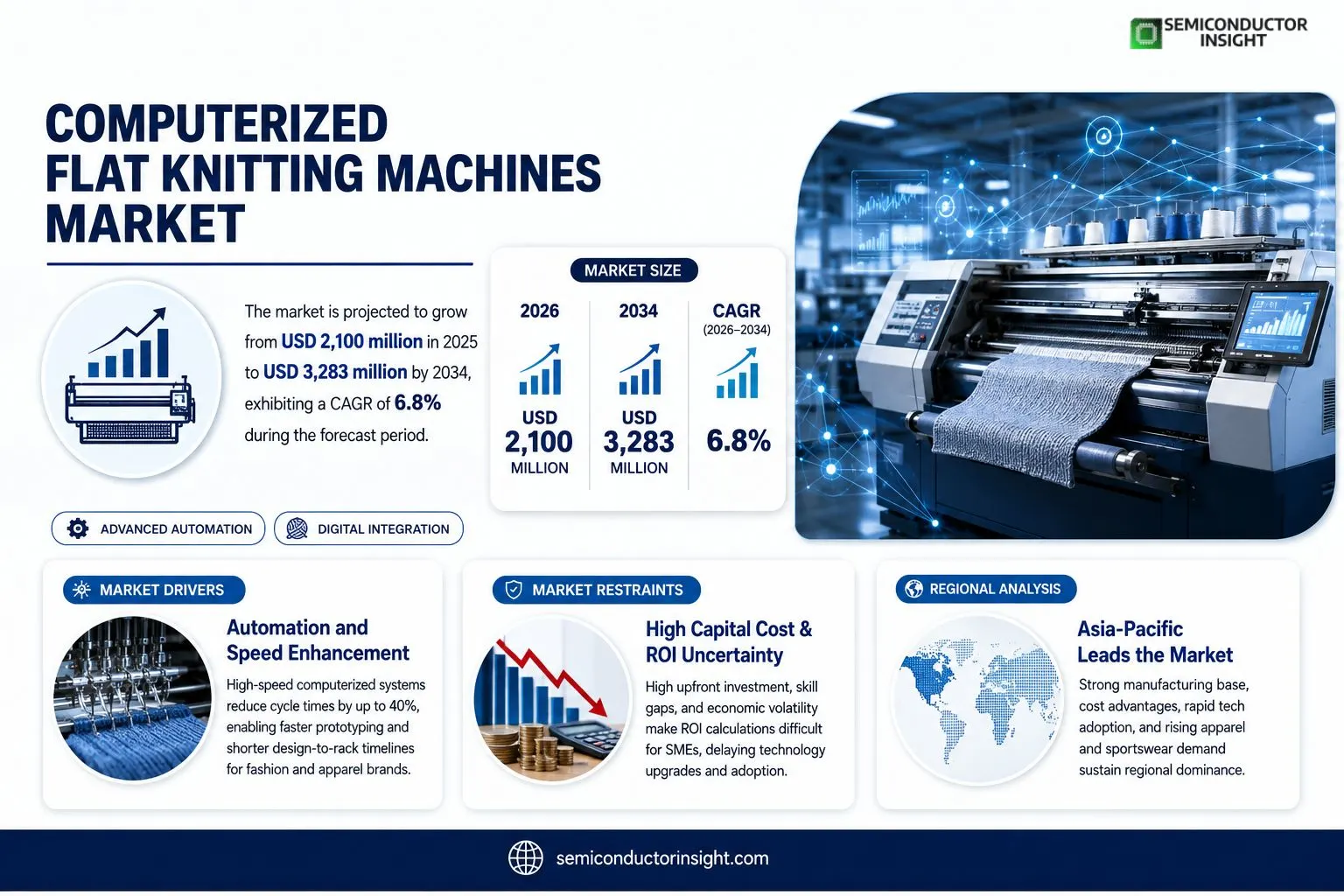
Computerized Flat Knitting Machines market size was valued at USD 2100 million in 2025. The market is projected to grow from USD 2100 million in 2025 to USD 3283 million by 2034, exhibiting a CAGR of 6.8% during the forecast period.
A Computerized Flat Knitting Machine is an industrial weft‑knitting system built around one or more flat needle beds and governed by digital programs that control needle selection, yarn feeding, loop formation, transfer, tuck, float and shaped knitting. Typical configurations include a machine frame, needle beds, traversing carriage, knitting needles, sinkers, yarn carriers/feeders, take‑down units, servo drives and an electronic control interface; variants range from standard flat machines to fully‑fashioned, whole‑garment or seamless models for footwear uppers and technical textiles.The market’s expansion stems from manufacturers seeking shorter lead times, lower material waste and on‑demand production capabilities. Brands across fashion, sportswear and healthcare are integrating these machines with design software and virtual sampling to reduce sampling costs and accelerate time‑to‑market. Meanwhile, suppliers such as Shima Seiki and Ningbo Cixing are enhancing service networks and software ecosystems to lower adoption barriers for mid‑size factories that otherwise face steep learning curves.
MARKET DRIVERS
Automation and Speed Enhancement
The surge in demand for rapid prototyping has pushed garment manufacturers to adopt Computerized Flat Knitting Machines. These systems cut cycle times by up to 40 %, allowing brands to shorten the “design‑to‑rack” interval and react to fast‑fashion cues. As the cost of labor rises in major production hubs, firms view automation as a way to protect margins while retaining design flexibility.
Digital Integration and Data‑Driven Production
Companies are embedding CAD, AI‑based pattern optimization, and real‑time analytics directly into the knitting process. This convergence creates a feedback loop where yarn consumption, tension, and defect rates are monitored live, enabling immediate corrective actions. The resulting efficiency gains are compelling for midsize and luxury apparel houses that cannot afford large batch waste.
➤ “When our knitting line became data‑centric, we trimmed material waste by a measurable margin and unlocked new design possibilities that were previously too costly to explore.” – Senior Engineer, European Knitwear Firm
Beyond pure productivity, the environmental narrative is reshaping investment decisions. Machine‑level precision reduces off‑cut volume, helping brands align with sustainability pledges without sacrificing style. This dual benefit of cost containment and brand‑level ESG compliance is a cornerstone of the market’s upward trajectory.
MARKET CHALLENGES
Capital Intensity and ROI Uncertainty
While the performance upside is clear, the upfront price tag of a state‑of‑the‑art computerized flat knitting line remains prohibitive for many small to medium enterprises. Decision‑makers grapple with calculating a reliable payback period, especially when product mix volatility can distort utilization rates.
Other Challenges
Skill Gap and Training Overheads
Effective operation demands engineers fluent in both textile mechanics and software scripting. The scarcity of such hybrid talent forces firms to invest heavily in continual training programs, which drags the total cost of ownership upward.
MARKET RESTRAINTS
Economic Volatility and Investment Hesitation
economic headwindsrising interest rates, fluctuating currency values, and cautious consumer spendinghave made capital‑heavy projects harder to justify. Manufacturers in regions facing slower GDP growth are delaying upgrades, thereby tempering market momentum.
Raw Material Price Sensitivity
Yarn price spikes, driven by limited cotton harvests and synthetic polymer supply constraints, compress margins on knitted apparel. When material costs surge, firms prioritize cost‑control measures over technology refreshes, slowing the adoption curve for sophisticated knitting equipment.
MARKET OPPORTUNITIES
IoT‑Enabled Predictive Maintenance
Embedding sensors that monitor motor health, needle wear, and thermal profiles opens a pathway for service providers to offer subscription‑based predictive maintenance. Early fault detection not only maximizes uptime but also transforms the cost model from capex‑heavy to a more predictable opex framework, appealing to firms with limited cash reserves.
Customization for Technical Textiles
Emerging segments such as wearable health sensors, smart apparel, and high‑performance sportswear demand intricate stitch architectures that only computerized flat knitting machines can deliver. As product developers explore multifunctional fabrics, the market will see a surge in demand for machines capable of integrating conductive yarns and variable gauge patterns in a single pass.
Computerized Flat Knitting Machines Market Trends
Digital Design Integration as a Growth Lever
The industry is moving beyond simple mechanisation toward a tightly coupled design‑to‑production workflow. Manufacturers now embed CAD‑compatible software directly into the machine’s control unit, allowing designers to convert a digital stitch pattern into an executable program within minutes. This reduces sampling cycles, cuts material waste, and enables rapid adjustments when a fashion house decides to modify a silhouette late in the season. Because the machinery can interpret variable‑density stitch maps, brands are able to produce garments with localized performance zonessuch as reinforced heel caps in footwear or moisture‑wicking panels in activewearwithout adding separate assembly steps. The consequence for equipment vendors is a shift in product roadmaps: hardware upgrades are bundled with subscription‑based software libraries, and after‑sales teams focus on training pattern engineers rather than just routine maintenance. Companies that master this integration are positioning themselves as platforms for on‑demand manufacturing, giving them a strategic foothold in markets that value speed, customization, and low inventory footprints.
Other Trends
Complex Material Compatibility
Recent introductions of hybrid yarnscombining conductive filaments, elastomers, and high‑modulus fibershave forced machine builders to redesign needle‑bed geometry and develop adaptive tension controls. The ability to knit multi‑material structures in a single pass is attracting customers in automotive interiors, medical textiles, and smart apparel. However, the learning curve for operators is steep; successful adoption hinges on comprehensive material libraries and real‑time process monitoring tools. Vendors that offer extensive testing data and on‑site technical support are seeing higher conversion rates, as factories are less willing to risk production downtime on unproven yarns. This trend also pushes the supply chain toward tighter collaboration between yarn producers and machine makers, creating new co‑development opportunities that can shorten time‑to‑market for innovative fabrics.
Service‑Centric Business Models
Because the equipment’s sophistication now rivals that of advanced robotics, the traditional sales‑only model is losing relevance. Providers are increasingly bundling predictive maintenance, remote diagnostics, and performance analytics into multi‑year contracts. Data harvested from the machines delivers insights on stitch quality, energy consumption, and component wear, which customers use to benchmark efficiency across facilities. This service orientation not only stabilises revenue streams for manufacturers but also raises the barrier to entry for low‑cost competitors lacking the digital infrastructure. For end users, the promise of reduced unplanned downtime translates into higher utilization rates and more reliable delivery schedules, reinforcing the strategic importance of these machines within broader digital transformation initiatives.
COMPETITIVE LANDSCAPE
Key Industry Players
Competitive dynamics in the computerized flat knitting machine sector
Shima Seiki remains the benchmark supplier, leveraging its long‑standing software ecosystem and service network to lock in premium contracts across fashion, sportswear and technical textiles. The company’s emphasis on whole‑garment capability, integrated virtual sampling and a high‑availability parts depot gives it an edge in markets that prize speed to market and low material waste. Because its machines combine advanced needle selection with a robust control platform, major apparel brands view Shima Seiki as a strategic partner rather than a mere equipment vendor. This perception reshapes the market structure, concentrating top‑tier revenue in a few firms that can deliver end‑to‑end digital workflows.Beyond the leader, a constellation of midsized manufacturers competes on specialization and regional reach. Ningbo Cixing and Jiangsu Jinlong focus on cost‑effective single‑ and double‑system machines for domestic Chinese knitwear producers, while Steiger and Pailung differentiate through high‑precision engineering for technical textile applications such as automotive interiors and medical fabrics. Companies such as Zhejiang Tongcheng Technology and Wellknit carve niches in shoe‑upper and performance‑wear segments by adapting needle configurations to elastic and conductive yarns. The overall competitive picture is one of fragmented expertise, where firms that blend machine hardware with software, training and localized support tend to capture recurring revenue streams, whereas pure‑hardware players face margin pressure.
List of Key Computerized Flat Knitting Machines Companies Profiled
- Shima Seiki
- Ningbo Cixing
- Pailung
- Steiger
- Jiangsu Jinlong Technology
- Zhejiang Tongcheng Technology
- Fujian Yonthin CNC Technology
- Ningbo Beworth Textile Machinery
- Tongxiang Qianglong Machinery
- Changshu Changhua Smart Manufacturing Technology
- Tongxiang Juxing Knitting Machinery
- Wellknit
- Zhejiang Weihuan Machinery
- Changshu Guosheng Knitting Machinery Factory
- Kauo Heng Precision Machinery
Segment Analysis:
| Segment Category | Sub-Segments | Key Insights |
| By Type |
|
Multi System Machine is favored for its integrated needle‑bed architecture that enables simultaneous pattern branches and complex stitch structures. – Provides superior design flexibility for whole‑garment shaping. – Reduces manual intervention through coordinated electronic controls. – Enhances sustainability by minimizing material waste and post‑processing steps. |
| By Application |
|
Sportswear & Technical Textiles drive innovation because they demand precise stitch engineering, zonal functionality, and multi‑material integration. – Enables incorporation of conductive, elastic and high‑performance fibers. – Supports rapid prototyping and virtual sampling for fast‑track product cycles. – Aligns with brand goals for performance, durability and sustainable manufacturing. |
| By End User |
|
Apparel Brands view computerized flat knitting as a strategic platform for on‑demand production. – They value reduced lead times and lower inventory exposure. – Integrated software ecosystems enable virtual design‑to‑production workflows. – The technology supports style experimentation without costly sampling. |
| By Machine Gauge |
|
Fine Gauge is increasingly critical for high‑definition functional fabrics. – Allows intricate stitch patterns required in medical and protective textiles. – Supports seamless integration of ultra‑fine yarns and composite structures. – Enhances product differentiation through texture and performance attributes. |
| By Knitting Output Form |
|
Whole Garment Products represent the frontier of digital textile manufacturing. – Eliminate cutting and sewing steps, delivering true seamless construction. – Enable rapid response to niche fashion trends and personalized sizing. – Position manufacturers as agile suppliers within a data‑driven supply chain. |
Regional Analysis: Computerized Flat Knitting Machines Market
Europe
Joint projects between machine builders and textile universities accelerate adoption of machine‑learning algorithms that predict yarn breakage before it occurs, shrinking waste and strengthening Europe’s value proposition for high‑margin niche fabrics.
Proximity of component supplierselectronics, drive‑systems, and specialty coatingsallows rapid redesign cycles, insulating manufacturers from logistics bottlenecks that affect other continents.
European regulations encourage low‑energy motor designs and recyclable machine frames, prompting vendors to embed energy‑monitoring dashboards that appeal to eco‑conscious brands.
The region’s focus on technical textilesmedical, automotive, and performance sportscreates distinct demand patterns that drive specialized software modules for custom stitch geometry.
North America
In North America, the Computerized Flat Knitting Machines Market is shaped by a blend of domestic brand loyalty and aggressive adoption of Industry 4.0 standards. End‑users, particularly in the high‑fashion sector, prioritize machines that integrate directly with PLM systems, enabling seamless transfer of design files to the shop floor. Venture capital inflows into start‑ups developing open‑source knitting firmware have introduced a degree of modularity previously unseen in the market, allowing mid‑size manufacturers to upgrade select components without full equipment replacement. Trade shows focusing on digital textile manufacturing reinforce knowledge sharing, while strategic partnerships between US software firms and European hardware makers deliver hybrid solutions that appeal to cost‑conscious producers seeking high precision without overseas shipping delays. The region’s competitive edge rests on its ability to fuse software agility with a mature customer base that values rapid design iteration.
Asia‑Pacific
Asia‑Pacific remains a powerhouse of volume production, yet the Computerized Flat Knitting Machines Market there is gradually shifting from pure cost leadership toward technology‑driven differentiation. Chinese and Indian manufacturers are investing in in‑house automation labs to retrofit legacy flat knitting platforms with IoT sensors, aiming to improve real‑time quality analytics. The surge in demand for functional apparel in Southeast Asia has prompted local OEMs to explore machine configurations capable of integrating conductive yarns for smart‑textile applications. While labor remains inexpensive, rising wage pressures and stricter environmental regulations are nudging producers to adopt energy‑efficient drives and closed‑loop cooling systems. Regional trade agreements facilitate cross‑border component sourcing, but intellectual‑property concerns continue to influence the pace at which advanced software features are shared across borders.
South America
South American textile clusters, especially in Brazil and Argentina, view computerized flat knitting as a gateway to higher‑value export markets. Operators are attracted to machines that can switch between jersey and technical fabrics within a single production run, reducing changeover time and aligning with the continent’s diverse product mix. Government incentives for automation have lowered the barrier to entry for small‑to‑medium enterprises, encouraging them to replace manual flat knitting stations with digitally controlled alternatives. However, uneven power quality and limited access to high‑speed data networks present operational challenges, prompting vendors to develop ruggedized control units that can operate reliably under variable utility conditions.
Middle East & Africa
In the Middle East & Africa, the market is still nascent but benefits from strategic investments in textile parks that aim to attract foreign OEMs. The region’s focus on luxury fashion and high‑end interior décor drives demand for machines capable of producing intricate patterns with minimal yarn waste. Partnerships with European manufacturers bring advanced tension‑control algorithms to local factories, enabling them to meet precise design specifications required by premium brands. Infrastructure constraints, particularly in sub‑Saharan Africa, limit widespread implementation, yet mobile‑based monitoring solutions are emerging as a low‑cost alternative to traditional SCADA systems, allowing operators to oversee machine performance remotely and reduce downtime.
Report Scope
This market research report provides a comprehensive analysis of the Computerized Flat Knitting Machines Market , covering the forecast period 2026–2034. It offers detailed insights into market dynamics, technological advancements, competitive landscape, and key trends shaping the industry.
Key focus areas of the report include:
- Market Overview: The report begins with an overview outlining its current market scenario, key growth indicators, and industry transformation drivers. It discusses macroeconomic factors, demand–supply balance, regulatory landscape, and the strategic role of semiconductors in powering advancements across industries such as automotive, telecommunications, consumer electronics, and industrial automation.
- Market Size & Forecast: Historical data and future projections for revenue, unit shipments, and market value across major regions and segments.
- Segmentation Analysis: Detailed breakdown by product type, technology, application, and end-user industry to identify high-growth segments and investment opportunities.
- Regional Insights: Insights into market performance across North America, Europe, Asia-Pacific, Latin America, and the Middle East & Africa, including country-level analysis where relevant.
- Competitive Landscape: Profiles of leading market participants, including their product offerings, R&D focus, manufacturing capacity, pricing strategies, and recent developments such as mergers, acquisitions, and partnerships.
- Technology Trends & Innovation: Assessment of emerging technologies, integration of AI/IoT, semiconductor design trends, fabrication techniques, and evolving industry standards.
- Market Drivers & Restraints: Evaluation of factors driving market growth along with challenges, supply chain constraints, regulatory issues, and market-entry barriers.
- Stakeholder Insights: Insights for component suppliers, OEMs, system integrators, investors, and policymakers regarding the evolving ecosystem and strategic opportunities.
Primary and secondary research methods are employed, including interviews with industry experts, data from verified sources, and real-time market intelligence to ensure the accuracy and reliability of the insights presented.
FREQUENTLY ASKED QUESTIONS:
What is the current market size of Computerized Flat Knitting Machines Market?
-> Computerized Flat Knitting Machines market was valued at USD 2100 million in 2025 and is expected to reach USD 3283 million by 2034, growing at a CAGR of 6.8%.
Which key companies operate in Computerized Flat Knitting Machines Market?
-> Key players include Shima Seiki, Ningbo Cixing, Pailung, Jiangsu Jinlong Technology, Steiger, Kauo Heng Precision Machinery, Zhejiang Tongcheng Technology, Fujian Yonthin CNC Technology, Ningbo Beworth Textile Machinery, Tongxiang Qianglong Machinery, Changshu Changhua Smart Manufacturing Technology, Tongxiang Juxing Knitting Machinery, Wellknit, Zhejiang Weihuan Machinery, Changshu Guosheng Knitting Machinery Factory, among others.
What are the key growth drivers?
-> Key growth drivers include design flexibility, reduced sewing steps, lower material waste, quick‑response small‑lot production, on‑demand manufacturing, shortening lead times, lower inventory exposure, and the shift toward mass customization and sustainable production.
Which region dominates the market?
-> Asia holds the dominant position due to a high concentration of manufacturers, rapid adoption of advanced knitting technologies, and strong demand from apparel, sportswear, footwear, and technical textile segments.
What are the emerging trends?
-> Emerging trends include integration of digital design software with knitting machines, virtual sampling, whole‑garment capabilities, mass customization, sustainable and low‑waste manufacturing, and the development of machines capable of processing conductive, elastic and high‑performance yarns for advanced functional textiles.

Get Sample Report PDF for Exclusive Insights
Report Sample Includes
- Table of Contents
- List of Tables & Figures
- Charts, Research Methodology, and more...
 Download Sample Report PDF