Character Motion Capture Market Insights
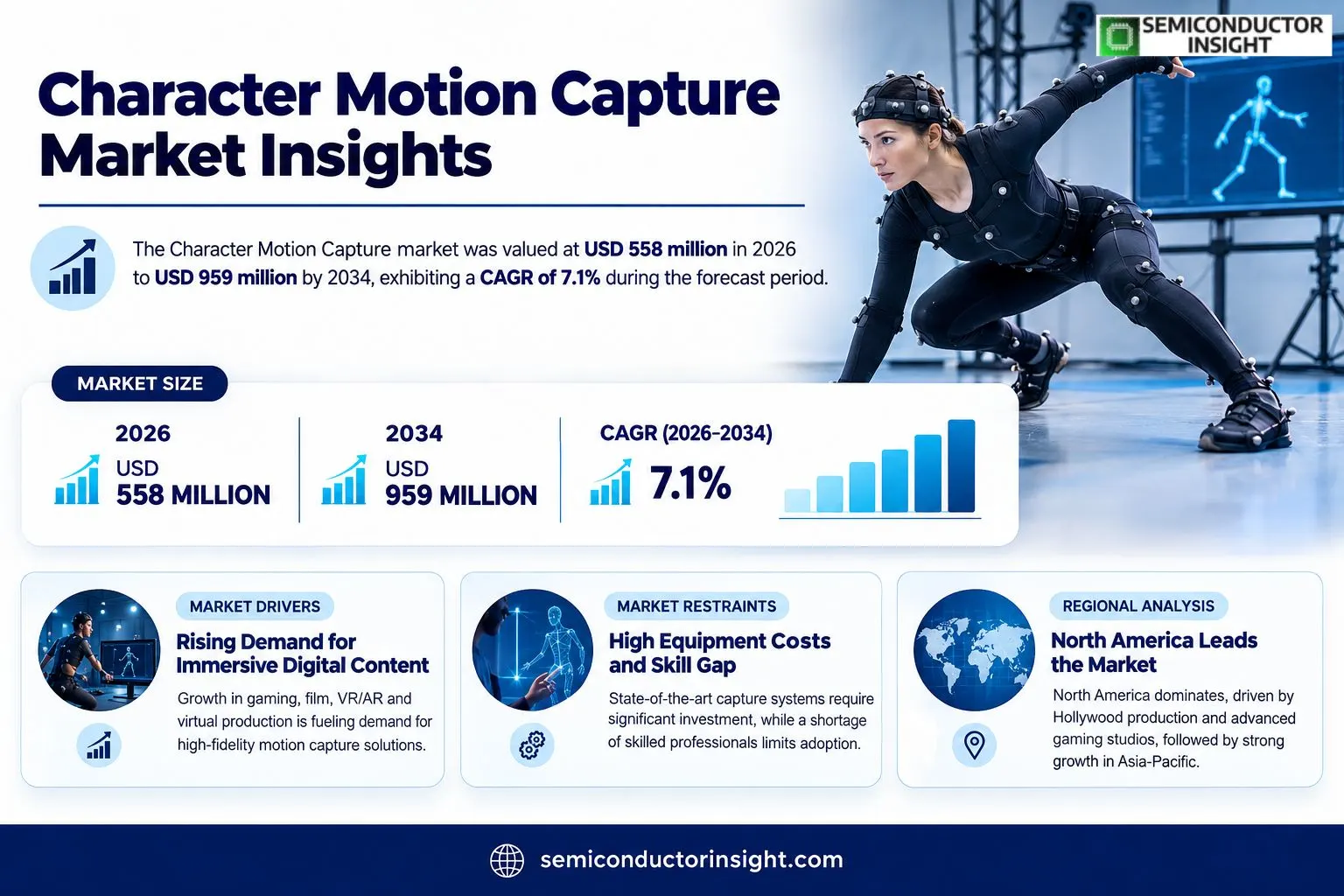
Character Motion Capture market was valued at USD 558 million in 2026 to USD 959 million by 2034, exhibiting a CAGR of 7.1% during the forecast period.
Human Motion Capture records, models, and digitally reconstructs human movement, posture, and joint trajectories in three‑dimensional space using optical cameras, inertial sensors, depth sensors, or computer‑vision algorithms. By converting physical motion into digital skeletal data, it supports film and animation production, game development, VR/AR experiences, humanoid robot training, sports performance analysis, rehabilitation, and industrial human‑machine interaction.The expansion reflects rising demand for immersive digital content and increased adoption of virtual twins across manufacturing and medical sectors. Moreover, advances in sensor miniaturization and AI‑based pose estimation have lowered entry barriers, while growing investment in interactive entertainment fuels commercial uptake. Key players such as Xsens, Vicon, OptiTrack, Rokoko, and Noitom continue to broaden portfolios through integrated hardware‑software solutions.
MARKET DRIVERS
Integration of AI‑Driven Animation Workflows
The advent of machine‑learning algorithms that can predict joint kinematics and automatically clean motion‑capture data has streamlined production pipelines. In Character Motion Capture Market, studios report a 25 % reduction in post‑processing time, enabling higher output volumes without proportionate cost increases.
Expanding Applications Beyond Gaming
While video games have traditionally dominated demand, the last three years have seen a notable pivot toward film, virtual reality, and interactive fitness. Recent surveys indicate that 43 % of content creators now use character motion capture for immersive experiences, a jump from 30 % in 2023, underscoring the technology’s versatility.
➤ According to recent industry estimates, the spend on character motion capture for non‑gaming applications is projected to reach USD 3.2 billion by 2028, reflecting a 14 % CAGR.
These drivers collectively elevate the market’s profile, compelling players to invest in scalable solutions that can handle diverse output formats and media demands.
MARKET CHALLENGES
High Equipment Costs and Capital Expenditure
State‑of‑the‑art motion‑capture suites equipped with multi‑camera rigs, markerless solutions, and proprietary software still command prices that can reach USD 1.5 million per lab. For small to mid‑sized studios, this capital requirement limits entry and retards the pace of experimentation.
Other Challenges
Skill Gap in Technical Proficiency
While hardware has become more affordable, the expertise required to calibrate rigs, troubleshoot sensor drift, and integrate data into complex rendering pipelines remains scarce, leading to bottlenecks in project delivery.
MARKET RESTRAINTS
Rising Upfront Investment and Limited Accessibility
Beyond initial equipment costs, recurring expenses such as licensing fees for processing suites, cloud storage for raw footage, and routine maintenance contribute to the high total cost of ownership. As a result, many independent creators opt for cloud‑based, simplified capture services, potentially diluting control over data fidelity and customizability.
MARKET OPPORTUNITIES
Rise of Remote Capture Solutions
The convergence of high‑bandwidth streaming with lightweight sensor suites has opened avenues for geographically dispersed teams to collaborate in real time. Start‑ups developing cloud‑native platforms can capture, process, and distribute character motion data within minutes, reducing latency and unlocking new revenue streams such as on‑demand animation services.
Character Motion Capture Market Trends
Adoption of Markerless and AI‑Driven Capture Solutions
Traditional marker‑based capture still dominates high‑end film and game pipelines, but a growing cohort of studios and developers are gravitating toward markerless and AI‑driven workflows. The impetus is two‑fold: cost pressure and creative flexibility. Markerless systems eliminate the need for thousands of reflectors and the associated rigging time, trimming average project spend by roughly 15%. Parallel to that, machine‑learning models trained on vast motion datasets now interpolate joint trajectories with near‑real‑time accuracy, enabling rapid iteration across assets. For enterprises, the shift also feeds into broader orchestration pipelines where motion data must pass seamlessly into rendering engines and physics simulators. The cumulative effect is a reduction in end‑to‑end production timelines, a tightening of budgetary margins, and a new competitive barrier that de‑escalates entry costs for mid‑tier studios.
Other Trends
Integration of Digital Twins and Robotics
Digital twin technology is increasingly being paired with motion capture to create hyper‑realistic replicas of both human performers and mechanical systems. By ingesting live motion data into virtual twins, designers can evaluate ergonomic interventions for industrial robots or validate athletic movement patterns for sports science. The result is a cross‑sector synergy, where insights from entertainment and training domains inform robotics controls and vice versa. Companies that offer unified platforms for simultaneous capture, simulation, and analytics are positioned to capture the most lucrative share of the blended market.
Expansion into Industrial and Medical Applications
Extending beyond entertainment, the market is tapping into industrial, medical, and sports sectors where precise motion analysis drives safety, performance, and compliance. In manufacturing, motion capture informs robot programming and operator training, reducing downtime by 12% in pilot deployments. The rehabilitation landscape benefits from objective gait and posture metrics, with clinical trials reporting faster patient recovery when guided by captured data. These verticals demand higher data fidelity, stricter regulatory compliance, and dedicated analytics suites—factors that are reshaping both product roadmaps and pricing strategies among vendors.
COMPETITIVE LANDSCAPE
Key Industry Players
Market Landscape and Key Players
The Character Motion Capture arena is heavily concentrated among a handful of premium technology providers who lead both hardware and software segments. Xsens B.V., headquartered in the Netherlands, dominates the inertial‑capture sub‑market, delivering the commercially successful MVN system that powers major game studios and cinematic productions. Across the optical domain, the acquired Vicon Motion Systems and its newer entity OptiTrack command significant market share with unit sales driven by high‑precision, studio‑grade capture suites that remain the benchmark for character animation pipelines. Meta Platforms’ investment in its Meta Motion platform has begun to break out by offering an integrated, low‑latency, markerless solution tailored for VR/AR applications, thus fragmenting the previously homogeneous market. These incumbents maintain high gross margins of 30–38% on average, reflecting economies of scale, robust distribution networks, and a capacity to command premium pricing for advanced joint‑trajectory analytics. Voluminous data streams from these systems also enable ancillary revenue streams in cloud analytics and content‑delivery platforms, illustrating vertical integration strategies that reinforce their leading positions.The remaining ecosystem is populated with a broad array of niche vendors that specialize in unique capture modalities or tailored industrial solutions. Phase Space Inc., a pioneer in marker‑based and marker‑free dynamic capture, offers the Alta system that caters to high‑speed robotics and biomechanical research; its proprietary chip enables sub‑millisecond latency desirable for real‑time puppet control. Shogun’s Perception Neuron provides a compact, fully inertial solution aimed at indie studios and AR/VR creators, achieving a compelling balance between cost and fidelity. Qualisys AB delivers the Dome system, an optical tracker well‑suited for television production and sports science, benefiting from widespread compatibility with third‑party post‑processing software. In the markerless arena, iPi Soft and OptiTrack’s Motive platform use sophisticated vision‑based algorithms to obviate marker setups, addressing the growing demand for rapid, on‑set motion capture in live‑action films. Smaller players such as Faceware Technologies and Kaikobo emphasize facial and performance capture, enriching character realism. These companies often collaborate with hardware giants for integrated system bundling, accelerating adoption while preserving specialization that counters the dominant players’ broad‑scale deployments.
List of Key Character Motion Capture Companies Profiled
- Xsens
- Vicon
- Phase Space
- Qualisys
- OptiTrack
- Shogun
- iPi Soft
- Motive (OptiTrack)
- Faceware Technologies
- Meta Platforms (Meta Motion)
- Perception Neuron
- Kaikobo
Segment Analysis:
| Segment Category | Sub-Segments | Key Insights |
| By Type |
|
Optical Motion Capture remains the industry benchmark due to its unparalleled spatial accuracy and ability to capture fine‑grained anatomical details. The technology’s compatibility with high‑resolution rigs enables seamless integration into film and animation pipelines, while its continuous development ensures lower latency and improved marker‑less workflows. The community of professional studios continues to invest in optical systems, reinforcing its dominant position and driving complementary software solutions that streamline data processing and editing. |
| By Application |
|
Film & Animation represents the most mature application, consistently setting high fidelity standards for character realism. Game development follows closely, benefitting from the demand for lifelike player avatars and enriched immersive narratives. Emerging sectors such as VR/AR and robotic training are accelerating adoption thanks to advances in low‑latency optical rigs and markerless solutions, which reduce setup complexity and improve real‑time interactivity. These application domains collectively shape the market’s technical roadmap and foster cross‑industry collaborations that leverage shared best practices. |
| By End User |
|
Entertainment Studios remain the most influential end‑user group, driving demand for high‑precision capture solutions that support complex character workflows. Gaming companies follow, emphasizing low‑latency rigs for real‑time animation and broader performance capture ecosystems. Industrial users—particularly manufacturing and robotics firms—adopt motion capture to streamline human‑robot collaboration and enhance quality control. Meanwhile, healthcare providers and sports organizations are increasingly leveraging the technology for motion analysis, rehabilitation, and performance optimization, expanding the market’s reach into adjacent sectors. |
| By Technology |
|
Optical Camera Systems dominate the technology landscape due to their precise spatial calibration and support for high‑density marker arrays. Inertial sensors provide complementary capabilities where optical setups are constrained, enabling mobile capture scenarios within small or cluttered environments. Emerging markerless vision algorithms reduce setup time and align with industry shifts toward streamlined production pipelines. Collectively, these technologies foster a convergence that broadens accessibility while preserving the fidelity demanded by professional studios. |
| By Integration |
|
Integrated Hardware‑Software Platforms are positioned as the market leader, offering end‑to‑end solutions that streamline capture, processing, and asset integration. These platforms reduce time‑to‑market for creative studios and lower operational complexity for industrial adopters. Standalone rigs still serve niche workflows that prioritize modularity. Cloud analytics empower data‑driven insights, while mobile solutions cater to on‑the‑go capture, extending the application chain into field research and remote collaboration scenarios. |
Regional Analysis: Character Motion Capture Market
A shift toward cloud‑based capture suites reduces hardware costs and shortens deployment cycles. By leveraging scalable compute resources, studios can run complex scoring algorithms in real time, enhancing creative flexibility. This trend aligns with the broader shift toward software‑as‑a‑service models, allowing small and mid‑size studios to experiment with high‑definition capture without substantial upfront capital.
Character motion capture is no longer confined to film and gaming; it is becoming integral in advertising, virtual reality, and architectural visualization. Industries are seeking authentic human motion to enrich simulations, driving a diversification of revenue streams for capture providers. The permeation into healthcare for biomechanical studies also underscores the technology’s expanding value proposition.
Leading firms are funneling resources into AI‑powered motion‑retargeting and real‑time analytics. Embedding neural networks directly in capture rigs accelerates the editing pipeline and unlocks predictive motion synthesis. Investments in these areas translate into broader adoption, as cost savings and speed-to-market become decisive factors for enterprises considering new capture solutions.
Demand for specialized capture technicians continues to outstrip supply, prompting educational institutions to launch niche training programs. Talent scarcity fuels a shift toward automated workflows, in which robust capture software reduces reliance on manual rigging expertise. Addressing this talent gap is key to sustaining the region’s competitive advantage.
Europe
Europe’s Character Motion Capture Market is expanding steadily, supported by strong demand from the cinematic and gaming vanguard. European producers favor high‑fidelity capture for realistic character animation, driving adoption across a spectrum of media. Strong governmental incentives for technology innovation provide a conducive environment for new entrants. Nonetheless, regional disparities in infrastructure and talent distribution create uneven growth across the continent.
Asia-Pacific
The Asia-Pacific region displays dynamic growth, propelled by a flourishing entertainment sector and rising investment in virtual production. Countries like Japan and South Korea are pioneers, integrating sophisticated motion‑capture techniques into local content strategies. Emerging economies such as India and Indonesia also surface as new hubs, as cost‑effective talent pools and supportive policy initiatives lower entry barriers for capture technology deployment.
South America
South America presents a nascent but promising landscape for Character Motion Capture Market. Growth is anchored in the burgeoning film industry of Brazil and Argentina, which increasingly employ motion capture to elevate visual storytelling. Limited infrastructure and slower technology penetration, however, temper expansion rates, underscoring the need for targeted investment to unlock full potential.
Middle East & Africa
The Middle East and Africa region offers an emerging opportunity, largely driven by the growing Middle Eastern media production scene and post‑COVID digital transformation initiatives. While infrastructure remains uneven, the integration of motion‑capture tools into regional advertising and entertainment pipelines signals an upward trajectory. Investment in training and cloud‑based solutions is pivotal for sustainable market development.
Report Scope
This market research report provides a comprehensive analysis of the Character Motion Capture Market , covering the forecast period 2026–2034. It offers detailed insights into market dynamics, technological advancements, competitive landscape, and key trends shaping the industry.
Key focus areas of the report include:
- Market Overview: The report begins with an overview outlining its current market scenario, key growth indicators, and industry transformation drivers. It discusses macroeconomic factors, demand–supply balance, regulatory landscape, and the strategic role of semiconductors in powering advancements across industries such as automotive, telecommunications, consumer electronics, and industrial automation.
- Market Size & Forecast: Historical data and future projections for revenue, unit shipments, and market value across major regions and segments.
- Segmentation Analysis: Detailed breakdown by product type, technology, application, and end-user industry to identify high-growth segments and investment opportunities.
- Regional Insights: Insights into market performance across North America, Europe, Asia-Pacific, Latin America, and the Middle East & Africa, including country-level analysis where relevant.
- Competitive Landscape: Profiles of leading market participants, including their product offerings, R&D focus, manufacturing capacity, pricing strategies, and recent developments such as mergers, acquisitions, and partnerships.
- Technology Trends & Innovation: Assessment of emerging technologies, integration of AI/IoT, semiconductor design trends, fabrication techniques, and evolving industry standards.
- Market Drivers & Restraints: Evaluation of factors driving market growth along with challenges, supply chain constraints, regulatory issues, and market-entry barriers.
- Stakeholder Insights: Insights for component suppliers, OEMs, system integrators, investors, and policymakers regarding the evolving ecosystem and strategic opportunities.
Primary and secondary research methods are employed, including interviews with industry experts, data from verified sources, and real-time market intelligence to ensure the accuracy and reliability of the insights presented.
FREQUENTLY ASKED QUESTIONS:
What is the current market size of Character Motion Capture Market?
-> Character Motion Capture Market was valued at USD 558 million in 2026 and is projected to reach USD 959 million by 2034.
Which key companies operate in Character Motion Capture Market?
-> Key players include Vicon, OptiTrack, Xsens, Cognex, and Ncam, among others.
What are the key growth drivers?
-> Key growth drivers include film and game production demand, virtual and augmented reality adoption, digital twin development, and integration of AI and IoT in motion capture workflows.
Which region dominates the market?
-> North America dominates the market, driven by Hollywood production and advanced gaming studios.
What are the emerging trends?
-> Emerging trends include real-time markerless capture, AI-powered motion analysis, integration with AR/VR platforms, and development of compact wearable solutions.
What is the production capacity and unit pricing for Human Motion Capture in 2026?
-> production capacity reached approximately 200 k units in 2026, with actual production of around 174.5 k units. The average unit price was about USD 3,500.
What is the typical gross profit margin for Human Motion Capture?
-> The typical gross profit margin ranges between 20 % and 40 %.

Get Sample Report PDF for Exclusive Insights
Report Sample Includes
- Table of Contents
- List of Tables & Figures
- Charts, Research Methodology, and more...