
Buck-Boost Switching Regulator Market Insights
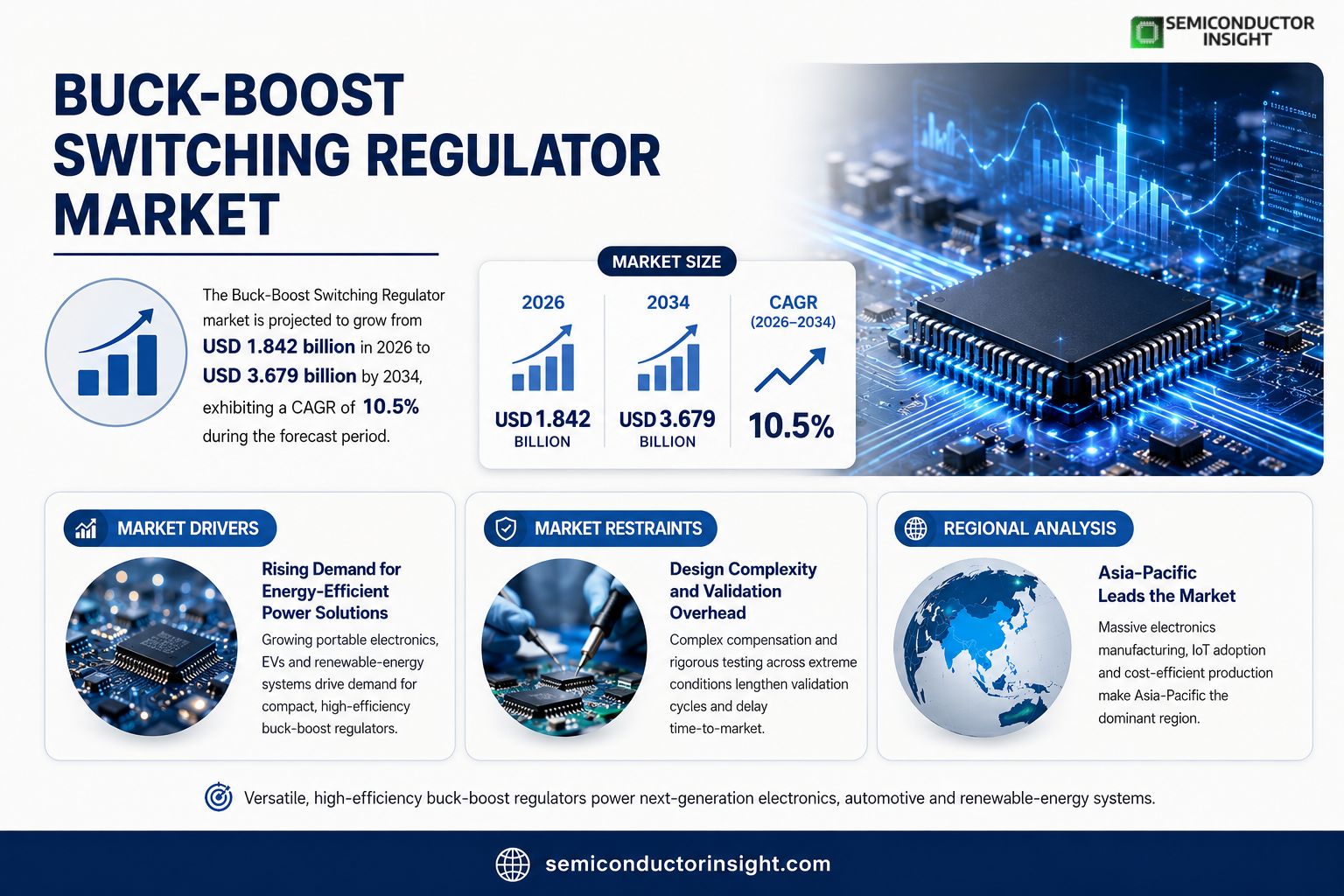
Buck-Boost Switching Regulator market size was valued at USD 1.842 billion in 2025 and is projected to reach USD 3.679 billion by 2034, exhibiting a CAGR of 10.5 % during the forecast period.
Buck‑Boost switching regulators are power‑management ICs that automatically toggle between boost and buck operation to keep the output voltage constant when the input voltage moves above or below the target level. They commonly use synchronous rectification, pulse‑width modulation control and high‑efficiency DC‑DC topologies, offering efficiencies above 90 %, compact form factors and ultra‑low standby powerfeatures that drive adoption across consumer electronics, IoT devices, automotive electronics and renewable‑energy systems.
MARKET DRIVERS
Rising Demand for Energy‑Efficient Power Solutions
Buck-Boost Switching Regulator Market is benefitting from a surge in portable electronics, electric vehicles, and renewable‑energy interfaces where designers require a single converter that can step voltage up or down without sacrificing efficiency. This versatility reduces bill‑of‑materials and board‑space, giving manufacturers a competitive edge.
Stringent Efficiency Regulations
energy‑efficiency standards are tightening, prompting OEMs to adopt regulators that can achieve efficiencies above 95 % across wide input ranges. Regulatory compliance not only avoids penalties but also strengthens brand perception among sustainability‑focused customers.
➤ “Designers are prioritising converters that deliver both buck and boost functionality in a single package, because it translates directly into lower system cost and higher reliability.”
Integration of digital control loops further refines transient response, allowing the Buck‑Boost Switching Regulator Market to penetrate high‑precision sectors such as medical instrumentation where rapid load changes are common.
MARKET CHALLENGES
Design Complexity and Validation Overhead
Achieving stable operation across both step‑up and step‑down modes demands sophisticated compensation networks. Validation cycles lengthen as engineers must verify performance under extreme temperature swings and varying load transients, which can delay time‑to‑market.
Other Challenges
Cost Sensitivity
Despite efficiency gains, the added silicon area and control logic raise unit costs. Price‑pressured segmentssuch as mass‑produced consumer gadgetsmay limit adoption unless economies of scale offset the premium.
Supply Chain Volatility
Fluctuations in semiconductor raw‑material availability can interrupt production plans, forcing manufacturers to hold larger inventories and eroding margin potential.
MARKET RESTRAINTS
Manufacturing Yield Constraints
Advanced mixed‑signal processes required for high‑frequency buck‑boost topologies can suffer from lower first‑pass yields. Defects in gate drivers or magnetic components lead to scrap rates that elevate overall production expense.The need for tightly coupled magnetic designoften involving custom inductorsadds another layer of complexity, limiting the feasibility of low‑volume, highly specialized applications.Additionally, re‑qualification of legacy systems to accommodate newer buck‑boost architectures can create hesitation among long‑standing equipment manufacturers, slowing market penetration.
MARKET OPPORTUNITIES
Emerging Application Segments
Growth in battery‑powered drones and edge‑computing nodes presents a ripe avenue for the Buck‑Boost Switching Regulator Market. These platforms demand power modules that can handle fluctuating input from solar panels or varying battery states without compromising uptime.Industrial automation is adopting modular power architectures that rely on buck‑boost converters to standardize voltage rails across disparate equipment, simplifying factory wiring and reducing downtime during upgrades.Furthermore, the rollout of 5G infrastructure introduces high‑density antenna arrays where power‑efficiency and compact form‑factor converters become critical to meet space constraints on tower installations.
Buck-Boost Switching Regulator Market Trends
Accelerating Adoption in Wearable and Automotive Electronics
The Buck‑Boost Switching Regulator Market recorded revenues of roughly $1.84 billion in 2025 and is on track to surpass $3.6 billion by 2034. Unit shipments reached 2.46 billion in the same year, reflecting an average selling price near $0.82. The surge is rooted in the expanding portfolio of wearable gadgets, true‑wireless earbuds, and electric‑vehicle power‑train modules that demand stable output despite wide input‑voltage swings. Designers favor the buck‑boost topology because it consolidates step‑up and step‑down functions, trimming board space and enabling higher energy‑efficiency targets. As battery chemistries evolve and device form‑factors shrink, the need for a single chip that can accommodate both charging and discharge extremes becomes a decisive factor for original equipment manufacturers.
Other Trends
Technology Integration and Ultra‑Low Quiescent Current
R&D programs across the leading analog‑IC firms are converging on fully integrated power modules that embed synchronous rectifiers, PWM controllers, and protective circuits in a single die. The push for sub‑microampere quiescent currents addresses the power budget of edge‑computing nodes and battery‑operated sensors, where standby draw directly influences device uptime. Concurrently, automotive‑grade reliability specifications are being baked into the silicon, allowing the Buck‑Boost Switching Regulator Market to serve safety‑critical functions such as power‑train control and infotainment power rails. These technology strides create a barrier to entry, reinforcing the high gross‑margin profileapproximately 46 % industry‑wide in 2025and squeezing price competition among lower‑tier suppliers.
Supply‑Side Concentration and Margin Dynamics
Upstream, silicon wafer fabrication accounts for the bulk of material expense, while packaging substrates and lead‑frame costs remain secondary. The production capacity of about 3 billion units in 2025 outpaces current demand, granting leading fabs the leverage to negotiate volume discounts and sustain healthy margins. Downstream, mobile‑phone assemblers, wearable device makers, and automotive electronics integrators dominate order books, with Asian manufacturing hubs absorbing the majority of shipments. Risks linger in the form of cyclical consumer‑electronics demand and possible tightening of foundry capacity, yet the overall outlook remains stable as the proliferation of IoT endpoints and electrified transport continues to generate fresh design projects.
COMPETITIVE LANDSCAPEKey Industry Players
Buck‑Boost Switching Regulator Market – Competitive Overview
Texas Instruments remains the market anchor, commanding a sizable share of shipments through its extensive portfolio of synchronous‑rectifier buck‑boost modules. Its ability to supply high‑volume, low‑cost silicon‑on‑glass solutions gives it leverage across consumer‑electronics, IoT and automotive segments. The firm’s aggressive node shrinkage and integration of digital control loops have created a technology moat that smaller rivals find difficult to replicate, reinforcing a concentration of earnings among the top five analog‑IC providers.Beyond the tier‑one leaders, a cluster of niche innovators is shaping specialized demand pockets. Nisshinbo Micro Devices leverages its expertise in ultra‑low‑quiescent‑current architectures for wearable and TWS applications, while RECOM focuses on automotive‑grade, high‑temperature modules that satisfy stringent reliability standards. Smaller players such as Diodes Incorporated and Vicor are expanding into edge‑computing power‑management solutions, and regional champions like ROHM and ON Semiconductor continue to capture growth in Asian manufacturing hubs through targeted foundry partnerships.
List of Key Buck‑Boost Switching Regulator Companies Profiled
- Texas Instruments
- Infineon Technologies
- Analog Devices
- NXP Semiconductors
- Renesas Electronics
- STMicroelectronics
- ON Semiconductor
- ROHM Semiconductor
- Microchip Technology
- Diodes Incorporated
- Nisshinbo Micro Devices
- Semtech Corporation
- Vicor Corporation
- RECOM Power
- Skyworks Solutions
Segment Analysis:
| Segment Category | Sub-Segments | Key Insights |
| By Type |
|
Low‑Voltage segment drives broad adoption because:
|
| By Application |
|
Consumer Electronics segment remains pivotal because:
|
| By End User |
|
Wearable Devices lead because:
|
| By Integration |
|
Single‑Chip Fully Integrated is favored because:
|
| By Topology |
|
SEPIC Topology stands out because:
|
Regional Analysis: Buck-Boost Switching Regulator Market
North America
Vehicle electrification requires power modules that can handle battery voltage variability while supplying stable rails to infotainment and safety systems. Buck‑boost regulators meet this need by delivering consistent performance across a broad input range, prompting tier‑one suppliers to embed them in next‑generation chassis control units. The move consolidates the market around a few specialist vendors capable of meeting automotive‑grade reliability criteria.
Factories adopting modular, plug‑and‑play controllers benefit from buck‑boost regulators because they simplify power‑architectures for mixed‑voltage sensor arrays. As manufacturers upgrade legacy lines with smart drives, the demand for flexible regulation rises, encouraging system integrators to standardize on platforms that incorporate buck‑boost chips for their compact footprint and fast transient response.
Portable wearables and Bluetooth audio devices often face battery voltages that dip below the required operating level for certain analog blocks. Designers turn to buck‑boost solutions to avoid multiple DC‑DC stages, shrinking bill‑of‑materials and improving battery life. This trend nudges semiconductor firms to integrate higher efficiency modes that align with stringent consumer‑grade power budgets.
Distributed solar and wind installations rely on power‑conditioning equipment that must accept fluctuating input voltages while delivering stable DC to storage systems. Buck‑boost regulators provide a cost‑effective bridge between variable generation and fixed‑voltage battery banks, prompting equipment manufacturers to embed them in inverters and charge controllers as a standard design practice.
Europe
European manufacturers are navigating stricter EU directives on energy consumption, prompting a shift toward power‑management ICs that can eliminate redundant conversion stages. In automotive, the push for zero‑emission vehicles amplifies the need for versatile regulation, while industrial players in Germany and France favor buck‑boost modules that simplify multi‑rail architectures on the factory floor. Companies that can certify devices to EU environmental standards gain a competitive edge, encouraging consolidation among niche European firmware specialists.
Asia‑Pacific
The Asia‑Pacific region, led by China, Japan, and South Korea, exhibits rapid adoption of buck‑boost technology within consumer gadgets and emerging IoT deployments. Local fabs benefit from lower production costs, allowing OEMs to embed more sophisticated regulation without inflating price points. However, fragmented supply chains and varied regulatory environments require vendors to offer region‑specific qualification packages, shaping a market where agility and local support become decisive factors for success.
South America
In South America, rising demand for renewable micro‑grid solutions drives interest in buck‑boost regulators that can handle diverse input sources, from solar panels to small hydro installations. While the overall market size lags behind more developed regions, Brazil’s growing industrial base is introducing advanced motor‑control systems that rely on flexible voltage conversion. Suppliers that can provide ruggedized devices suited to the continent’s climatic extremes are positioned to capture early contracts in infrastructure upgrades.
Middle East & Africa
The Middle East & Africa region sees buck‑boost regulators primarily in defense and aerospace projects where mission‑critical power stability is paramount. In addition, expanding data‑center footprints in the Gulf states demand efficient DC‑DC conversion to reduce cooling loads. African markets, though nascent, are beginning to adopt renewable off‑grid power solutions, creating a niche for regulators that can tolerate wide input swings while maintaining high efficiency. Firms that align product roadmaps with regional standards and invest in on‑ground technical support will likely dominate emerging opportunities.
Report Scope
This market research report provides a comprehensive analysis of the Buck-Boost Switching Regulator Market , covering the forecast period 2026–2034. It offers detailed insights into market dynamics, technological advancements, competitive landscape, and key trends shaping the industry.
Key focus areas of the report include:
- Market Overview: The report begins with an overview outlining its current market scenario, key growth indicators, and industry transformation drivers. It discusses macroeconomic factors, demand–supply balance, regulatory landscape, and the strategic role of semiconductors in powering advancements across industries such as automotive, telecommunications, consumer electronics, and industrial automation.
- Market Size & Forecast: Historical data and future projections for revenue, unit shipments, and market value across major regions and segments.
- Segmentation Analysis: Detailed breakdown by product type, technology, application, and end-user industry to identify high-growth segments and investment opportunities.
- Regional Insights: Insights into market performance across North America, Europe, Asia-Pacific, Latin America, and the Middle East & Africa, including country-level analysis where relevant.
- Competitive Landscape: Profiles of leading market participants, including their product offerings, R&D focus, manufacturing capacity, pricing strategies, and recent developments such as mergers, acquisitions, and partnerships.
- Technology Trends & Innovation: Assessment of emerging technologies, integration of AI/IoT, semiconductor design trends, fabrication techniques, and evolving industry standards.
- Market Drivers & Restraints: Evaluation of factors driving market growth along with challenges, supply chain constraints, regulatory issues, and market-entry barriers.
- Stakeholder Insights: Insights for component suppliers, OEMs, system integrators, investors, and policymakers regarding the evolving ecosystem and strategic opportunities.
Primary and secondary research methods are employed, including interviews with industry experts, data from verified sources, and real-time market intelligence to ensure the accuracy and reliability of the insights presented.
FREQUENTLY ASKED QUESTIONS:
What is the current market size of Buck-Boost Switching Regulator Market?
-> Buck-Boost Switching Regulator Market was valued at USD 1842 million in 2025 and is expected to reach USD 3679 million by 2034, at a CAGR of 10.5% during the forecast period.
Which key companies operate in Buck-Boost Switching Regulator Market?
-> Key players include Infineon, Texas Instruments (TI), Analog Devices, Renesas Electronics, STMicroelectronics, Nisshinbo Micro Devices, Microchip Technology, ROHM Semiconductor, ON Semiconductor, Diodes Incorporated, NXP, RECOM, Semtech Corporation, OMNIVISION, Vicor Corporation.
What are the key growth drivers?
-> Key growth drivers include the rapid expansion of wearable devices, the electrification of electric vehicles, increasing demand for power management in edge‑computing and IoT terminals, and the need for high‑efficiency, miniaturized power solutions driven by battery integration and multi‑voltage system complexity.
Which region dominates the market?
-> Asia dominates the market, driven by massive consumer‑electronics and IoT manufacturing clusters, while Europe and North America hold strong positions in industrial and automotive electronics segments.
What are the emerging trends?
-> Emerging trends include the development of highly integrated power modules, automotive‑grade chips with enhanced reliability, ultra‑low‑power IoT applications, ultra‑low quiescent current designs, and dedicated power‑management solutions for AI‑enabled terminals.
Get Sample Report PDF for Exclusive Insights
Report Sample Includes
- Table of Contents
- List of Tables & Figures
- Charts, Research Methodology, and more...
