Automotive TFT-LCD Display Market Insights
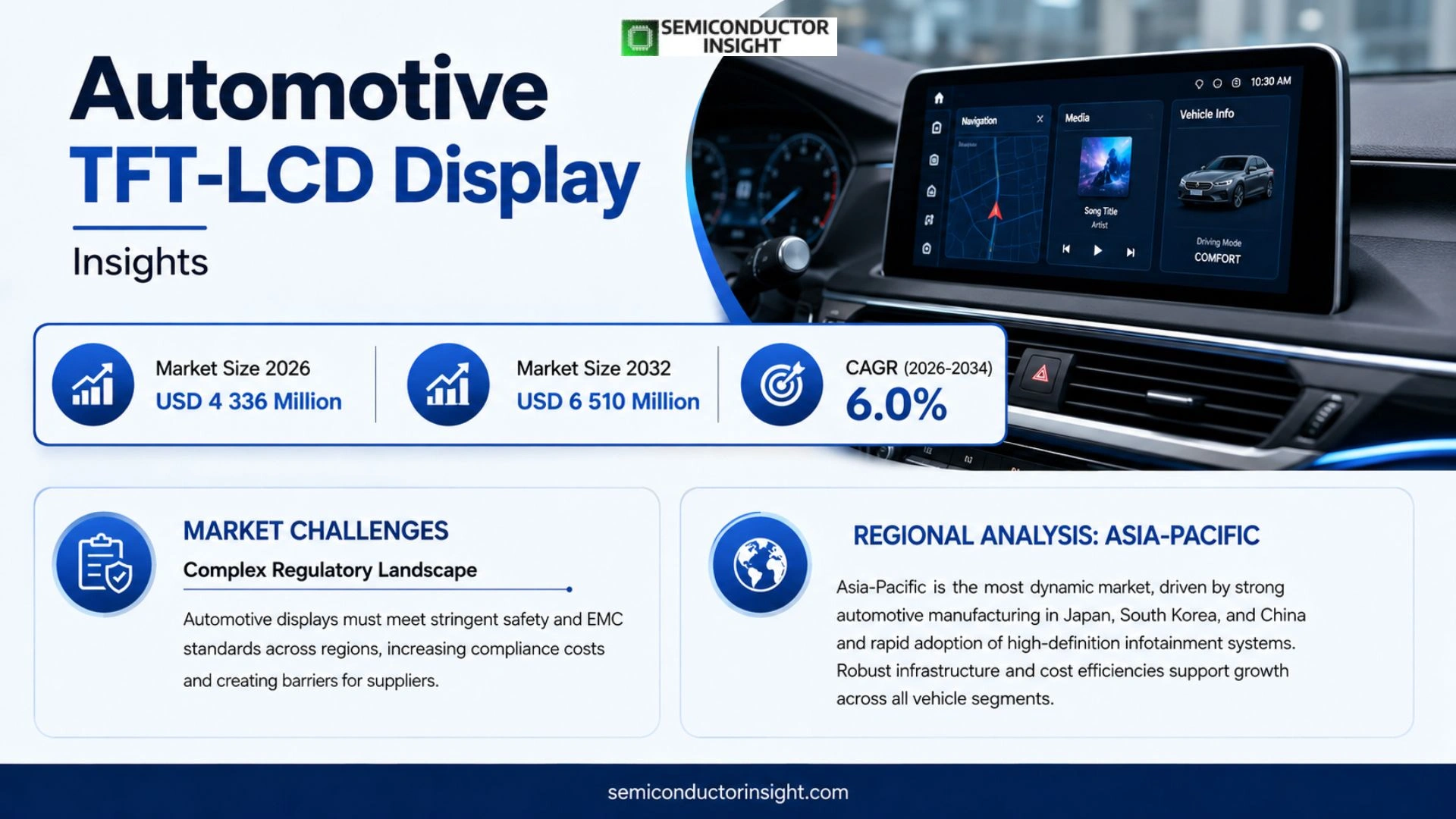
Automotive TFT‑LCD Display market is projected to grow from USD 4 336 million in 2026 to USD 6 510 million by 2032, exhibiting a CAGR of 6.0% during the forecast period.
An automotive TFT‑LCD display is a ruggedised flat‐panel screen used in vehicles,such as instrument clusters, centre infotainment screens, passenger displays or rear‐seat monitors,that employs thin‐film transistors (TFTs) to control individual liquid‐crystal pixels and generate images. Compared with consumer TFT‑LCDs, automotive versions are engineered for extended service life under harsh conditions, wide operating temperature ranges, high brightness for sunlight readability, optical bonding and anti‐reflection treatments, reliable backlighting and compliance with automotive quality and safety requirements.
The market expands because OEMs are shifting from isolated infotainment screens toward integrated cockpit surfaces,pillar-to-pillar dashboards and panoramic layouts,allowing software-defined interiors to differentiate brand experience while meeting safety mandates such as EU driver distraction warnings. Moreover manufacturers are moving away from commodity a-Si panels toward automotive-grade LTPS TFT LCDs that deliver higher resolution within thinner form factors; Mini-LED local dimming combined with quantum-dot films is also gaining traction because it offers OLED-like contrast while preserving LCD strengths in brightness and lifetime. These technical shifts drive demand for higher-quality panels capable of touch integration, optical bonding and full cockpit integration capabilities.
MARKET DRIVERS
Rise in Vehicle Feature Complexity
Automotive TFT-LCD Display Market is energized by the escalating demand for integrated infotainment suites that combine navigation, multimedia, and connectivity into a single cohesive interface. Modern driving environments routinely require real‑time weather updates, cloud‑based services, and seamless smartphone interaction, all of which hinge on crisp, responsive display panels. As OEMs amplify the functions of these panels,from advanced driver assistance modules to full‑suite connectivity suites,manufacturers of high‑resolution panels must rise to meet stringent clarity and responsiveness standards, driving a steady increase in market activity.
Shift Toward Premium User Experience
The premium segment has become a pivotal pivot. Buyers are now demanding displays that not only deliver high resolution but also support immersive features such as adaptive brightness, eye‑tracking, and gesture control. This shift pushes panels to deliver higher refresh rates and improved color accuracy, compelling suppliers to innovate in backlight technology, pixel density, and power efficiency. The convergence of quality and cost‑sensibility makes this trend a primary lever for long‑term value creation in the display ecosystem.
➤ Analytics suggest a concentrated rise in premium display deployments, prompting a widespread transition from legacy analog meters to touch‑enabled, high‑resolution panels across mainstream platforms.
Consequently, market pricing models are evolving; manufacturers that optimize for performance without proportionally raising cost margins are positioned to win competing contracts in both mass‑production and high‑end niches.
MARKET CHALLENGES
Complex Regulatory Landscape
Automotive displays must satisfy harmonized safety and electromagnetic compatibility specifications applicable across regions, tightening compliance pathways. The cost of sequential testing and certification cycles increases the barrier to entry for suppliers relying on generic, non‑specialized components.
Power Efficiency Management
With vehicles pushing towards longer electric ranges, every watt of power consumed by infotainment subsystems directly translates to range attrition. High‑resolution panels, typically associated with elevated power draw, prompt an intensified focus on low‑power backlight solutions and dynamic screen‑on/off strategies to balance user expectations against energy budget constraints.
Other Challenges
Supply Chain Instability
Disruptions caused by geopolitical tensions and component shortages can halt panel production, forcing OEMs to delay vehicle launches or seek alternative suppliers, thereby increasing overall cost of ownership.
MARKET RESTRAINTS
Component Scarcity and Pricing Volatility
The rapid push for 4K and higher resolution panels has strained the supply of high‑quality OLED and advanced LCD substrates, causing price spikes that erode margins for display producers. In parallel, the cost of critical materials such as indium tin oxide and various solder alloys has escalated, pushing the overall manufacturing cost toward unsustainable thresholds for high‑volume production. This heightened cost pressure limits the pace at which new technologies can be translated into market offerings.
MARKET OPPORTUNITIES
Expansion into Emerging Markets
Automotive infrastructure is expanding in mid‑income regions where electrification programs are gaining government support. These markets are increasingly adopting infotainment standards that align with global trends, generating a new, rapid‑growth corridor for display technology. Suppliers that achieve cost parity while delivering high‑end visual performance stand to capture significant market share in these emerging ecosystems.
Additionally, the rise of automotive AI dashboards, which rely on advanced display layers to visualize real‑time telemetry, predictive analytics, and autonomous vehicle states, presents a fertile ground for innovators who can integrate machine‑vision‑capable panels with robust edge‑computing platforms. The convergence of automotive connectivity, AI workloads, and visual processing signals a next‑generation opportunity for display suppliers to forge deeper OEM alliances and diversify revenue streams.
Automotive TFT-LCD Display Market Trends
Digital Cockpit Integration Accelerates Adoption
Automotive TFT‑LCD Display Market is driving the current transition from isolated panels to cohesive cockpit surfaces, enabling vehicle cabins to evolve around seamless displays that span pillar‑to‑pillar or panoramic areas. OEMs redesign cabins around these unified panels, allowing software‑centric interiors to advance rapidly. The shift is powered by the need to deliver richer driver information while simultaneously reducing eye‑off‑road times,a balance OEMs pursue through high‑resolution displays that integrate with advanced driver‑information systems. As functional boundaries blur, the display module simultaneously serves as a user interface and a vehicle‑diagnostic visual medium. Consequently, demand for robust TFT‑LCD modules that withstand extreme temperatures, high brightness, and vibration is steepening, prompting panel suppliers to accelerate capability development.
Other Trends
Mini‑LED Local Dimming Adoption
Parallel to the cockpit trend, the application of Mini‑LED local dimming is emerging as a decisive differentiator across high‑end vehicle segments. By combining dense arrays of sub‑diodes with adaptive backlight control, manufacturers can deliver OLED‑like contrast levels without sacrificing the longevity advantages inherent to LCD technology. This approach also mitigates tear‑in and burn‑in risks that plague pure OLED solutions, thereby satisfying regulatory constraints on endurance for certificates such as UL and ISO 26262. The move toward hybrid architectures that layer quantum‑dot enhancements atop Mini‑LED backlights reflects a broader strategy: maintaining brightness and contrast while keeping power envelopes compatible with electric‑vehicle distributions. Early adopters have already reported measurable gains in driver attentiveness and passenger engagement, reinforcing the expectation that display‑centric value will increasingly dictate the competitive hierarchy among Tier‑1 suppliers.
Supply Chain Resilience Drives Cost Management
Automotive TFT‑LCD Display Market must align its supply‑chain architecture with the OEMs’ design cycles, as fluctuations in raw‑material costs for glass substrates and thin‑film transistors, coupled with global transport bottlenecks, compel suppliers to craft contingency plans that prioritize component diversity and local sourcing. Tier‑1 OEMs demand tighter integration with panel manufacturers to shorten lead times and lock in pricing. The resulting shift toward vertically‑aligned partnerships,offering optical bonding, touch‑screen glass, and front‑end cockpit integration as bundled solutions,dampens price volatility and reduces coordination friction that traditionally delayed new‑vehicle introductions. For participants aligning their supply‑chain architecture with OEM design cycles, the advantage extends beyond cost savings to the ability to iterate on cabin concepts at a pace that matches software updates and connectivity standards.
COMPETITIVE LANDSCAPE
Key Industry Players
Competitive Landscape of Automotive TFT‑LCD Display Market 2025‑2032
In 2025 the automotive TFT‑LCD segment remained concentrated, with Korean and Chinese giants securing a combined share above 55%. LG Display and Samsung Display consistently lead on volume, exploiting domestic manufacturing meshes to meet the tight supply of LTPS panels required for pilot‑to‑pillar cockpit concepts. BOE Technology has accelerated its automotive‑grade LTPS production, positioning itself as the go‑to supplier for mid‑tier markets and electrified fleets, while TCL China Star has established strategic alliances with Tier‑1 OEMs such as Continental and Denso. The rise of Mini‑LED local‑dimming, combined with optical bonding and touch integration, has split the market into high‑margin, high‑resolution modular solutions for luxury EVs and cost‑optimal, durability‑centric panels for mass production ICE vehicles. ESG‑driven push for reduced driver‑distraction rewards manufacturers that embed safety standards into the hardware, forcing rapid alignment with EU driver‑distraction mandates and the evolving ISO 12228 safety module architecture. This confluence of price, reliability, and regulatory compliance tightens the competitive circle around a handful of players.
Beyond the leading tri‑ad, a constellation of mid‑cap and specialist manufacturers has carved out differentiated roles. Tianma Microelectronics and Innolux dominate the cost‑effective, large‑area “flat” panel niche, partnering with Tier‑1 integrators to supply rear‑seat entertainment and supplementary instrument clusters. Sharp’s “transparent” front‑screen cockpit initiative, Caihong Display Devices’ focus on EMV‑qualified modules, and InfoVision Optoelectronics’ high‑brightness, low‑power panels cater to safety‑centric HMI designs. Investment in AI‑based glare mitigation and real‑time contrast adjustment has emerged as a differentiator, allowing firms to promise better driver‑visibility KPIs to regulatory bodies. These players’ vertical integration and lean capex enable them to penetrate compact automotive segments and emerging EV fleets in Asia‑Pacific, where margin erosion from competing display types remains modest. Together, they form a competitive mosaic that forces OEMs to pursue joint platforms and differentiated infotainment experiences.
List of Key Automotive TFT‑LCD Companies Profiled
- BOE Technology
- BOE Technology
- LG Display
- LG Display
- Tianma Microelectronics
- Tianma Microelectronics
- Innolux
- Innolux
- Sharp
- Caihong Display Devices
- JDI Display
- InfoVision Optoelectronics
- TCL China Star Optoelectronics Technology
- Samsung Display
- Panasonic Display
Segment Analysis:
| Segment Category | Sub-Segments | Key Insights |
| By Type |
|
Digital Instrument Panel continues to capture premium vehicle segments, as OEMs prioritize seamless integration of navigation, glance‑aware alerts, and adaptive lighting within the driver’s field of view. Key drivers include the push for industry‑wide advanced driver‑assistance systems and the need for intuitive, low‑distraction interfaces that align with evolving safety regulations. The growing emphasis on software‑defined interiors encourages manufacturers to bundle higher‑resolution panels with robust touch or gesture controls, reinforcing the importance of a modular, scalable platform that can accommodate varying vehicle architectures. |
| By Application |
|
Driver Information Display represents the core application driving adoption, as safety-focused regulatory frameworks demand real‑time telemetry and driver‑distraction mitigation. Manufacturers are investing in higher dynamic range, anti‑reflection coatings, and adaptive brightness to maintain clarity under variable sunlight. Integration with voice assistants, navigation overlays, and AR layers is becoming standard, creating a convergence of display technologies with HMI. Design simplicity and reliable iconography are critical to reduce eyes‑off‑road time, directly influencing consumer perception and brand differentiation. |
| By End User |
|
Electric Vehicles drive significant momentum, as battery‑centric designs demand all‑in‑one dashboards that convey battery state, range, and power usage without compromising aesthetic appeal. EV OEMs favor higher resolution panels with sophisticated color palettes to support charging infrastructure integration and enable immersive infotainment experiences. The sustainability focus pushes for thinner, lighter modules that reduce system weight while adhering to stringent thermal management requirements. Consequently, the EV segment is anticipated to lead portfolio diversification and technology experimentation. |
| By Display Size |
|
Medium (10–18”) panels stand out as the optimal compromise between cost, weight and visual clarity for broad vehicle platforms. They enable pillar‑to‑pillar dashboards, panoramic displays, and integrated MMI systems while remaining compatible with a wide range of infotainment architectures. The scalability of medium‑sized modules offers manufacturers flexibility to retrofit existing chassis or design future vehicles that accommodate evolving UI paradigms. Consequently, this size range is shaping aftermarket and OEM upgrade strategies across both commuter and premium segments. |
| By Technology |
|
LTPS TFT has emerged as the foundation of next‑generation automotive displays, offering superior pixel densities, reduced pixel pitch, and lower power consumption compared to conventional a‑Si panels. Its compatibility with flexible substrates and high‑temperature operation aligns with stringent automotive safety and longevity standards. Moreover, many Tier‑1 suppliers are adopting LTPS layers to provide touch‑integrated glass solutions that support advanced driver‑assist displays, driver‑monitor cameras, and holographic circuit overlays. The synergy between LTPS and evolving drive‑bandwidth ecosystems places it at the forefront of vehicle cockpit innovation. |
Regional Analysis: Automotive TFT-LCD Display Market
A primary lever for success in Asia‑Pacific stems from a tightly knit supply‑chain corridor that merges display panel fabrication with driver‑IC and backplane integration. Firms that synchronize production schedules with automotive OEMs can cut cycle times by up to half. Moreover, proximity to electric‑vehicle battery hubs enables cascading efficiency across power‑management subsystems, giving companies a decisive edge in cost‑critical model series.
Developers in the region repeatedly venture into high‑contrast, low‑power TFT‑LCD solutions that meet strict ISO‑16750 temperature ranges. These innovations fuel premium infotainment adoption and position suppliers that invest in R&D hubs. The result is a talent‑rich pipeline that prizes engineers adept at crystallizing pixel‑density breakthroughs into production‑ready modules.
Regulatory convergence around digital instrument clusters, mandated across Japan, South Korea, and China, has created a coherent compliance roadmap. OEMs prefer vendors that can certify across all three markets simultaneously, providing a single‑source compliance pathway. This has narrowed the competitive field, reinforcing reliance on regional giants, and accelerating consolidation.
Fiscal packages through technology parks and export‑promotion schemes reduce upfront capital expenditures for display suppliers. These incentives, coupled with favorable credit terms, lower the barrier to scaling semi‑automated production lines. Consequently, the financial climate favors firms with deep capital reserves or robust joint‑venture models, intensifying rivalry among capital‑heavy players.
North America
North America continues to be a significant consumer of automotive TFT‑LCD displays, yet its growth trajectory is more measured than that of the Asia‑Pacific. The region hosts several key OEMs that prioritize adaptive lighting and digital cockpit integration, creating incremental demand for high‑resolution, low‑glare panels. However, stringent safety and emissions regulations impose rigorous testing cycles, slowing market entry for new designs. Consequently, suppliers often engage in long‑term licensing agreements with local component producers to ensure compliance with Federal Motor Vehicle Safety Standards. The presence of a sophisticated aftermarket sector further diversifies opportunities, allowing tuners and retrofit providers to introduce premium displays in legacy vehicles, thereby sustaining demand beyond the original production window.
Europe
Europe’s automotive sector is sharply focused on sustainability and data‑centric driving experiences, positioning TFT‑LCD displays as a critical enabler of digital dashboards and advanced driver‑assist features. Regulatory pressure from the European Commission’s New‑Passenger‑Car‑Emissions Regulations (EU‑NCPER) and Low‑Emission Zones has accelerated uptake in high‑definition panels that support screen‑based speed limits and real‑time traffic information. Nevertheless, the patchwork of national safety standards requires manufacturers to adapt solutions to differing testing protocols, slowing the rollout of uniform designs. Suppliers leveraging agile development cycles and modular architecture to meet multi‑country specifications can capture substantial market share, while rigid process owners encounter renewed pressure to innovate or risk obsolescence.
South America
South America’s automotive landscape is evolving as emerging economies push for electrification and modern cockpit experiences. Brazil’s recent legislative push for autonomous driving‑assist systems has spurred a modest but growing appetite for TFT‑LCD displays that integrate with vehicle‑to‑everything (V2X) communication modules. Added to this, public‑transport fleets in Chile and Argentina are exploring retrofit projects that convert conventional instrument clusters into crystal‑clear OLED and liquid‑crystal interfaces. While import duties on semiconductor components moderate cost advantages, local partnerships with semiconductor finds help mitigate supply‑chain uncertainties. Competitors that prioritize flexible contract manufacturing and local assembly can navigate tariff environments more effectively, allowing a faster time‑to‑market. The region remains receptive to technologies that combine durability with low energy consumption, essential for year‑round operation in variable climates.
Middle East & Africa
The GCC and Sub‑Saharan markets exhibit a dual‑faced demand structure, driven by both luxury imports and expanding domestic vehicle fleets. In oil‑rich Gulf States, high‑price premium vehicles embed large, high‑contrast TFT‑LCD displays to accommodate cockpit isolation and mid‑range infotainment service. Simultaneously, emerging African markets, with a surge in low‑mileage vehicles, emphasize reliability and longevity over visual flair. Import‑leaning economies compensate by sourcing displays from regional hubs in India and China, where volume production drives down unit costs. Regulatory harmonization efforts around safety and electronic communication standards are still in nascent stages, compelling suppliers to adopt a ‘one‑size‑fits‑all’ approach. Firms that invest in scalable, cost‑efficient platforms will be better positioned to establish a foothold in both high‑end and mass‑market segments.
Report Scope
This market research report provides a comprehensive analysis of the Automotive TFT-LCD Display Market , covering the forecast period 2026–2034. It offers detailed insights into market dynamics, technological advancements, competitive landscape, and key trends shaping the industry.
Key focus areas of the report include:
- Market Overview: The report begins with an overview outlining its current market scenario, key growth indicators, and industry transformation drivers. It discusses macroeconomic factors, demand–supply balance, regulatory landscape, and the strategic role of semiconductors in powering advancements across industries such as automotive, telecommunications, consumer electronics, and industrial automation.
- Market Size & Forecast: Historical data and future projections for revenue, unit shipments, and market value across major regions and segments.
- Segmentation Analysis: Detailed breakdown by product type, technology, application, and end-user industry to identify high-growth segments and investment opportunities.
- Regional Insights: Insights into market performance across North America, Europe, Asia-Pacific, Latin America, and the Middle East & Africa, including country-level analysis where relevant.
- Competitive Landscape: Profiles of leading market participants, including their product offerings, R&D focus, manufacturing capacity, pricing strategies, and recent developments such as mergers, acquisitions, and partnerships.
- Technology Trends & Innovation: Assessment of emerging technologies, integration of AI/IoT, semiconductor design trends, fabrication techniques, and evolving industry standards.
- Market Drivers & Restraints: Evaluation of factors driving market growth along with challenges, supply chain constraints, regulatory issues, and market-entry barriers.
- Stakeholder Insights: Insights for component suppliers, OEMs, system integrators, investors, and policymakers regarding the evolving ecosystem and strategic opportunities.
Primary and secondary research methods are employed, including interviews with industry experts, data from verified sources, and real-time market intelligence to ensure the accuracy and reliability of the insights presented.
FREQUENTLY ASKED QUESTIONS:
What is the current market size of Automotive TFT-LCD Display Market?
-> Automotive TFT‑LCD Display market is projected to grow from USD 4 336 million in 2026 to USD 6 510 million by 2032, exhibiting a CAGR of 6.0%
Which key companies operate in Automotive TFT-LCD Display Market?
-> Key players include Boe Technology, TCL China Star Optoelectronics Technology, JDI, Sharp, Tianma Microelectronics, LG Display, Innolux, Caihong Display Devices, and InfoVision Optoelectronics, among others.
What are the key growth drivers?
-> Key growth drivers include advanced vehicle electrification, increasing adoption of connected and autonomous driving technologies, and regulatory push for improved driver‑distraction warnings.
Which region dominates the market?
-> Asia‑Pacific is the fastest‑growing region, driven by high vehicle production volumes and rapid adoption of advanced infotainment systems, while Europe remains a dominant market in terms of sales volume.
What are the emerging trends?
-> Emerging trends include Mini‑LED local dimming, LTPS TFT LCD integration, and the shift toward cockpit‑wide integrated displays with edge‑of‑panel touch sensing and optical bonding.

Get Sample Report PDF for Exclusive Insights
Report Sample Includes
- Table of Contents
- List of Tables & Figures
- Charts, Research Methodology, and more...