Automotive Grade Op Amps Market Insights
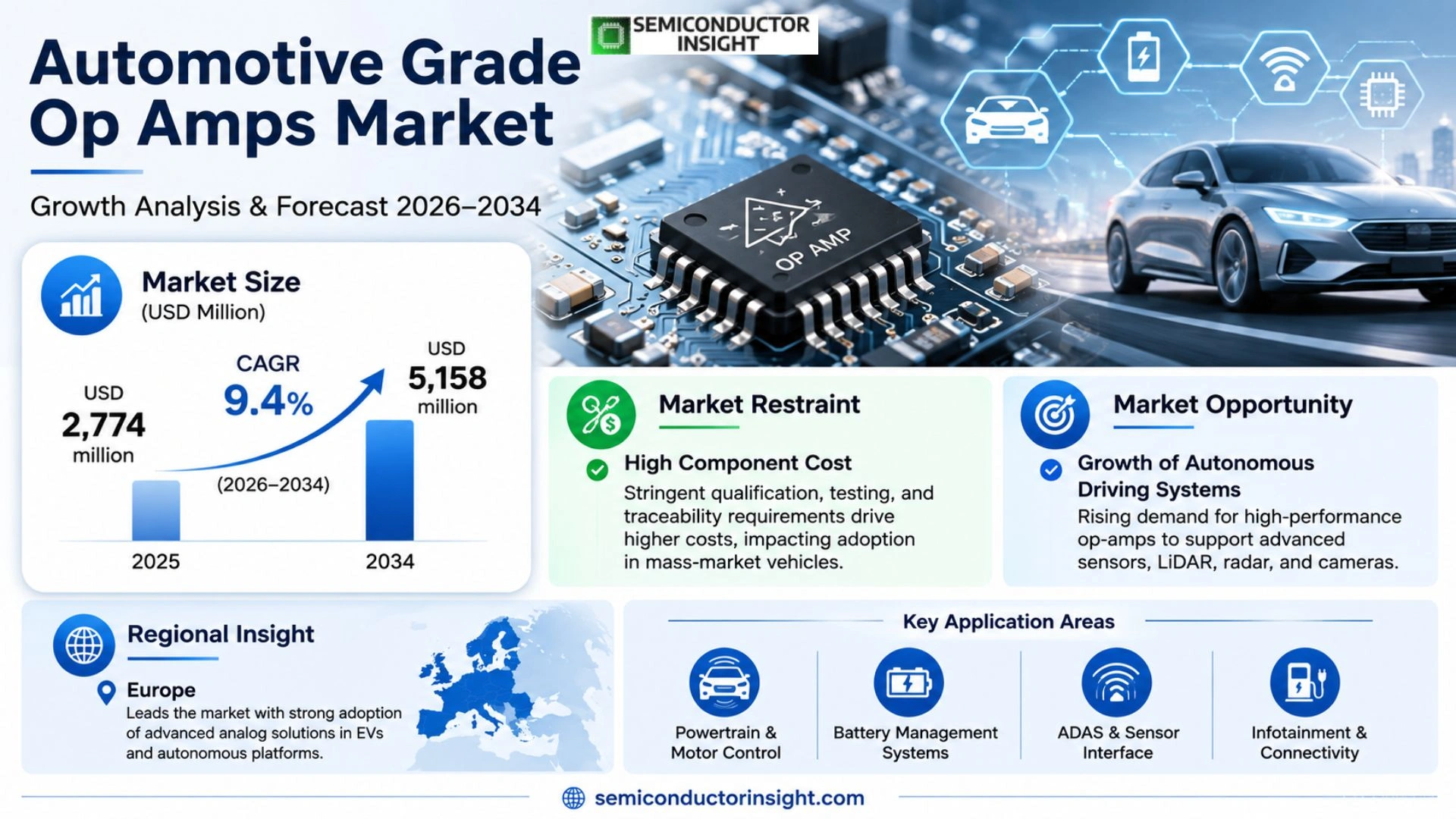
Automotive Grade Op Amps market size was valued at USD 2,774 million in 2025 and is expected to reach USD 5,158 million by 2034, exhibiting a CAGR of 9.4% during the forecast period.
Automotive grade operational amplifiers are essential analog‑signal‑chain ICs that amplify, buffer, filter, bias and drive weak or noise‑sensitive signals originating from sensors, current‑sampling circuits, voltage‑sampling nodes, temperature detectors and actuator feedback loops. Their function enables reliable conversion of these analog quantities for downstream ADCs, MCUs, motor controllers, BMS, OBC and cockpit display systems. Unlike generic industrial op‑amps, automotive variants must satisfy stringent reliability frameworks such as AEC‑Q100 qualification, PPAP compliance and IATF 16949 standards while operating across wide temperature ranges and ensuring lot‑to‑lot consistency.
The upward trajectory of this segment is linked to several converging forces: the surge in electric‑vehicle production pushes demand for high‑precision current and voltage sensing; advanced driver‑assistance systems increase the number of sensor interfaces; and stricter safety regulations compel manufacturers to adopt components that meet rigorous automotive qualification criteria. Leading suppliers,including Texas Instruments, Analog Devices, STMicroelectronics, ROHM and onsemi,are expanding their portfolios with zero‑drift architectures, rail‑to‑rail I/O and isolated sampling solutions to address these emerging requirements.
MARKET DRIVERS
Electrification of Powertrains
The shift toward electric and hybrid vehicles has forced OEMs to redesign control architectures. Automotive Grade Op Amps are indispensable for managing battery‑management systems, motor‑drive converters, and regenerative‑braking circuits. Their high‑speed response and low‑noise characteristics enable precise voltage regulation, which directly influences vehicle range and performance.
Stringent Safety and Functional‑Safety Standards
Regulatory bodies worldwide are tightening functional‑safety requirements for electronic control units. Designers now rely on op‑amps that meet automotive‑grade qualification (AEC‑Q100, ISO‑26262) to certify systems such as air‑bag deployment, electronic stability control, and advanced driver‑assistance. The need for components that can operate across extreme temperature gradients without degradation fuels demand.
➤ Design engineers prioritize op‑amps that combine wide bandwidth with automotive‑grade reliability, because any deviation can cascade into system‑level failures.
Beyond safety, the proliferation of connectivity features,infotainment, telematics, and over‑the‑air updates,requires op‑amps that support high‑resolution sensor fusion. Manufacturers that can deliver parts with integrated protection and low power draw are positioning themselves as preferred suppliers in Automotive Grade Op Amps Market.
MARKET CHALLENGES
Complex Design Requirements
Modern vehicles integrate dozens of electronic subsystems, each demanding op‑amps with specific gain, slew‑rate, and input‑bias characteristics. Achieving optimal performance while adhering to automotive thermal cycles is a delicate balancing act, and design teams often encounter trade‑offs between speed, power consumption, and robustness.
Other Challenges
Supply Chain Volatility
The concentration of op‑amp production in a handful of foundries exposes Automotive Grade Op Amps Market to lead‑time fluctuations. Recent geopolitical tensions and semiconductor shortages have amplified risk, prompting OEMs to seek qualified secondary sources or to increase inventory buffers.
MARKET RESTRAINTS
High Component Cost
Automotive‑grade op‑amps command a premium over commercial equivalents due to stringent testing, qualification, and traceability requirements. This cost sensitivity is especially pronounced in mass‑market vehicle segments where unit margins remain thin.
Additionally, the necessity for extensive reliability data and long‑term support contracts adds to total ownership expense, discouraging some Tier‑1 suppliers from adopting the latest high‑performance parts.
MARKET OPPORTUNITIES
Growth of Autonomous Driving Systems
Autonomous platforms rely heavily on sensor arrays,lidar, radar, and camera,that produce high‑frequency analog signals. Op‑amps with ultra‑low offset and high slew rates enable real‑time signal conditioning, a prerequisite for reliable perception algorithms. This creates a niche for specialized op‑amps tailored to autonomous stacks.
Emerging markets in Southeast Asia and Eastern Europe are experiencing accelerated vehicle electrification, yet local suppliers remain scarce. Companies that can establish regional fabs or secure long‑term partnerships stand to capture a growing share of Automotive Grade Op Amps Market.
Finally, the aftermarket segment,retrofit kits for older models and performance upgrades,offers a modest but steady revenue stream. Aftermarket distributors value op‑amps that combine ease of integration with proven durability, opening a channel for product lines that might otherwise be confined to OEM supply chains.
Automotive Grade Op Amps Market Trends
Reliability‑Centric Design as a Market Differentiator
Automotive Grade Op Amps Market is increasingly defined by the rigor of its qualification ecosystem. Products that achieve AEC‑Q100, PPAP, and IATF‑16949 approval enjoy a distinct advantage because vehicle manufacturers treat these certifications as non‑negotiable gate filters for design‑in. As power‑train architectures become more complex, any drift or offset in an analog front end can cascade into mis‑read sensor data, jeopardising safety functions such as brake‑by‑wire or battery‑management. Consequently, vendors are channeling R&D resources into zero‑drift, auto‑zero, and EMI‑enhanced topologies, while also expanding lot‑to‑lot consistency programs. The shift from simple gain stages to rugged, rail‑to‑rail, high‑current drivers underscores a broader industry move toward reliability as a pricing lever rather than a cost center.
Other Trends
Electrification‑Driven Demand Surge
The transition to hybrid and full‑electric propulsion has inflated the analog pin count per vehicle, giving Automotive Grade Op Amps Market a clear growth runway. Battery‑management systems, on‑board chargers, and traction‑inverter controllers now require high‑voltage precision amplifiers capable of handling hundreds of volts while maintaining low‑noise performance. Simultaneously, sensor‑intensive domains such as ADAS and cockpit displays rely on low‑voltage general‑purpose op‑amps for temperature, pressure, and optical signal conditioning. This bifurcation forces manufacturers to broaden product portfolios across voltage classes and to embed isolation features that protect low‑voltage control logic from high‑energy domains. The net effect is a per‑vehicle analog content increase of roughly 30 % compared with internal‑combustion platforms, translating into higher design‑in frequency and longer supply contracts.
Supply‑Chain Localization and New Entrants
While legacy players such as TI, ADI, and ST retain dominance through extensive global support networks, regional firms from China, Taiwan, and Korea are gaining footholds by aligning closely with new‑energy vehicle OEMs. These newcomers differentiate through accelerated design‑in cycles, cost‑effective packaging options, and assurances of long‑term supply in the face of geopolitical constraints. Their ability to meet automotive qualification standards while offering competitive pricing pressures incumbents to reassess pricing models and to enhance after‑sales services such as reference designs and failure‑analysis support. The emergent dual‑track supply structure is likely to foster healthier price competition without compromising the stringent reliability expectations that underpin Automotive Grade Op Amps Market.
COMPETITIVE LANDSCAPE
Key Industry Players
Automotive Grade Op‑Amps: Competitive Overview
The market is anchored by a handful of multinational analog specialists that command the majority of design‑in volume. Texas Instruments, Analog Devices and STMicroelectronics operate extensive automotive‑qualified portfolios covering low‑voltage general‑purpose parts to high‑voltage precision devices. Their product families are built around AEC‑Q100 compliance, long‑term supply guarantees and global application engineering teams that support tier‑1 OEM programs across North America, Europe and Asia‑Pacific. ON Semiconductor and Microchip complement this tier with strong presence in body‑electronics and battery‑management segments, leveraging on‑site design‑support labs that accelerate validation cycles. ROHM and Renesas add depth in rail‑to‑rail and high‑current driver families, often bundling reference designs that lock in automaker specifications. The collective strength of these firms lies in breadth of voltage classes, robust reliability frameworks, and the ability to service high‑volume, safety‑critical platforms such as power‑train inverters and on‑board chargers.
Beyond the global leaders, a vibrant cohort of regional players is expanding the competitive set. 3PEAK, SG Micro and NOVOSENSE focus on isolated and zero‑drift architectures tailored for next‑generation electric‑vehicle architectures, where voltage isolation and ultra‑low offset become differentiators. Jiangsu Runic and Shanghai Awinic pursue cost‑effective solutions for sensor‑front‑end and body‑control modules, leveraging rapid design‑in cycles with Chinese OEMs. Chipanalog and Smartnam target high‑speed driver segments for traction inverters, offering custom packages that meet aggressive thermal budgets. Linearin Technology and MediaTek are experimenting with mixed‑signal integration that could blur the line between traditional op‑amp functions and smart‑analog processing. These niche entrants gain market traction through aggressive pricing, flexible supply agreements and close collaboration with emerging NEV manufacturers, creating a parallel competitive track that challenges the incumbents on speed‑to‑market and application‑specific customization.
List of Key Automotive Grade Op Amps Companies Profiled
- Texas Instruments
- Analog Devices
- STMicroelectronics
- ON Semiconductor
- Microchip Technology
- ROHM Semiconductor
- Renesas Electronics
- Nisshinbo Holdings
- MinebeaMitsumi
- KEC Holdings
- 3PEAK Incorporated
- SG Micro Corp
- NOVOSENSE Microelectronics
- Jiangsu Runic Technology
- Shanghai Awinic Technology
- Shanghai Chipanalog Microelectronics
- Shenzhen Smartnam Semiconductor
- Linearin Technology Corporation
- MediaTek Inc.
Segment Analysis:
| Segment Category | Sub-Segments | Key Insights |
| By Type |
|
General‑purpose Op‑amps dominate early vehicle platforms because they meet most sensor front‑end needs with modest performance; they are favored for cost‑sensitive body electronics, enabling rapid design‑in through extensive reference designs. • Their broad voltage range and rail‑to‑rail I/O simplify integration across multiple ECU families. • Reliability built on AEC‑Q100 ensures consistent lot‑to‑lot behavior, a critical factor for mass production. • Designers appreciate the flexibility to reuse the same part across power‑train and infotainment subsystems, reducing bill‑of‑materials complexity. |
| By Application |
|
Sensor Signal Conditioning is the primary growth catalyst as vehicles integrate an ever‑increasing array of analog sensors; op‑amps must deliver ultra‑low offset and drift to preserve measurement fidelity under harsh temperature swings. • Zero‑drift architectures enable stable temperature compensation for pressure and humidity sensors. • Low‑noise front ends are essential for high‑resolution ADCs in advanced driver‑assistance systems. • The need for EMI‑hardening drives incorporation of differential input stages that reject motor and power‑train noise. |
| By End User |
|
Tier‑1 Module Suppliers act as the decisive bridge between semiconductor vendors and vehicle programs; their expertise in design‑in support and long‑term supply contracts elevates specific op‑amp families to de‑facto standards. • They prioritize parts with comprehensive qualification kits, simplifying PPAP and IATF16949 compliance. • Close collaboration with OEM engineering teams accelerates signal‑chain validation for new electric‑drive architectures. • Preference for families offering multiple voltage classes reduces inventory complexity across global platforms. |
| By Reliability Requirements |
|
AEC‑Q100 Certified parts are non‑negotiable for safety‑critical circuits; they provide documented failure‑analysis methodologies and lot‑to‑lot consistency that OEMs embed into their quality systems. • Wide‑temperature capability (‑40 °C to +125 °C) enables deployment across power‑train and cabin domains. • Suppliers that publish robust, audited supply‑chain roadmaps gain preferential treatment in platform engineering decisions. • Compliance with PPAP and IATF16949 further reduces risk during series production start‑up. |
| By Product Architecture |
|
Zero‑Drift Auto‑Zero architectures are prized for high‑precision battery‑current and temperature monitoring where long‑term stability outweighs raw speed; they effectively eliminate offset drift over the vehicle’s lifetime. • CMOS low‑power designs support the growing number of low‑voltage sensor nodes without excessive power draw. • High‑voltage rail‑to‑rail families enable direct interfacing with battery‑pack domains, reducing the need for auxiliary level‑shifting circuitry. • Isolated sampling solutions provide safety isolation between high‑voltage power modules and low‑voltage control electronics, a key requirement for traction‑inverter designs. |
Regional Analysis: Automotive Grade Op Amps Market
Europe
European emissions standards drive stricter power‑management requirements, nudging automotive designers toward op‑amps that can operate efficiently under a wide temperature envelope while preserving signal integrity.
The continent’s mature semiconductor ecosystem enables close coordination between chip makers and vehicle manufacturers, reducing lead times and fostering co‑development of application‑specific amplifier families.
Regional research consortia in Germany and Scandinavia focus on low‑power, high‑precision analog design, feeding the market with novel topologies that meet the evolving needs of connected cars.
Established European suppliers are reinforced by emerging startups, creating a layered competitive environment where legacy expertise meets disruptive design approaches.
North America
North America’s Automotive Grade Op Amps Market is shaped by the United States’ focus on autonomous‑vehicle testing corridors and Canada’s push for battery‑electric adoption. Automotive firms are increasingly selecting op‑amps that support high‑speed data acquisition for advanced driver‑assistance systems, a requirement that dovetails with the region’s strong software‑heavy vehicle architectures. Strategic partnerships between semiconductor giants and Tier‑1 suppliers are fostering the development of hardened analog blocks that can survive harsh automotive environments while delivering the low‑latency performance demanded by next‑generation safety features.
Asia‑Pacific
The Asia‑Pacific region, anchored by China, Japan, South Korea and India, presents a rapidly diversifying landscape for automotive analog components. While high‑volume production in China emphasizes cost‑effective designs, Japan and South Korea prioritize precision and reliability for premium vehicle segments. This duality forces op‑amp providers to tailor portfolios that span rugged, low‑cost solutions for mass‑market models and ultra‑low‑noise variants for high‑end applications. The region’s aggressive rollout of electric‑vehicle incentives further stimulates demand for amplifiers capable of managing complex power‑train control loops.
South America
In South America, Brazil and Argentina dominate automotive manufacturing, and both countries are gradually transitioning toward greener vehicle technologies. This shift encourages local OEMs to seek op‑amps that can endure tropical climates while maintaining performance consistency. Limited domestic semiconductor capacity leads many manufacturers to import specialized components, creating opportunities for global suppliers to establish regional distribution hubs and offer localized technical support, thereby reducing the perceived risk of adopting advanced analog solutions.
Middle East & Africa
The Middle East & Africa region is witnessing modest growth in automotive analog demand, propelled by infrastructure projects and a rising interest in connected‑car services. Harsh desert conditions test the robustness of analog devices, prompting a preference for op‑amps with extended temperature ranges and strong electro‑static discharge protection. Moreover, emerging automotive assembly plants in the Gulf Cooperation Council nations are beginning to integrate European‑sourced op‑amp designs, fostering a nascent but strategic supply corridor that could broaden market penetration over the next decade.
Report Scope
This market research report provides a comprehensive analysis of the Automotive Grade Op Amps Market , covering the forecast period 2026–2034. It offers detailed insights into market dynamics, technological advancements, competitive landscape, and key trends shaping the industry.
Key focus areas of the report include:
- Market Overview: The report begins with an overview outlining its current market scenario, key growth indicators, and industry transformation drivers. It discusses macroeconomic factors, demand–supply balance, regulatory landscape, and the strategic role of semiconductors in powering advancements across industries such as automotive, telecommunications, consumer electronics, and industrial automation.
- Market Size & Forecast: Historical data and future projections for revenue, unit shipments, and market value across major regions and segments.
- Segmentation Analysis: Detailed breakdown by product type, technology, application, and end-user industry to identify high-growth segments and investment opportunities.
- Regional Insights: Insights into market performance across North America, Europe, Asia-Pacific, Latin America, and the Middle East & Africa, including country-level analysis where relevant.
- Competitive Landscape: Profiles of leading market participants, including their product offerings, R&D focus, manufacturing capacity, pricing strategies, and recent developments such as mergers, acquisitions, and partnerships.
- Technology Trends & Innovation: Assessment of emerging technologies, integration of AI/IoT, semiconductor design trends, fabrication techniques, and evolving industry standards.
- Market Drivers & Restraints: Evaluation of factors driving market growth along with challenges, supply chain constraints, regulatory issues, and market-entry barriers.
- Stakeholder Insights: Insights for component suppliers, OEMs, system integrators, investors, and policymakers regarding the evolving ecosystem and strategic opportunities.
Primary and secondary research methods are employed, including interviews with industry experts, data from verified sources, and real-time market intelligence to ensure the accuracy and reliability of the insights presented.
FREQUENTLY ASKED QUESTIONS:
What is the current market size of Automotive Grade Op Amps Market?
-> Automotive Grade Op Amps market is expected to reach USD 5,158 million by 2034, exhibiting a CAGR of 9.4% during the forecast period.
Which key companies operate in Automotive Grade Op Amps Market?
-> Key players include Texas Instruments Incorporated, Analog Devices, Inc., STMicroelectronics N.V., onsemi, Microchip Technology Inc., ROHM Co., Ltd., Renesas Electronics Corporation, 3PEAK Incorporated, SG Micro Corp, NOVOSENSE Microelectronics Co., Ltd.
What are the key growth drivers?
-> Key growth drivers include electrification of vehicles, increasing power electronics demand, expansion of battery management systems, on‑board chargers, DC‑DC converters, traction inverters, sensor interface growth, and stringent automotive reliability standards such as AEC‑Q100 and IATF16949.
Which region dominates the market?
-> Asia‑Pacific is the fastest‑growing region due to strong new‑energy vehicle adoption, while Europe remains a dominant market with extensive automotive manufacturing bases.
What are the emerging trends?
-> Emerging trends include zero‑drift and auto‑zero architectures, CMOS low‑power designs, EMI‑enhanced op‑amps, high‑voltage and high‑current capabilities, isolated sampling solutions, and broader product families to support domain‑controlled vehicle architectures.

Get Sample Report PDF for Exclusive Insights
Report Sample Includes
- Table of Contents
- List of Tables & Figures
- Charts, Research Methodology, and more...
 Download Sample Report PDF