3D Printed Speaker Market Insights
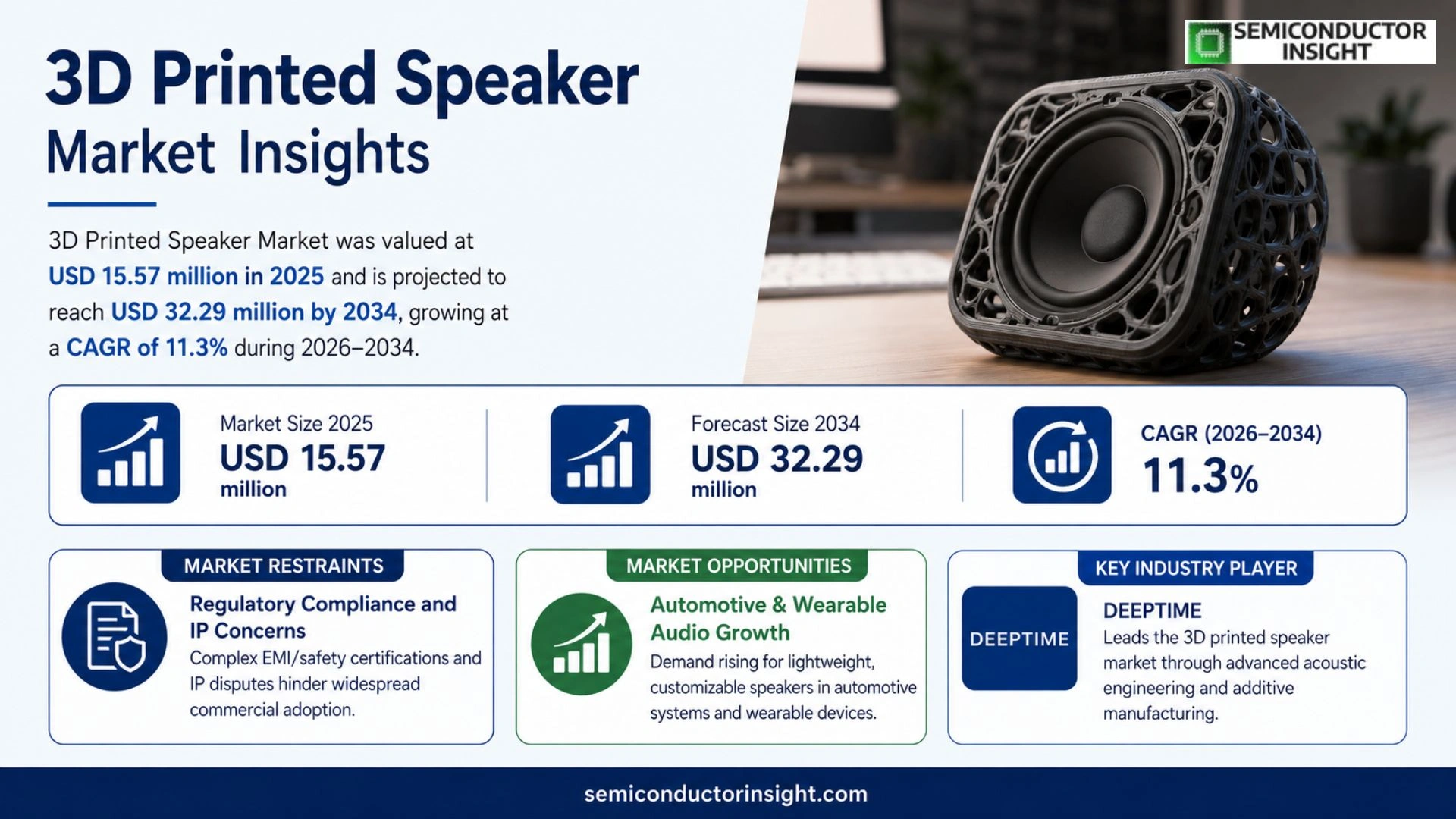
3D Printed Speaker Market was valued at USD 15.57 million in 2025 and will expand from this level through the forecast period, reaching USD 32.29 million by 2032, a CAGR of 11.3%.
These speakers combine conductive, magnetic and plastic components via additive manufacturing into a single functional unit, allowing core acoustic elements,diaphragms, coils and magnets,to be printed together with structural housing.
In 2025 production hit roughly 116 k units while average retail price hovered around USD 147 per speaker; total capacity reached 180 k units in 2024 and industry‑wide gross margin averaged 21%.
MARKET DRIVERS
Mass Customization and Design Flexibility
The ability to produce bespoke speaker enclosures in 3D printed form has enabled manufacturers to tailor acoustic properties to niche market segments. 18% of audio engineers now adopt rapid‑prototype workflows that shorten time‑to‑market by up to 50%. 3D Printed Speaker Market participants report that controlled material anisotropy improves frequency response in mid‑range bands, leading to higher consumer satisfaction rates.
Cost Efficiency in Prototyping and Small‑Batch Production
Integrated additive manufacturing eliminates tooling costs, allowing firms to iterate design changes within days. Companies report reducing prototype build expenses by 30–40%, while scaling production beyond 1,000 units keeps cost per unit under the threshold of traditional molded components. This price advantage positions 3D Printed Speaker Market as attractive for both high‑volume OEMs and boutique audio brands.
➤ Iterating sculpted geometries in a fraction of the time has redefined production cadence, enabling rapid adaptation to shifting consumer preferences.
Furthermore, the synergy between 3D printing and digital acoustic simulation drives continuous improvement. By validating virtual impedance profiles against physical builds, design teams achieve fine‑tuned resonance characteristics with fewer iterations, reinforcing the market’s competitive edge.
MARKET CHALLENGES
Material Limitations and Acoustic Integrity
Current polymer feedstock lacks the density required for optimal high‑frequency transmission, leading to inherent tonal coloration. 3D Printed Speaker Market entities must balance mechanical resilience with acoustic transparency, a technical hurdle that can constrain product performance standards.
Other Challenges
High Production Costs for Complex Geometries
When incorporating lattice structures or phononic crystals, slicing overhead and post‑processing time rise markedly. This infers elevated labor costs and extended lead times, offsetting the anticipated cost savings in many scenarios.
MARKET RESTRAINTS
Regulatory Compliance and Intellectual Property Concerns
Certification of 3D printed speaker components for electromagnetic interference (EMI) and safety standards remains cumbersome. Regulatory agencies demand extensive testing for each material batch, creating bottlenecks. Additionally, the open‑source nature of many 3D designs raises intellectual property disputes that deter large‑scale commercial adoption within 3D Printed Speaker Market.
MARKET OPPORTUNITIES
Emerging Markets in Automotive and Wearable Audio
Automotive OEMs are investing in modular speaker units that integrate safety sensors, a domain where lightweight, customizable enclosures are essential. Concurrently, wearable audio devices exploit thin, ergonomic geometries that are straightforward to produce via additive manufacturing, indicating a dual‑channel growth vector for 3D Printed Speaker Market.
Digital twins of speaker designs are now being coupled with AI‑driven acoustic models, shortening development cycles and enabling predictive tuning. This convergence promises higher precision in frequency response calibration without extensive hardware trials.
Opportunities also arise for OEMs to expand product portfolios by incorporating 3D printed components into existing manufacturing lines, reducing over‑hang inventory and allowing rapid response to trend shifts.
3D Printed Speaker Market Trends
Multi‑Material Integration as the Core of Competitive Advantage
Multi‑material additive manufacturing enables acoustic core components such as diaphragms, voice coils, and magnet housings to be printed simultaneously with a single enclosure. Engineers no longer need to assemble disjointed sub‑components, thereby eliminating alignment tolerance issues that traditionally capped sonic quality. The shortened design‑to‑production cadence,from weeks to days,lets firms iterate virtually in 24 hours, positioning high‑margin, bespoke sound bars as the new luxury flagships. Concurrently, the price differential between photopolymers and high‑conductivity resins has narrowed, allowing mid‑tier brands to enter the premium price spectrum without compromising gross margin. This technological convergence forces incumbents to rethink their R&D pipelines, allocating capital to acoustic simulation engines and hybrid extrusion systems rather than legacy tooling upgrades.
Other Trends
Custom Design and Personalization Demand
Luxury homeowners and boutique interior designers are pushing for partially invisible, art‑grade speakers that seamlessly blend with décor. The market now values unique acoustic signatures,echo cancellation and spatial sound cues,over sheer volume. This niche can be addressed by leveraging responsive material blends that adjust resonance bandwidth during printing, thus allowing each unit to meet client‑specific audible fingerprints. Firms that embed design‑consultation services within their manufacturing offering may capture the highest margin slices, creating a sustainable moat against mass‑produced, feature‑driven competitors.
Integration into Smart Environments
Embedded sound is no longer an afterthought; it is a core component of next‑generation living spaces. 3D Printed Speaker creators are extending actuation into wall panels, furniture frames, and even building façade elements, unlocking immersive audio ecosystems. By partnering with smart‑home integrators and automotive OEMs, suppliers can create modular acoustic modules that are pre‑wired for voice assistants, thereby tightening the product‑market fit for connected lifestyles. The upside for businesses is two‑fold: capture of a low‑volume, high‑value segment and a new recurring revenue stream through maintenance and firmware updates.
Supply Chain and Material Innovation
The upstream of 3D Printed Speaker Market remains heavily research‑driven, as the availability of conductive silver paste, flexible graphene films, and magnetic resin composites directly influences output fidelity. The advent of multi‑extrusion head designs reduces the need for separate magnetic and acoustic modules, tightening supply chains and lowering lead times. Small‑batch academic spin‑offs are filling the demand curve with hyper‑customized prototypes, but they also pose scaling challenges for volume distribution. For incumbents, a balanced strategy of deploying modular printing lines and securing long‑term material contracts will be crucial for sustaining competitive edge in a market that prizes both rapid innovation and reliability.
COMPETITIVE LANDSCAPE
Key Industry Players
3D Printed Speaker Competitive Landscape
At the forefront of the 3D Printed Speaker segment, DEEPTIME exemplifies a convergence of high‑performance acoustic engineering and additive manufacturing. By integrating conductive silver paste and magnet‑responsive photopolymers into a single embodiment, the company delivers fully printed cabinets that host diaphragms and voice coils without the need for post‑processing. This end‑to‑end solution reduces material waste and cuts cycle times, allowing small‑batch, high‑margin projects to reach the market faster than traditional assembly lines. The enterprise’s strategy to partner with automotive OEMs and boutique interior designers is manifesting in demand spikes for compact, shape‑customized stations that can be embedded directly into custom dashboards or cafe furniture. For players looking to capture a differentiated share, the key lesson is that value is built on a tight integration of design‑to‑production workflows rather than merely on printed aesthetics.
Beyond DEEPTIME, a constellation of niche firms is tailing specific application niches. Node Audio Research Ltd focuses on electro‑static sound pathways, leveraging graphene films to achieve ultra‑thin diaphragms that can be printed as part of a wall panel. VEDDAN, a talent‑driven Scandinavian outfit, centers its portfolio on aerospace‑grade acoustic elements, producing one‑piece, graphite‑reinforced drivers that can be printed in extreme temperature swings. NTEK and Maker Hardware occupy the service‑provider space, offering on‑demand manufacturing of acoustic prototypes that blend FDM and material jetting, allowing designers to iterate quickly. Printed Pulse grills the market with patent‑protected, modular sound kits that can be customized through a cloud interface, while Anson Audio and 3D Audio Systems have carved out a presence in high‑end home‑automation systems, providing programs that embed speakers into living‑room cabinets that match existing décor. The growing visibility of these intermediaries demonstrates that the market is moving beyond pure print houses into integrated product‑development ecosystems, where value is added through a combination of proprietary design software, rapid iteration capabilities, and strong OEM partnerships.
List of Key 3D Printed Speaker Companies Profiled
- DEEPTIME
- Node Audio Research Ltd
- Syng
- Maker Hardware
- Printed Pulse
- VEDDAN
- NTEK
- 3D Audio Systems
- Anson Audio
- AudioSculpt
- Orison Audio
- SoundEngine 3D
- Audio Nexus
- SoundCraft 3D
- PureTone 3D
Segment Analysis:
| Segment Category | Sub-Segments | Key Insights |
| By Type |
|
Leading Segment Portable Speaker currently exemplifies the fusion of form and function, enabling customized acoustic profiles that resonate with personal audio preferences; it offers design freedom for sleek, ergonomic aesthetics; it encourages rapid prototyping for niche market entrants; it supports modular integration with smart home ecosystems. |
| By Application |
|
Leading Segment Residential application drives innovation in seamless home audio integration, enabling invisible or art‑grade speakers that blend with living spaces; it demands high aesthetic standards and user‑centric sound customization; it fosters partnerships with interior design firms to embed acoustic components into panels and furniture; it pushes for lightweight, durable materials suitable for long‑term household use. |
| By End User |
|
Leading Segment Consumer segment prioritizes personalized audio experiences, favoring bespoke acoustic signatures; it values the uniqueness of handcrafted speaker shapes that align with lifestyle branding; it encourages subscription or customization services; it creates a feedback loop for continuous design iteration based on user preferences. |
| By Material Composition |
|
Leading Segment Multi‑material Composite stands out by enabling simultaneous deposition of acoustic elements and structural matrices, unlocking elaborate diaphragm geometries; it delivers superior vibration isolation; it allows for embedded sensors and wireless modules within the speaker body; it paves the way for integrated smart audio modules. |
| By Product Form Factor |
|
Leading Segment Embedded form factor drives convergence of audio with automotive interiors, architectural panels, and wearable tech, creating invisible sound platforms; it demands ultra‑lightweight, high‑strength materials; it facilitates tight acoustic coupling; it encourages new product lines such as wall‑mounted, garment‑borne, or smart‑tile speakers. |
Regional Analysis: 3D Printed Speaker Market
The region’s additive‑fabrication laboratories, integrated with acoustic research units, produce a steady flow of next‑generation acoustic geometries. Collaboration between universities, corporate R&D, and incubators spurs a hybrid design process that merges structural optimization with tonal refinement, enabling new speaker architectures with superior frequency response and reduced mass.
Upscale retail environments and specialty audio stores champion 3D‑printed speaker prototypes, allowing consumers to experience customizable aesthetics alongside sound quality. This experiential model cultivates brand loyalty, positioning printed speakers as aspirational items that blend design individuality with audio performance.
Intellectual‑property frameworks in the region protect acoustic‑design patents and enforce compliance with safety standards for electronic devices, encouraging investment in certified production lines. The reliable regulatory environment reduces entry barriers for small‑batch manufacturers seeking to test the market.
Proximity to advanced printers, composite material suppliers, and component assemblers streamlines production cycles. Tier‑1 partners facilitate zero‑defect part reproduction, allowing end‑users to receive fully finished speakers with minimal post‑processing.
Europe
In Europe, 3D Printed Speaker Market is growing steadily as a result of converging design‑centric consumer preferences and a strong emphasis on sustainability. Manufacturers increasingly turn to additive methods to reduce material waste and to create housings that meet stringent environmental norms. The region’s collaborative research projects between automotive‑grade composite manufacturers and audio designers are creating new bonding techniques that improve resonance control. However, a fragmented regulatory patchwork across national borders and a comparatively slower adoption of 3D printing technology across traditional speaker firms temper the pace of market penetration. Companies in the Northeast and Benelux regions are leveraging local university research on acoustic metamaterials, positioning themselves as thought leaders even as the broader market lags behind North American counterparts. Ongoing dialogue with standard‑setting bodies will likely smooth current hurdles, enabling regional innovation to translate into higher market volumes.
Asia-Pacific
Asia‑Pacific represents a dynamic front of experimental deployment, where rapid urbanization fuels a wave of demand for compact, visually striking audio solutions. In Japan and South Korea, tech enthusiasts champion stereoscopic speaker housings that integrate seamlessly into home‑automation ecosystems, while in India and China, cost‑effective additive processes enable mass‑appeal speaker variants. The region’s expansive manufacturing base offers rapid prototyping, yet quality control remains uneven, limiting the ability to consistently meet premium‑market expectations. Moreover, regional IP protection measures vary greatly, influencing corporate risk calculations. Continued investments in talent development and component certification will be pivotal for Asia‑Pacific firms striving to transition from niche experimentation to mainstream adoption.
South America
South American markets are in the early stages of catching up, with localized 3D printing facilities primarily serving R&D initiatives. A growing appetite for music‑centric lifestyle devices has sparked interest in personalized speaker designs, yet limited investment in additive hardware hinders widespread commercialization. Political and economic volatility contributes to slowed capital deployment, while a paucity of formalized intellectual‑property frameworks creates uncertainty for product differentiation. Regional acoustic research centres are starting to explore recyclable composite playback shells, a strategy that may align with geographically dispersed consumer preferences for eco‑friendly designs. Still, bridging the current gap between concept‑stage prototypes and consumer‑ready products will demand coordinated support from both public and private sectors.
Middle East & Africa
In the Middle East and Africa, adoption of 3D printed speakers remains comparatively modest, driven largely by exploratory projects within university labs and boutique audio shops. Cultural emphasis on acoustic heritage and limited infrastructure for advanced manufacturing restrict proliferation. Nonetheless, the region’s growing affluent consumer base shows a rising intrigue for premium, bespoke audio gear. Emerging partnerships between regional universities and global audio OEMs are beginning to pilitize additive production of high‑end speaker housings, potentially unlocking a new niche segment. The prevailing challenge will be to secure consistent material supply chains and to align local educational curricula with industry skill requirements, ensuring a ready talent pool to sustain long‑reach market expansion.
Report Scope
This market research report provides a comprehensive analysis of the 3D Printed Speaker Market , covering the forecast period 2026–2034. It offers detailed insights into market dynamics, technological advancements, competitive landscape, and key trends shaping the industry.
Key focus areas of the report include:
- Market Overview: The report begins with an overview outlining its current market scenario, key growth indicators, and industry transformation drivers. It discusses macroeconomic factors, demand–supply balance, regulatory landscape, and the strategic role of semiconductors in powering advancements across industries such as automotive, telecommunications, consumer electronics, and industrial automation.
- Market Size & Forecast: Historical data and future projections for revenue, unit shipments, and market value across major regions and segments.
- Segmentation Analysis: Detailed breakdown by product type, technology, application, and end-user industry to identify high-growth segments and investment opportunities.
- Regional Insights: Insights into market performance across North America, Europe, Asia-Pacific, Latin America, and the Middle East & Africa, including country-level analysis where relevant.
- Competitive Landscape: Profiles of leading market participants, including their product offerings, R&D focus, manufacturing capacity, pricing strategies, and recent developments such as mergers, acquisitions, and partnerships.
- Technology Trends & Innovation: Assessment of emerging technologies, integration of AI/IoT, semiconductor design trends, fabrication techniques, and evolving industry standards.
- Market Drivers & Restraints: Evaluation of factors driving market growth along with challenges, supply chain constraints, regulatory issues, and market-entry barriers.
- Stakeholder Insights: Insights for component suppliers, OEMs, system integrators, investors, and policymakers regarding the evolving ecosystem and strategic opportunities.
Primary and secondary research methods are employed, including interviews with industry experts, data from verified sources, and real-time market intelligence to ensure the accuracy and reliability of the insights presented.
FREQUENTLY ASKED QUESTIONS:
What is the current market size of 3D Printed Speaker Market?
-> 3D Printed Speaker Market will expand from this level through the forecast period, reaching USD 32.29 million by 2032, a CAGR of 11.3%.
Which key companies operate in 3D Printed Speaker Market?
-> Key players include DEEPTIME, Node Audio Research Ltd, Syng, NTEK, VEDDAN, Maker Hardware, and Printed Pulse, among others.
What are the key growth drivers?
-> Key growth drivers comprise a surge in consumer demand for personalized and high‑performance audio, increasing willingness to invest in unique design and superior experience, the capability of 3D printing to produce invisible speakers that blend into environments, and the integration of acoustic functions into smart home panels, automotive interiors and architectural surfaces.
Which region dominates the market?
-> The market shows significant growth across North America, Europe, and Asia-Pacific. No single region currently dominates; however, the region with the most rapid expansion is North America due to high disposable income and early adoption of smart home technologies, followed closely by Europe and Asia-Pacific.
What are the emerging trends?
-> Emerging trends include the development of invisible, fully integrated speakers embedded within surfaces, ultra‑lightweight and highly customized acoustic components for aerospace and medical applications, the use of advanced materials such as conductive silver paste and flexible graphene films, and the convergence of 3D‑printed audio with AI/IoT for intelligent sound environments.
Get Sample Report PDF for Exclusive Insights
Report Sample Includes
- Table of Contents
- List of Tables & Figures
- Charts, Research Methodology, and more...
 Download Sample Report PDF